

This week, the latest round of U.S.-Iran negotiations effectively broke down. Iran offered to reopen the Strait of Hormuz if Washington lifts its naval blockade and ends the war — and offered to set the nuclear question aside for later. Trump’s team rejected the framing. The president then canceled the planned meeting between Steve Witkoff, Jared Kushner, and Iran’s negotiators in Pakistan.
So Hormuz stays closed. And we keep stacking days.
Which is a useful moment to step back and remind you just how big this crisis really is — because the news cycle has a way of turning even genuinely historic events into background noise. Two months in, people seem to have quietly grown accustomed to the idea that a big chunk of the world’s oil is offline. Like it’s the new normal, instead of the most acute oil disruption in modern history.
But context matters. So let me give you some.
Take a look at the chart below.
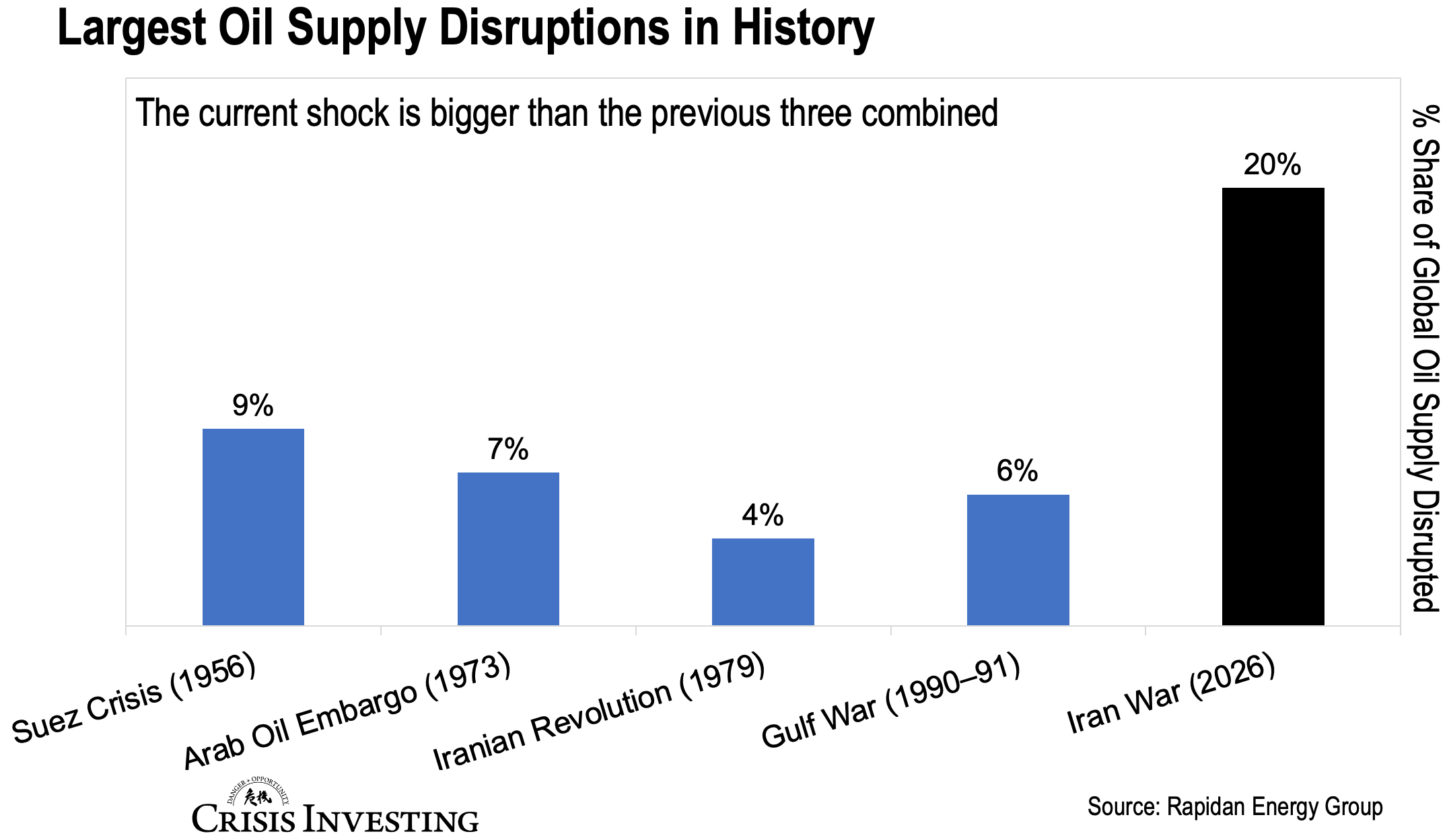
This is every major oil supply disruption of the post-war era, measured by the percentage of global oil supply taken offline at the peak of each crisis. The current one — the bar on the right — is taking more than twice as much oil out of the global market as any prior crisis since the end of WWII.
Almost three times the Arab Oil Embargo — which was bad enough to crash the S&P 500 by nearly 50% and inflict a decade of stagflation on the United States.
Five times the Iranian Revolution shock — which was bad enough to push U.S. inflation to nearly 15% and force the Fed to hike rates above 19% to crush it.
And every single one of those smaller bars on the chart triggered a recession.
And as I told you in a recent essay, we may already be inside one ourselves. Layer the current oil shock on top of all of that — and what’s actually brewing isn’t your run-of-the-mill recession. It’s a different animal entirely. And one most folks aren’t prepared for.
One more thing to keep in mind. The 20% figure on the chart is the share of total global oil supply. Of seaborne oil trade — the oil that actually has to move on a tanker to reach a market — Hormuz handles closer to 30%. And that’s just oil. The strait also carries about a fifth of the world’s LNG, a fifth of seaborne nitrogen fertilizers, and meaningful shares of helium and refined petroleum products. So when Hormuz is shut, you’re not just turning off 20% of oil. You’re tightening every commodity supply chain that runs through that 21-mile gap.
So when you hear someone like our dear friend Michael Yon warning that we may be heading into one of the most epic famines in human history — and your first instinct is to dismiss it as catastrophism — well, pull up the chart again. He may very well be on to something.
Regards,
Lau Vegys
P.S. As it becomes clearer the world can't keep relying on Middle Eastern oil, countries are going to be forced to fall back on the next-best alternative. Our new issue of Crisis Investing, out later this week, features two high-conviction picks built to profit from exactly that shift. Keep an eye out.
Good article. Linking it tomorrow @https://nothingnewunderthesun2016.com/
Europe is screwed. Cut off Putin oil and gas, closed their coal plants and turned to “green energy”, which is neither, but the USA is now a much bigger oil producer, Venezuela is coming back on line too, so, yes, this will have an impact in USA but not to the magnitude it would if this was 1979.
The West has been kicking ( and funding -Obama) the Iranian mess for over 50 yrs. We don’t need two North Koreas with nuclear weapons, so despite USA not wanting to be worlds cop, we are. And it gives USA a chance to reshuffle the deck to benefit us. As I see it the longer term benefits far outweigh the shorter term mess.
Europe will have to ditch green energy, buy LNG from us, settle their dispute with Putin or his successor. The world is awash in oil, gas and coal, ( companies like Frontieras are going to make trillion - literally- with their patented coal to refined products and then clean coal remainder still to burn for energy).
The market will adjust quickly. But yes, could be very very choppy in next 12 months. After that? The moon.