

Something seriously unusual is happening with oil refineries right now. You might have seen a headline or two, but I don’t think it’s turning nearly enough heads.
In the past three weeks, reports suggest that as many as 10 oil refineries and energy facilities have either blown up, caught fire, or gone offline - across four continents. Russia, Australia, India, Mexico, Texas, Romania.
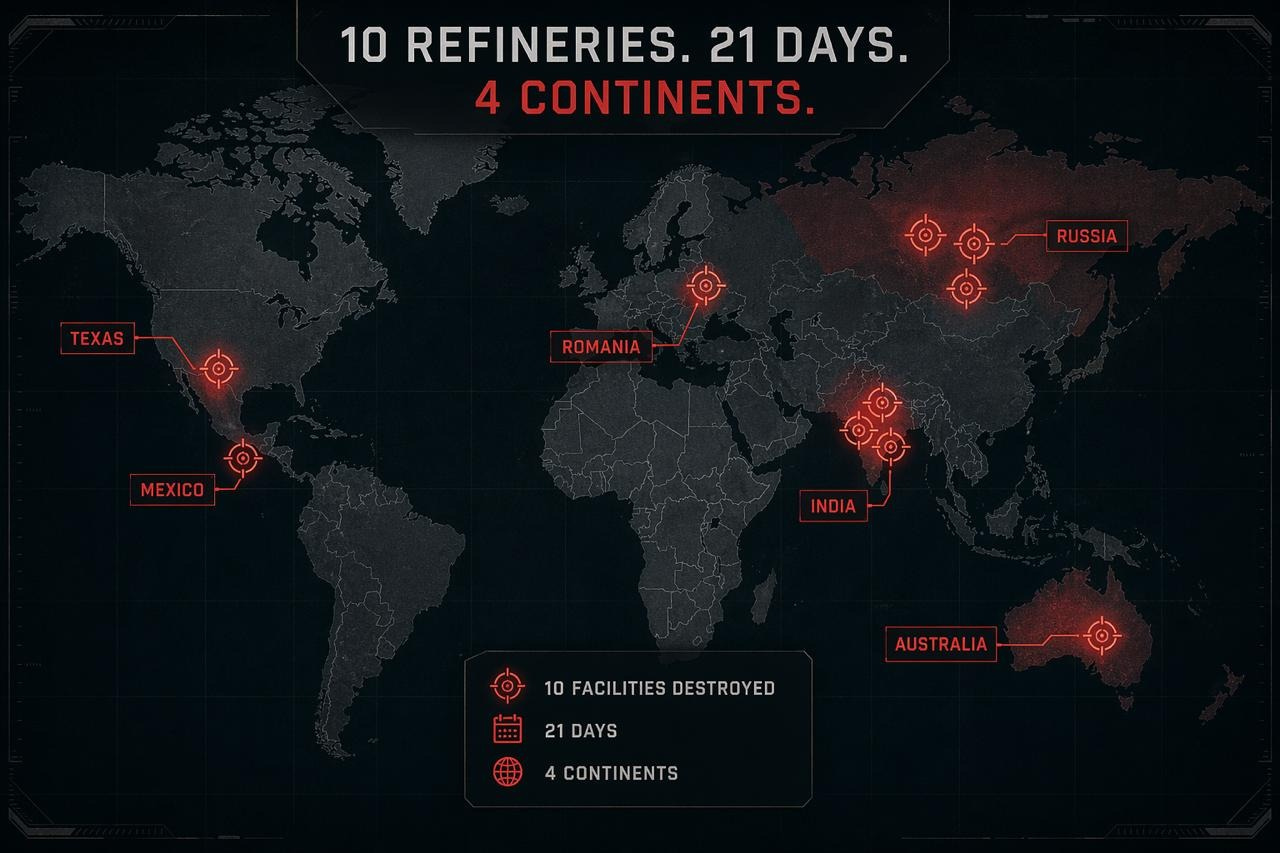
The Russian ones - fine, those are Ukrainian drone strikes. That’s war. But the rest? Australia just lost one of its only two working refineries to a fire. India’s brand-new $8.5 billion refinery caught fire the day before Prime Minister Modi was supposed to inaugurate it. Mexico’s newest refinery has had four separate incidents in three weeks. And in Washington State, a BP refinery exploded, injuring three workers.
Nobody’s calling it sabotage - officially. Equipment failures, gas leaks, “maintenance issues.” Just a very, very remarkable coincidence.
Needless to say, I was curious. I went through each incident and pulled the numbers. I found seven confirmed refineries that either blew up, caught fire, or went offline in a three-week window. I might have missed some - but even with just these seven, the damage is pretty striking. Here’s what I found:
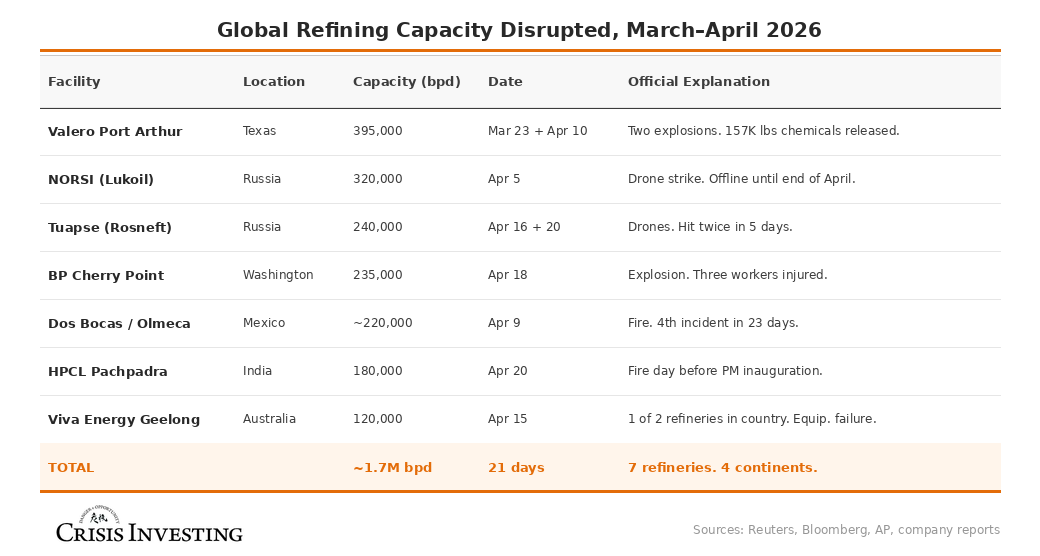
That’s roughly 1.7 million barrels per day of refining capacity either knocked offline or running at significantly reduced output.
And that’s just the refineries. I also found a thermal power plant in Bucharest that had three transformers explode on April 20 - over 3,000 apartment blocks lost hot water, repairs could take a year. An Oil and Natural Gas Corporation (ONGC) well site in India that caught fire the same day, evacuating three villages. And a well site in Nacogdoches, Texas that burst into flames around the same time. These aren’t exactly refineries, but they fit the same timeline and the same pattern of energy infrastructure going up in smoke.
So add it up. 1.7 million barrels per day of refining capacity disrupted - and that’s a conservative count. This is on top of the 13 million barrels per day the International Energy Agency (IEA) chief says are already gone from the broader Iran and Hormuz crisis - what he called “the biggest energy security threat in history.”
Demand Destruction?
That said - I want to leave you with something to chew on. A reader commented on my Notes about this with two words: “demand destruction.” And I think he might be on to something. Because there are really only two ways to look at what’s happening.
The first is the innocent reading. This is just a run of bad luck - aging infrastructure, deferred maintenance, unfortunate timing. And there’s a case for it. Refineries everywhere have been running flat out since late last year, working overtime to make up for Middle Eastern and Russian supply shortfalls. Less downtime for maintenance. More stress on aging equipment. More risk of exactly the kind of failures we’re seeing now. A system running at maximum strain doesn’t need a coordinated attack to start breaking. It just needs one more degree of pressure.
The second is... well, less innocent. If you wanted to engineer demand destruction - to break an economy without firing a shot - you wouldn’t need to stop the crude from flowing. You’d just need to make sure nobody can turn it into anything useful. And if you did it gradually, across multiple countries, with plausible deniability (”equipment failure,” “gas leak,” “maintenance issue”) - nobody would connect the dots until it was too late.
I’m not saying I know which one it is. But at least seven refineries across four continents, in three weeks. That’s a lot of coincidence.
And honestly, it almost doesn’t matter. Whether this is coordinated or just the global energy infrastructure falling apart at the worst possible moment, the result is the same. These facilities take months to bring back online. The Strait of Hormuz will reopen eventually. The crude will flow again. But you can have all the oil in the world - if you can’t refine it, it’s just expensive mud.
The bottom line? We’re already in an energy crisis. Most people just haven’t realized it yet. And if you think this stays over there - in Russia, in Australia, in India - I have a barrel of oil to sell you.
Have a great rest of the weekend,
Lau Vegys
P.S. In last month’s issue of Crisis Investing, we went through all of this in much greater detail - and named two specific positions to profit from it. If you’re a paid subscriber, make sure you haven’t missed it. And if you’re not yet on the paid side, the lead - featuring Doug Casey’s latest words of wisdom - is free to all. Keep an eye out for this month’s issue next week.
You ignored that CA had two refineries shut down due to state government bleeding them dry, and the rest that are left threatened the state they may do the same. CA is an energy island. Mike Ariza has been beating the drums over this. If you want him for a podcast DM me for his contact info.
https://californiaglobe.com/fr/statewide-fuel-shortages-are-imminent/
Lau- Again, I'm really impressed with the thinking and the analysis.