
The Strait of Hormuz Is Closed Again
Open on Thursday. Closed on Friday. Gunfire on Saturday.

On Thursday, President Trump posted this on Truth Social:
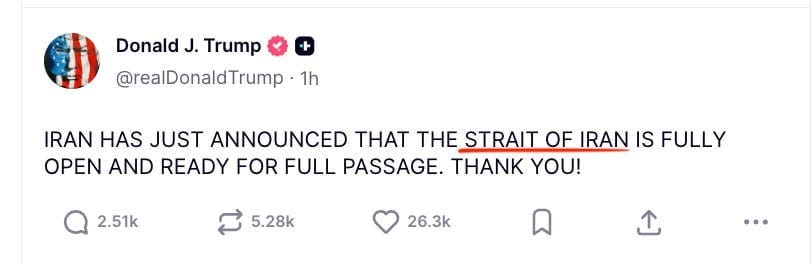
He got the name wrong. It’s the Strait of Hormuz, not the “Strait of Iran.” But that’s the least of the problems here.
What actually happened was this. On Thursday, Iran announced the strait was “completely open” — tied to the Lebanon ceasefire. Trump celebrated. Markets rallied. For a few hours, it looked like the worst might be over. Around 20 ships started to move.
Then the U.S. refused to lift its naval blockade on Iranian ports. Iran reversed course. By Saturday morning, Revolutionary Guard gunboats had opened fire on a tanker transiting the strait. A container vessel took a projectile hit. Two Indian-flagged ships — including a supertanker carrying Iraqi oil — were forced to turn around.
Open on Thursday. Closed on Friday. Gunfire on Saturday.
But I want you to understand something: none of it matters. At least not in the way most people think.
Obviously, the strait matters — a fifth of the world’s oil flows through it, and its closure has turned global energy markets upside down. But the daily headline about whether it’s “open” or “closed”? That's nothing but noise at this point. The damage was done weeks ago. And it’s still being done right now — regardless of what President Trump announces on any given afternoon.
The Damage Is Already Done
A few weeks ago, I published a chart showing how much runway each Gulf oil producer has before it runs out of storage and has to start shutting wells in.
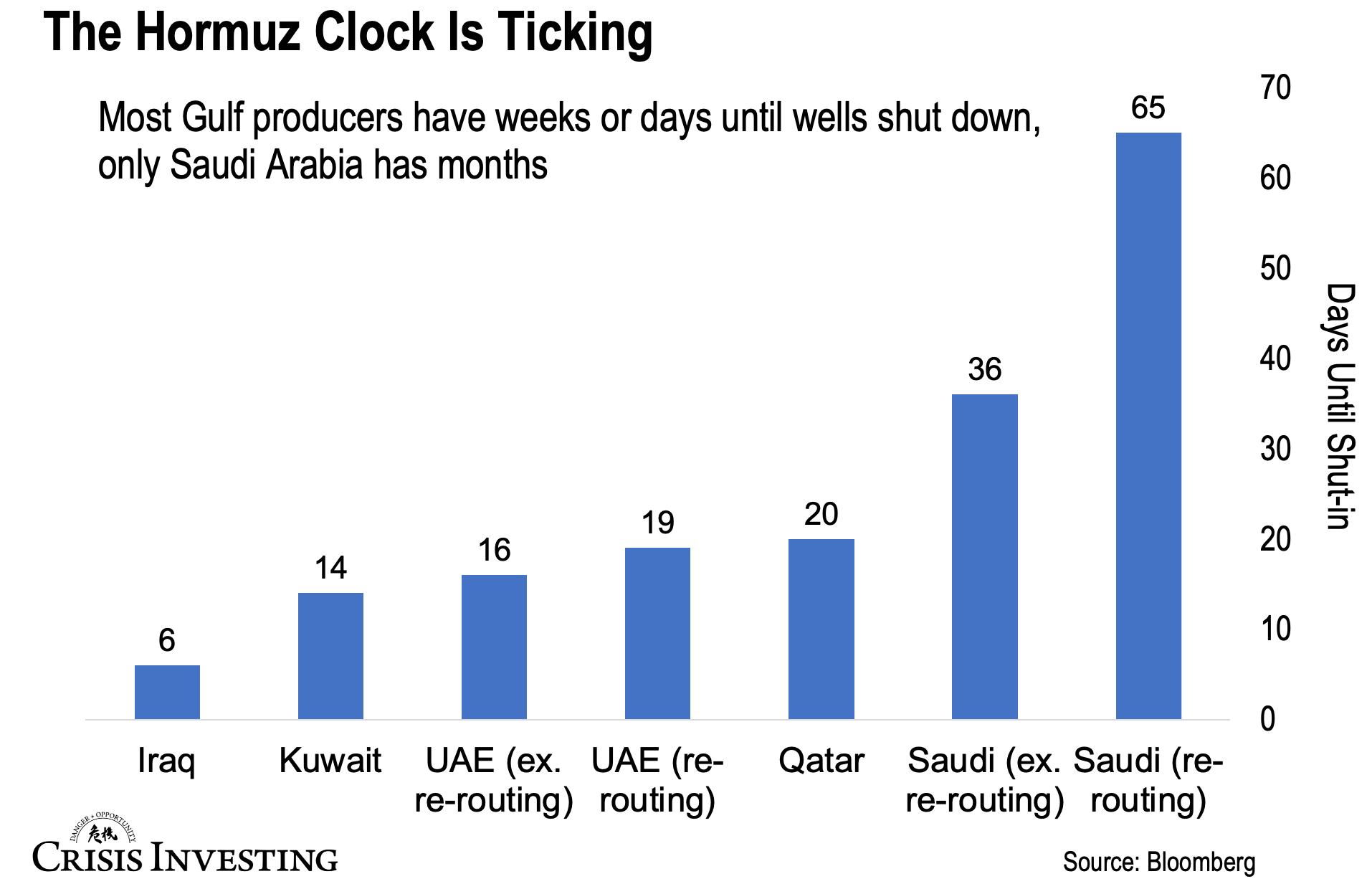
Look at those numbers again. Iraq had six days. Kuwait had 14. The UAE, 16 without rerouting. Qatar, 20.
We're now six weeks in. Every single one of those clocks has run out — except Saudi Arabia, which had 65 days with rerouting. They're almost there too.
Iraq was the first to go — it started shutting down the Rumaila oil field back in early March because storage was full and tankers couldn't move. Kuwait declared force majeure the same week. The UAE cut production. Bahrain's state energy company declared force majeure too. Saudi Arabia reduced output by 20%. As of this month, the EIA estimates 9.1 million barrels per day of Gulf oil production is shut in. That's nearly 10% of global supply, offline.
And here’s what most people don’t understand about shutting a well in: it’s not like turning off a faucet. You can’t just flip it back on. Restarting shut-in production is a delicate, drawn-out process — it takes weeks, sometimes months, and if done wrong, you risk permanently damaging the reservoir. Kuwait’s state oil company said it will take months for production to reach full capacity again. Saudi Arabia just reported that attacks on its energy infrastructure have knocked out 600,000 barrels per day of production capacity — damage that doesn’t come back with a ceasefire announcement.
So even if the strait opened tomorrow — fully, unconditionally, brass band and ribbon-cutting — the oil wouldn’t flow for months. And that’s because the physical infrastructure has been disrupted in ways that don’t reverse on a politician’s timeline.
Both Sides Are Reloading
But there's another piece of this that Doug nailed on yesterday’s Doug Casey’s Take:
This is just a pause in hostilities. Everybody’s taking the opportunity to reload.
He’s right. Since the truce was announced, dozens of military cargo flights from NATO bases in Europe have been pouring into the Middle East. We also know that GM and Ford have entered talks with the Pentagon about weapons production. You don’t do that if you’re winding down.
Iran, unsurprisingly, is doing the same. U.S. intelligence indicates China is preparing to ship weapons to Tehran — routed through third countries to mask the origin. Iran is also reportedly digging out weapons stored at underground sites buried under rubble during the bombing. And people with contacts in Iran tell me the state media is preparing the population for more war.
Not great.
But what about the ceasefire? Well, Trump says Iran agreed to everything — suspending its nuclear program, turning over enriched uranium, and ending its support for Hamas and Hezbollah. The problem is Iran denies all of it. The ceasefire expires next week, both sides are far apart, and the best anyone can report is that they may be moving toward a memorandum of understanding — a 60-day framework for more talks. Not a deal. A framework for talking about a deal.
But how do you even get there when your closest ally isn't playing along? Part of the ceasefire required Israel to stop striking Lebanon — Iran's condition for reopening the strait. Israel struck over 380 targets there as the ceasefire took effect. And yesterday, the Lebanese army reported more violations — shelling of villages in the south. This is not what ceasefire looks like.
I think it’s fair to say neither side has much faith in a positive outcome. Doug is spot-on — they’re just using the pause to reload. And if Trump’s own words are anything to go by — if no deal is reached, “we’ll have to start dropping bombs again” — more escalation may be coming.
Have a good rest of the weekend,
Lau Vegys
P.S. In our latest issue of Crisis Investing, we go through all of this in much greater detail — and name a specific position to profit from it. If you’re a paid subscriber, make sure you don’t miss it. And if you’re not yet on the paid side, the lead — featuring Doug Casey’s latest words of wisdom — is free to all.
This might explain the repeated opening and closing game going on?
Some well positioned inside traders are making millions every time the Strait opens or closes.
Those insiders are getting Trump's tweet announcements before they are published.
https://x.com/DropSiteNews/status/2045305644551422075
Peak oil smokescreen? Check the technical background of the Ghawar oil field in Saudi Arabia. Mind blowing.