


Trump’s tariffs finally cost Doug Casey some real money.
About 25 years ago, Doug invested $50,000 in a company raising geoduck clams in the Pacific Northwest. It turned into one of the best investments he ever made. For decades, the company paid him annual dividends equal to roughly half his original investment.
Then Trump’s trade war reached the clam business.
China imposed retaliatory tariffs on American shellfish. Sales collapsed. The company eliminated its dividend and fired half its employees.
This is what tariffs look like outside Washington.
They aren’t paid by foreign governments. They fall on businesses, employees, investors, and customers—usually people who had nothing to do with the political dispute in the first place.
Doug’s clam investment is a small example. Multiply it across thousands of companies and millions of transactions, and you begin to see the real price tag.
When Government Plans, Nobody Else Can
Trump treats tariffs as a universal cudgel.
Canada does something he doesn’t like? Tariffs.
Brazil develops a payment system that competes with Visa and Mastercard? Tariffs.
An American television network declines to broadcast his speech? Threaten its broadcast license.
The justifications change, but the underlying idea remains the same: economic and regulatory power should be used to reward friends, punish enemies, and force other countries and private companies to comply.
As Hayek observed, when the government plans, it makes it impossible for everyone else to plan.
A business can manage competition. It can manage changing consumer preferences. It can even manage a recession.
What it cannot reliably manage is a political system in which the rules change according to the mood of one man.
That uncertainty becomes a tax of its own.
Companies delay investment. Supply chains become less efficient. Trading partners retaliate. Consumers pay more. Foreigners start looking for ways to avoid doing business with Americans.
And they eventually find them.
Brazil’s Pix payment system is a good example. It is fast, cheap, convenient, and enormously popular. Brazilians aren’t using it because they hate America. They’re using it because it works.
Trying to punish Brazil for developing a better domestic payment system will not restore American competitiveness. It will encourage Brazil—and everyone watching—to reduce their dependence on American financial infrastructure.
That is how an empire slowly loses its advantages.
The American Albatross
Twenty years ago, the American passport was arguably the most valuable passport in the world.
Today, dozens of countries offer equal or better visa-free travel access. Meanwhile, American citizenship carries obligations that follow you almost anywhere on Earth.
Even if you leave permanently, the US government still demands tax returns, financial disclosures, and compliance with a growing pile of rules.
As Doug put it, the passport still guarantees you entry into the United States—which remains a very nice place to live. But it also comes with a $39 trillion albatross around your neck.
This decline is not happening because America lacks capital, talent, resources, or technology.
It is happening because the government increasingly treats every relationship as something to control.
Countries notice that. Investors notice it. Ordinary people notice it.
The consequences show up slowly, then all at once.
Everybody Is Betting on the Same Thing
The same dangerous concentration is now visible in the stock market.
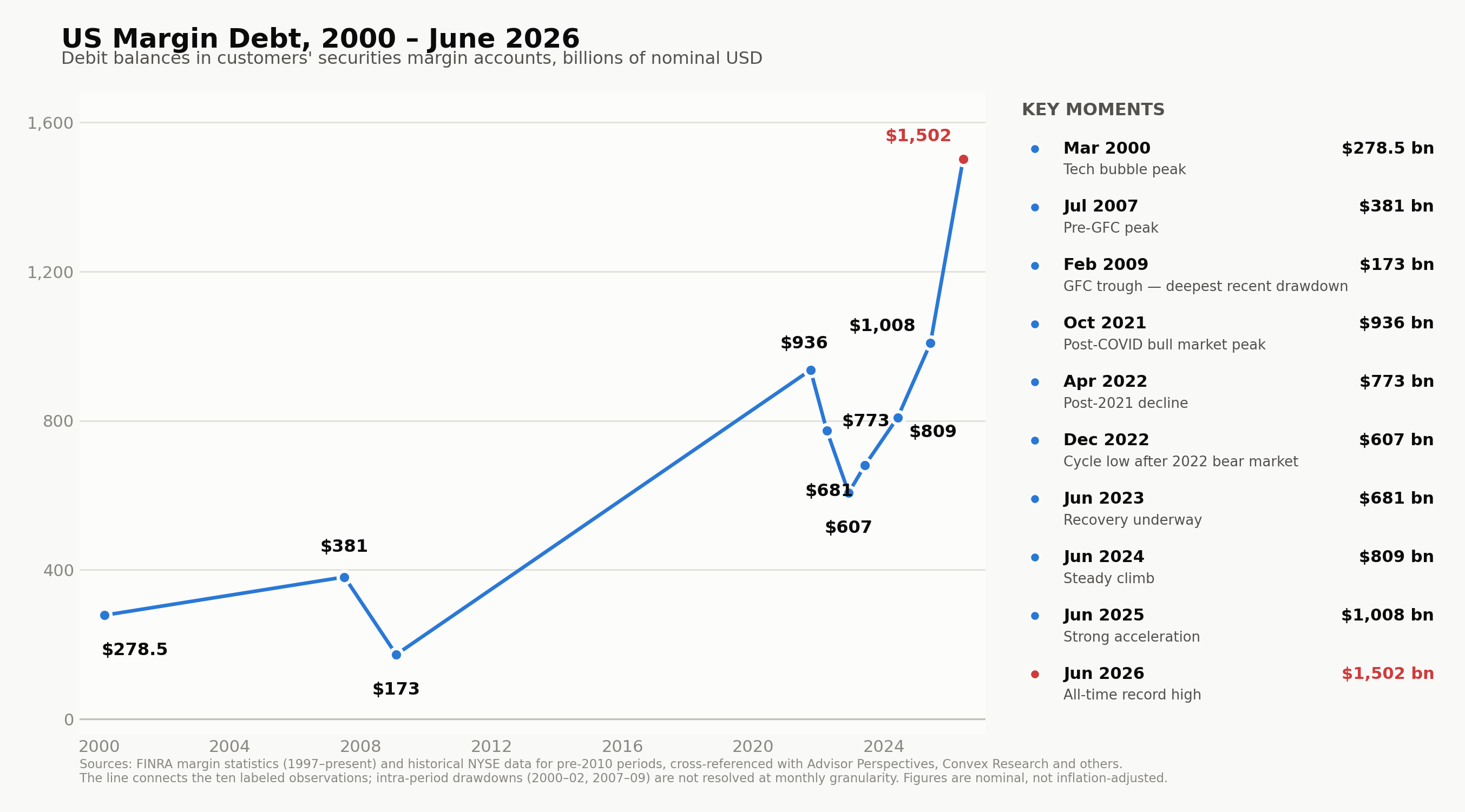
Margin debt is at a record high. It has reportedly risen about 50% in the last year. Retail investors are borrowing money to chase AI stocks because they assume artificial intelligence has made the normal rules of valuation obsolete.
AI is real. It is important. It will probably change nearly everything.
That does not mean today’s AI stocks are good investments at today’s prices.
Those are two completely different questions.
Enormous amounts of capital are being poured into chips, models, data centers, and electrical infrastructure. The market assumes the companies spending this money will capture extraordinary profits for decades.
But Chinese developers are already releasing increasingly capable open models that users can run on their own hardware. If models continue becoming cheaper, better, and freely available, the economics supporting some of these multibillion-dollar valuations could deteriorate quickly.
The technology may win while many of the investors lose.
We saw something similar during the dot-com boom. The internet really did change the world. Most of the companies financed during the mania still went broke.
Doug believes we may now be watching a “super double bubble”: one in AI companies and another in the massive data-center buildout supporting them.
When everyone owns the same trade, believes the same story, and borrows money to buy more of it, the risk is no longer hidden.
It is sitting directly in front of you.
Buy What Nobody Wants
While capital floods into AI, many of the basic industries required to keep civilization running remain neglected.
Oil.
Natural gas.
Uranium.
Copper.
Gold.
Agriculture.
The raw materials of civilization.
These industries are capital intensive, politically unpopular, difficult to permit, and badly underowned. In many cases, years of underinvestment have left the world with limited new supply just as demand is beginning to rise.
That is the setup Doug finds interesting.
You’re not buying what everyone already agrees will change the world. You’re buying the things the world cannot function without—and that most investors currently want nothing to do with.
That does not make every resource stock a good investment. Most junior resource companies are garbage. Management matters. Geology matters. Financing matters. Price matters.
But the broad asymmetry is becoming hard to ignore.
The fashionable part of the market is priced for enormous success.
The unfashionable part is priced as if nobody will ever want it again.
Doug’s prediction is bold: selected resource stocks could return ten times your money while the broader stock market is collapsing.
He could be wrong. We both could.
But I would rather own scarce, necessary assets that have been starved of capital than borrow money to join the crowd chasing the most popular trade on Earth.
Especially when government policy is making almost everything else harder to plan.


