

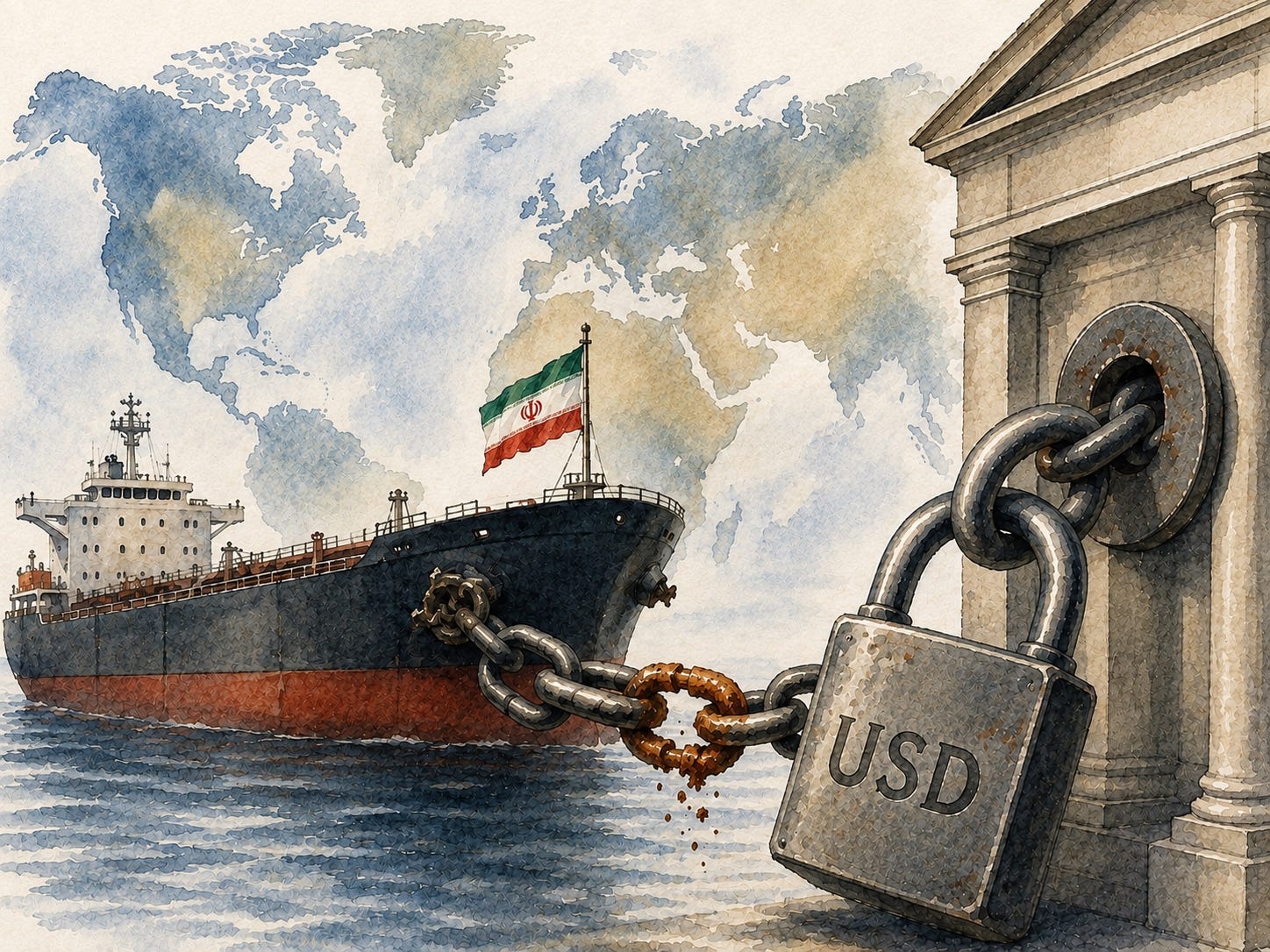
On Wednesday, Donald Trump announced what he called the most crushing economic operation ever taken against any country. Iran is not the only target. Anyone who does business with Iran is a target too.
He listed the offenses: oil smuggling, swap lines, cash transfers, exchange houses, ship registries, front companies.
As Trump said, “You know who you are.”
Some of that list needs translating. Swap lines are standing arrangements between two central banks to lend each other currency. Exchange houses are money changers, common across the Gulf and South Asia, that move value between countries by netting obligations instead of wiring funds. Ship registries are the flags a tanker sails under, sold by Panama and Liberia to owners who want cheap paperwork and few questions. Every item on the list is an attempt to avoid leaving a trail through an American bank.
Trump is not addressing Tehran with this threat. He is addressing every bank that clears dollars through New York.
Primary and Secondary Sanctions
A primary sanction binds Americans. It instructs a U.S. citizen, a U.S. company, or anyone standing on U.S. soil not to trade with the target. Congress can do that, and nobody abroad has to care. These days the president does it himself.
A secondary sanction punishes a foreigner for dealing with the target. A Greek shipowner, a Chinese refiner, a Turkish bank — none of them are subject to American law. The US Treasury reaches them anyway, by threatening to take away their dollars or ability to transfer dollars.
The Office of Foreign Assets Control, a sub-agency of Treasury, adds a name to a list. From that moment, any institution that touches the named party risks being added itself. No trial, no new legislation, no new vote. One designation in Washington, and the world’s bank compliance departments do the enforcement work for free.
How the Dollar Becomes a Chokepoint
Foreign banks do not keep dollars in a vault. They keep them as balances in accounts held at American banks, called correspondent accounts. When an Indian refiner pays a Dutch supplier in dollars, no money leaves India and none arrives in the Netherlands. A bank in New York debits one account and credits another. The transaction occurs on American soil. Some dollar payments do get netted between foreign banks offshore and never reach New York at all, but the banks doing that netting still need their New York relationship.
Losing access to this dollar clearing is currently a big problem for an institution. Close the correspondent account and the bank can still take deposits, still make loans, still operate at home. But it cannot settle with anyone abroad in USD. The dollar denominates about half the world’s trade and 80% of its trade finance, so getting blocked turns an international institution into a local one.
That is real leverage, real power.
It is also consumable, and dangerous to wield. Dangerous for the US.
Eroding the Network Effect
Reserve currency status rests on a set of mutually reinforcing preferences. Together, they create a network effect that has dominated international finance for decades.
Exporters price their goods in dollars. Banks settle those trades in dollars. Central banks hold dollars in reserve, because dollars are what their own importers will need next month. The US military is the most powerful and the US economy the largest. US capital markets are the deepest by far, and dollars and Treasuries the most liquid assets in the world. The US government can tax and print, and is trusted to pay its debts by deploying those two horrible powers. It runs a trade deficit, exporting dollars to supply the demand for them.
That is the ecology of the world’s reserve currency.
From a non-US perspective, the dollar is a service. A convenient tool.
But here’s the rub: the customers are capable of shopping around for a more trustworthy tool with a better warranty. What has stopped them is that leaving costs money, effort, and risk.
The US government, under Biden and under Trump, has turned staying in the USD system into a risk too.
There is now an evident worry that a bank or an entity or a country can get cut off from the USD reserve system when a US president feels like flexing muscles. People don’t like risk and don’t like being controlled by threats, so foreign entities hedge. They open a yuan line, but leave it idle. They sign a rupee settlement arrangement covering a tiny fraction of trade. They buy gold, which sits in a vault they control.
The precedent is 2022, when Russia’s central bank reserves were frozen where they sat in the US and in Europe. Every reserve manager took the lesson.
Reserves held abroad are a claim on a custodian, and custodians can be instructed.
Central banks have been net buyers of gold every year since. Those purchases look like a judgment of the custodian more than of the metal. Turns out governments are fickle.
Nobody likes fickle.
China takes most of what Iran still exports and has spent a decade building payment rails designed to avoid New York. Various “designations” have taught Beijing’s ruling class to prepare for precisely this announcement. The threats from Trump and Bessent land lightly on Russia and China. They land hardest on the parties already complying.
The United Arab Emirates suspended all trade with Iran on Tuesday, a day ahead of the post. European banks will comply because they have no alternative. Indian refiners will comply and resent it.
The measure threatens the already obedient and gives a pass to those already outside the USD system.
The lesson foreign institutions learn is to get outside the USD system. And outside the Euro for that matter.
Walking Away then Running Away
Bessent isn’t an idiot. He knows the risks of taking a hammer he wants customers to buy and hitting them over the head with it. We expect hyperbole from Trump, and so the actions actually taken may be minimal. But the threat matters. The participants in the dollar network now know how fickle its manager is.
I don’t expect a summit at which the dollar is suddenly and “officially” deposed, though there may be gatherings of muck-a-mucks that the textbooks eventually file alongside Bretton Woods. It will appear to us as a slow erosion. But at the timescale of history, it will seem sudden.
Reserve managers work under mandates written by committees; shifting one percentage point out of dollars in a year is an enormous decision inside a central bank, yet mostly ignored. Invoicing drifts at the margin too. Bilateral settlement quietly absorbs the trades that the parties won’t want exposed to US government veto. The dollar’s share of trade falls slowly, over a long time.
Trump may get a deal out of the threat. Maybe the pressure mounts high enough that Iranians risk their lives and throw their absolutely horrible government under a collective bus. That would be a good thing. I doubt it will happen now, but I’m rooting for it. I always root for freedom.
The cost of that small possibility is the dollar moving a big step further toward being just another piece of crap fiat currency, with no special status. As that happens, Americans’ quality of life deteriorates, and fast.
If you know what the next reserve currency is, good for you. I sure as heck don’t, though I expect it will be some central bank digital currency because a CBDC is so attractive to power-seekers.
Until we find out what the next reserve currency will be, gold is the 5,000-year default. As the dollar weakens, the gold-dollar exchange rate rises. Of course it’s the dollar (and all the fiat currencies) that are declining. Declining in trustworthiness.
As gold rises relative to the dollar, the miners tend to move up, and harder. We hold a choice selection of them in the Crisis Investing portfolio. Consider joining us.
Sincerely,
John Hunt, MD
Editor, Doug Casey’s Crisis Investing
Anyone helping Iran survive has my blessing. The US shouldn't be there to begin with. The rising crack spread for diesel just hit an all-time high. That means many input costs for farming and transportation are going to keep increasing. Inflation quelled? Don't believe a fricking word the government says.
The next world reserve currency will be... Monero.
Never officially sanctioned, but used to settle trade none the less. It already dominates the black market.