
Why Uranium Stocks Fell the Day Iran Started Shooting at Ships Again
Can rationality win against irrationality?

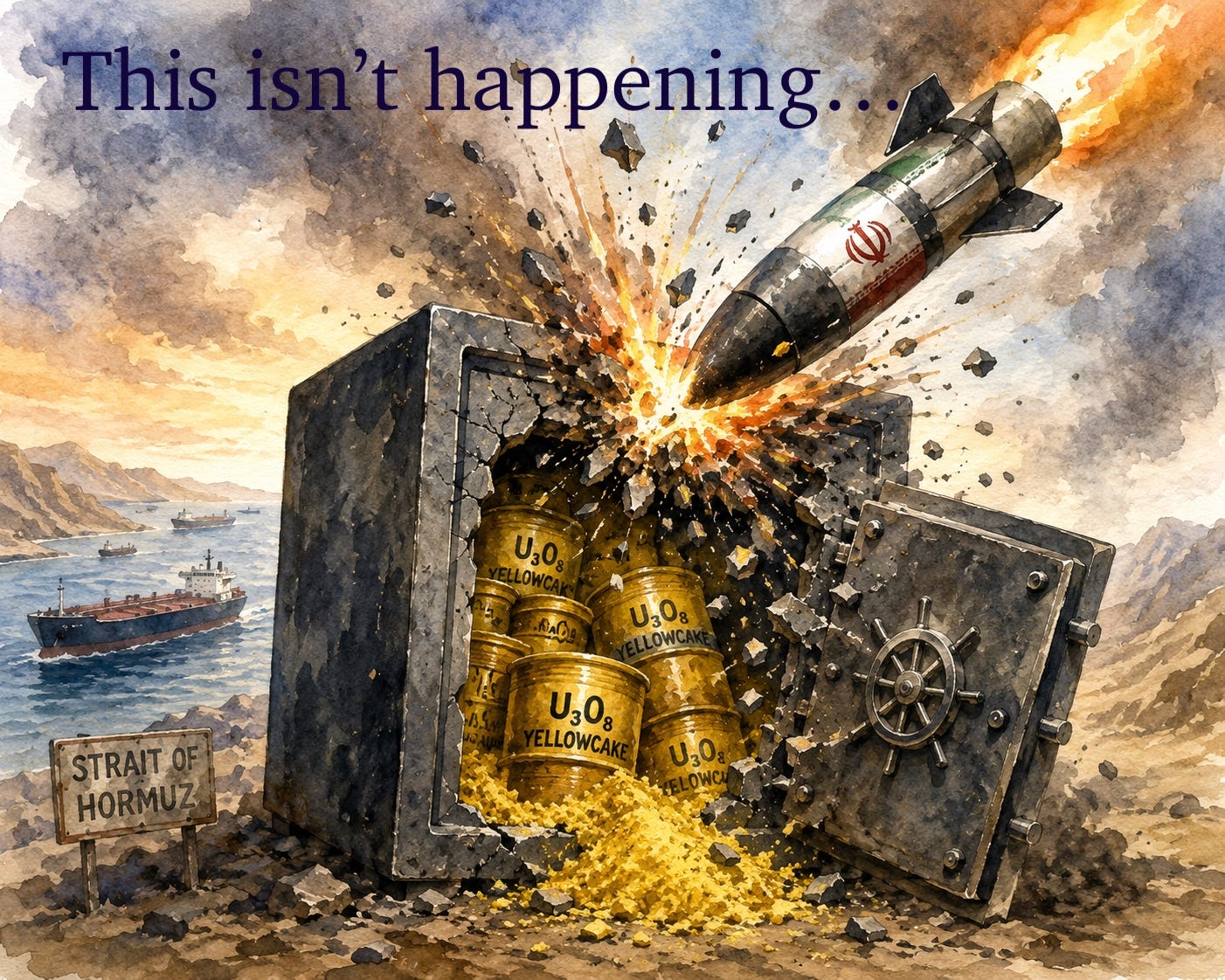
“The stock market can remain irrational a lot longer than you can remain solvent.” --A. Gary Shilling
Three ships took missiles in the Strait of Hormuz this week. Oil traders bid up tanker rates and war-risk insurance, which is the rational response to missiles hitting tankers. Uranium stocks did the opposite of what the geopolitics textbook says they should. UEC dropped 6.5%. URC.TO dropped 5.25%. Even the physical uranium trust, SRUUF, which owns nothing but yellowcake sitting in a vault, fell 3.4%.
A vault full of U3O8 does not care who the IRGC’s naval commanders decided to target last night. So where’s the irrationality, and where’s it not?
Start with what uranium is not. It is not a Gulf commodity. Kazatomprom ships out of Central Asia. Cameco ships out of Saskatchewan. Australian producers ship out of Australian ports. None of it crosses the Strait of Hormuz, and so none of it needs a Hormuz-focused war-risk premium priced into it.
The IRGC’s naval commanders cannot be written off as entirely irrational. Firing on tankers is a calculated move to extract tolls and leverage over a strait Iranian leaders can use in a protection racket to bring in money. And to rile up nationalist and religious fervor. Coercive morality, brutal method, sure. But rational, in the criminal type of mind.
The irrationality is in London, New York, Toronto, Miami and Chicago and every other trading floor where a portfolio manager sees “Missiles, Middle East” and sells down his portfolio without checking whether uranium ships anywhere near the Gulf. Layer on a passive fund having to meet redemption requests with a pro-rata sale across every holding, and a semiconductor desk spooked by a DeepSeek efficiency scare extending out to anything tied remotely to the AI bubble, including uranium. Each seller is following a mandate, a redemption schedule, or a risk model that has no line item for whether the company’s ore body sits anywhere near a war zone.
We will not talk the machinery (or the people who are pulling its levers) out of selling. Or if we think in the obverse, we will not talk people (or the machinery that puppets them) out of selling.
What we can do is recognize the pattern and stop being surprised by it the next time Hormuz, or Taiwan, or a Fed governor’s stray comment sends a basket of unrelated tickers down together. Spot uranium sat still all week in the mid-$80s. Term contracts stayed in the $90s. Nothing changed in the ground. What changed was a price, not a value, and the gap between the two is available to whoever’s willing to hold the other side of a forced sale.
If your daily grind leaves time for day trading, be prepared to be working in an irrational trading environment. Don’t expect standard rational thinking to work well here. Your rational mind will need to be good at predicting what irrational stuff might happen overnight. If your mind is good at that, you have a skill that can make you money.
If, however, you are short of time in your day and your rational brain isn’t so good at predicting irrationality, it might be better for you to focus on the longer term. The uranium supply/demand imbalance is real and growing. Over the longer term, uranium prices will be pushed up by this, and so will the profits of selected companies that produce uranium. That’s one of the rational analyses that supports the Crisis Investing portfolio positions in uranium stocks, available to premium subscribers (join us here).
The rational mind can look at Hormuz-induced uranium stock declines as an opportunity to start or add to a position. But don’t consume your emergency cash reserves to do so. First and foremost, keep an eye on your longer-term solvency, the roof over your head, food in your belly.
If you don’t have dry powder now, don’t worry, but do try to accumulate some. The market will remain irrational for a lot longer. There will be many more opportunities to buy low.
Sincerely,
John Hunt, MD
Editor, Doug Casey’s Crisis Investing
P.S. The quote at the beginning of this note is often attributed to John Maynard Keynes—a man whose work led to a ton of irrational actions in the economy. But it wasn’t Keynes who said it.
I am surprised you don't seriously consider Cameco. I bought them 5 years ago and they have gone up 10x since (now down at 8x). As the largest uranium producer in the western world with very smart management....