

Two Economies
Every dollar the Fed creates puts upward pressure on asset prices and consumer prices. On one side are people who own the assets. These folk check their net worth frequently. On the other: people who work for an hourly or salaried wage, buying groceries and fuel and waiting for a raise. These folk check their bank balance and credit card debt frequently. Both sides vote. They do not live in the same economy. Maybe not in the same world.
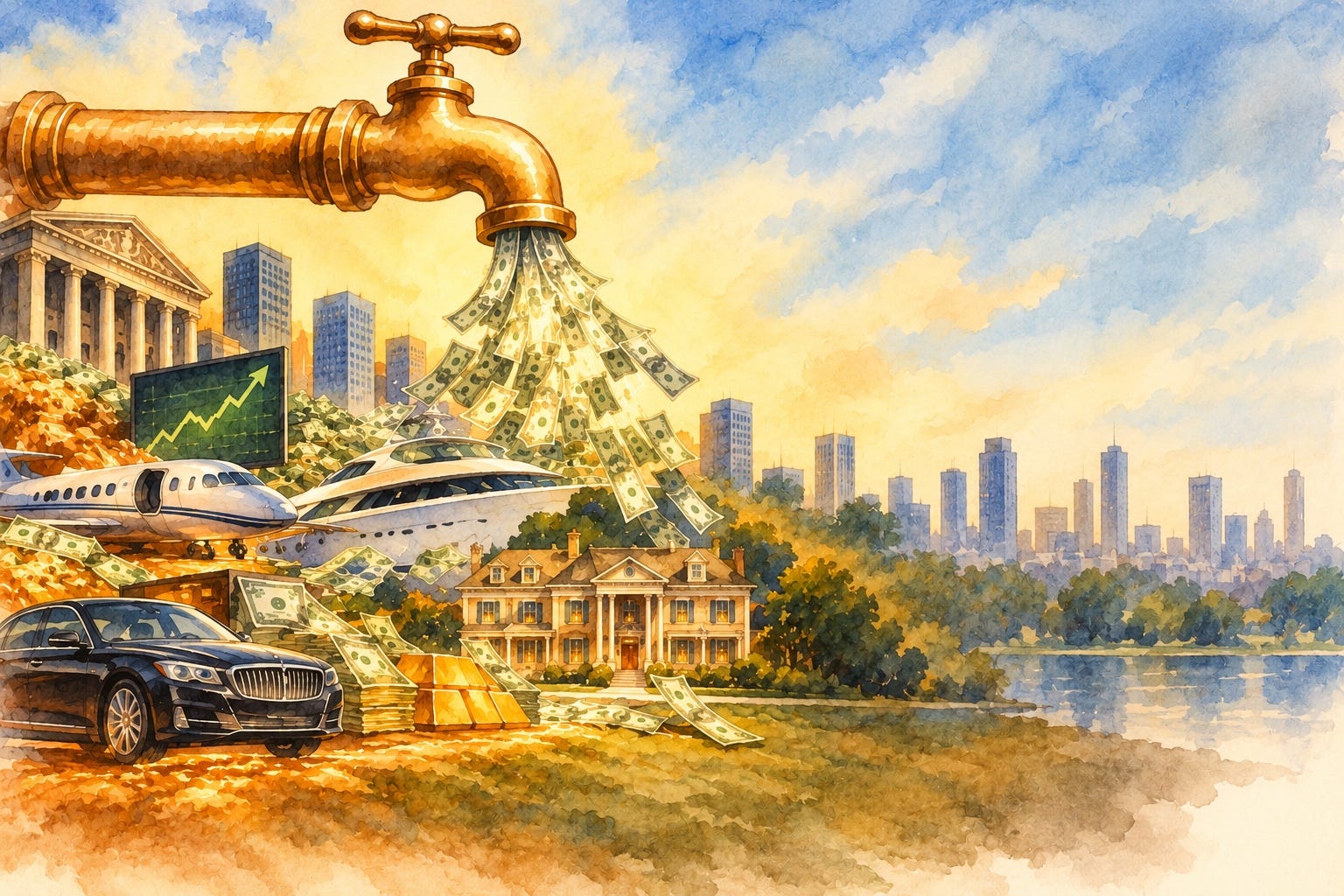
The first economy is dominated by a currency printing spigot. The second is constantly drained by a siphon.
The Spigot
New currency units — newly printed dollars, in plain English — do not arrive in an economy spread out evenly. They arrive through spigots targeted at selected spots. Richard Cantillon worked this out centuries ago and the effect is named after him.
Whoever stands closest to the spigot benefits first and benefits most.
The spigot flows first to the primary dealer system. When the Federal Reserve creates dollars, it buys Treasury bonds through open market operations from a short list of banks that have held seats at the table for decades — JPMorgan Chase, Goldman Sachs, Citigroup, and a handful of others. This system is as crony as crony can be. Those banks receive newly created reserve balances and earn interest on them, while also receiving fees and trading profits from their role as intermediaries. These bankers love inflation.
The Fed’s purchase of the Treasury bonds—using currency they conjure out of thin air—keeps the interest rate lower than the US Government would need to pay if the Fed wasn’t serving as a buyer of last resort. That is inflation. Or as the Fed would say, quantitative easing.
That there is a constant global demand for those newly printed currency units (dollars) allows the Fed and the US government to conspire to keep pumping up the inflation for longer than any other country on the planet could get away with.
Trickle-Down Counterfeiting
After the banks, the new currency moves to whoever the politicians this year are motivated to fund — defense contractors, university researchers, vaccine manufacturers, solar subsidy recipients, highway builders, electric car manufacturers, ICE agents, rare earth element miners, corn ethanol farmers, rocket builders, drone manufacturers. Whoever catches a politician’s fancy gets to drink from the spigots not long after Wall Street does.
The early recipients all then spend the currency on building their organization and paying off the politicians, and use the rest to bid up stocks, real estate, yachts, private jets, sports cars, specific classes of artwork, gold, silver and other commodities before the currency trickles through the system to get to the little guy. The asset bubbles, alongside ridiculous malinvestment in stupid projects are the evidence of where this inflated currency lands.
Occasionally the currency is drizzled out by helicopter to the little guy, as they did during Covid. But that is only just enough to prevent the pitchforks from coming out when the little guys see all the cronies getting the big wads of currency.
It’s not a problem unless it’s a problem for the banks. Then it’s a problem.
Ben Bernanke’s response to the 2008 financial crisis bought mortgage bonds and Treasuries from that same short list of banks, giving those banks tidy profits instead of bankruptcy. The S&P 500 more than tripled off its 2009 low by 2014 while median household income didn’t even recover its pre-crisis level in real terms until 2016 (if we can trust government stats). Jerome Powell ran the same play in 2020, at greater size and higher speed.
They don’t care about the little guy beyond making sure he doesn’t pull out those pitchforks.
The Siphon sucks from those who aren’t near the spigot.
Wages are the slowest-moving price in the system, because the wage earner stands furthest from the spigot.
A landlord raises rent each year. A grocery chain prints a new price tag each night. A stock reprices in the time it takes to refresh a screen. But a wage doesn’t move until an employee works up the nerve to ask for a raise, and by then rent has moved twice and the stock has moved a million times.
Bankers and government contractors and various cronies get richer on early access to the inflating currency. The private-sector wage earner, trying to sock away some savings, pays for it at the grocery store. It sucks the fruits of his labor out of him.
Between 2020 and 2022 the Fed’s balance sheet grew by roughly $5 trillion. Home prices and the S&P 500 both set records in nominal and inflation-adjusted terms. That was the spigot doing its thing—sending inflation to the asset holders.
Average hourly earnings, adjusted for the CPI, fell. Imagine if we adjusted the average hourly earnings not for the CPI, but the effect of the inflation on asset prices. The average hourly earner just can’t afford assets anymore.
The rich get richer and the poor get left behind. The cause of all this is a fiat currency and politicians spending other people’s money.
Keynesianism. Socialism. Fascism.
None of this is Capitalism.
How Close to the Spigot?
The inflation (currency printing, quantitative easing) keeps coming. You and I can’t do a damn thing to stop it.
What we can do is to decide how close to the spigot we are willing to stand. Banks get there through a nod-nod-wink-wink Fed relationship. Contractors and cronies get there through a member of Congress. The rest of us, who try to be honorable, can sort of get near a spigot by owning the stocks, the real estate, and the metal the new currency is going to bid up on its way through the economy. And, with a bit of speculative finesse, perhaps predicting which stupid companies are going to benefit from where the stupid politicians direct the next batch of currency units.
We also have to figure out which of the asset classes is bubbled up too far and may pop vs. which of the classes will be in most demand as the currency decays.
When the SHTF, we will realize that people don’t need stocks in companies that create useless crap that no one will buy if they had to spend their own money. People don’t need to pay huge sums to colleges to have their children turned into morons. People don’t need carbon credits.
People need homes. People need food and water. People need energy. People need real money (such as gold).
Of these, at Crisis Investing, we tend to focus on the gold, silver, and energy. But sometimes, we look at what those politicians are spending inflated currency units on. And maybe take a flyer alongside their cronies here and there.
And that is what September’s monthly issue for premium subscribers will discuss. I will present a method to start acquiring positions in companies that Warren Buffett would never put funds into, but that the politicians will. And that method, though not without risk, doesn’t consume any of your paycheck.
I hope you join us as we navigate through this strange economic period that is so dominated by the fact that the US dollar is the global reserve currency. And what happens as that changes.
John Hunt, MD
Editor, Doug Casey’s Crisis Investing
Fair point that monetary policy will have distributional consequences, some favoring those closest to the spigot or with real assets. But won't accommodative monetary policy that results in lower interest rates also tend to benefit borrowers (e.g., people trying to buy a new home)? And to the extent that expansive monetary policy raises inflation, doesn't that tend to transfer real wealth from creditors to debtors? In other words, aren't the distributional consequences more complex that just a pure benefit to those closest to the spigot?
As usual, excellent and right on.