
They Cut 270,000 Federal Jobs—But Missed the Real Target
Chart of the Week #84

I know I can be a downer sometimes, but there’s actually something worth celebrating in this week’s chart. Well, sort of. Take a look below.
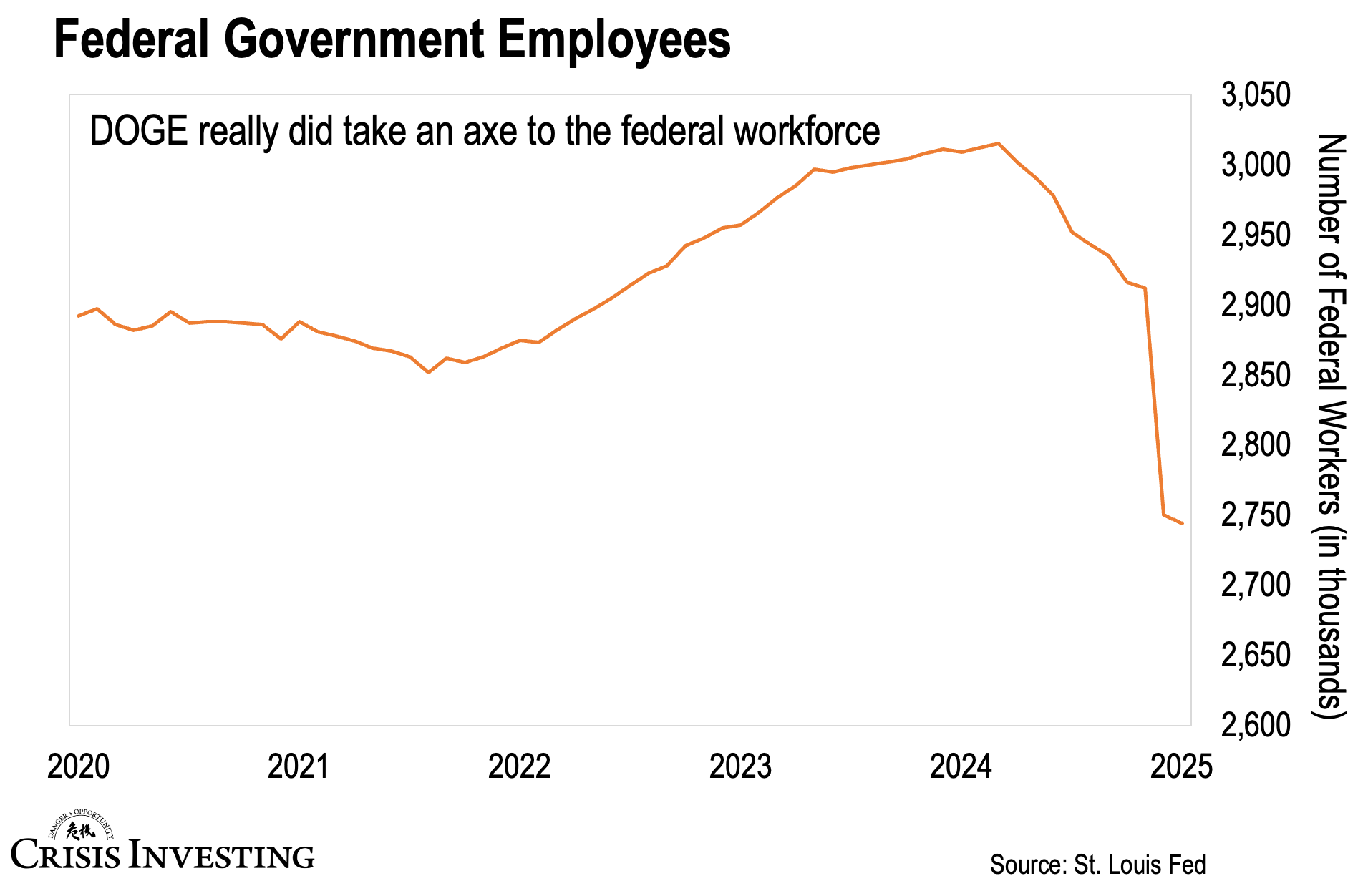
The federal workforce fell from over 3 million back in January when Trump took office to around 2.74 million at the end of 2025—shedding over 270,000 jobs. That’s the largest peacetime workforce reduction on record, and it happened in less than a year.
If you believe the federal government is inherently bloated and wasteful—and that certainly includes us and most of our readers—this is progress.
Less bureaucracy means fewer resources wasted on questionable programs and fewer layers of regulatory friction gumming up the works. Call it what you want—administrative cleanup, common sense—but it's been long overdue.
The force behind those cuts? DOGE—Trump’s Department of Government Efficiency led by Elon Musk. From the start, DOGE targeted agencies across the board: the U.S. Agency for International Development (USAID) was effectively shut down, with much of its 10,000-person workforce fired or placed on leave. The Department of Education lost nearly half its staff. AmeriCorps was gutted. Social Security offices, the IRS, Health and Human Services—DOGE slashed staffing left and right (often with legal challenges trailing in its wake).
So, great news all around, right?
Well, again, sort of.
Because while DOGE succeeded in cutting headcount, it completely failed at its actual mission: cutting spending.
Government spending didn’t go down during DOGE’s tenure. It went up.
Treasury figures show federal outlays climbing to about $7.01 trillion in FY 2025—around $275 billion higher than FY 2024. The national debt grew by about $2.2 trillion over the same period.
How could this be, you might be wondering? Thousands of government employees fired, yet spending still climbed?
The answer is simple: federal employee compensation is a rounding error in the federal budget. As of 2024, total federal employee compensation was roughly $290–300 billion. Total government spending? About $6.75 trillion. You can’t make a dent in spending by cutting workers when salaries represent such a tiny fraction of the budget.
The real drivers of federal spending—Social Security, Medicare, the Pentagon, and interest on the debt—weren’t touched. In fact, they grew.
Social Security spending hit roughly $1.6 trillion in 2025—up over $100 billion from the previous year. Medicare and Medicaid together cost around $1.8 trillion. Defense spending came in at roughly $900 billion. And net interest on the national debt—now the second-largest line item in the budget—consumed over $900 billion, nearly double what it was just a few years ago.
Those four categories alone account for over $5 trillion of the $7 trillion budget. Everything else—including every federal worker’s salary—is fighting over the scraps.
This is where DOGE’s—and Trump’s—failure becomes painfully obvious.
Musk originally promised “at least” $2 trillion in annual savings during the campaign. That number was quietly revised down to $1 trillion, then again to $150 billion. Even that proved impossible. When Musk left DOGE in May after clashes with Trump’s cabinet and legal setbacks, he called the effort “a little bit successful” and said he wouldn’t do it again.
That’s a far cry from the “chainsaw for bureaucracy” he literally held up at a conservative conference.
Trump promised voters he would tackle “massive waste and fraud” in government spending. He promised drastic reforms. And he promised trillions in savings.
What he’s delivered so far is a smaller workforce and a bigger bill.
Regards,
Lau Vegys
P.S. In our latest Crisis Investing issue, we reviewed all our 2025 picks, including our rare earths and silver plays, which were some of the best performers. If you're a paid subscriber, make sure you haven't missed it. If you're not yet a subscriber, the lead is free for all readers.
Until we get the millions off of the government freebees, we will never balance anything!....Congress continues to give out money and goods to people who have NO intention of ever getting off of the pork. Everyone of them should be vetted. Welfare was not designed to feed 3 generations of the same people. That was the downfall of the US. Not taxes, not DOGE, not Trump. Bring back Ellis Island, screen these people, and shut the borders. I have known a lot of government workers. Most of them do as little as possible, and dream of the retirement check. Sorry, but true. That includes politicians that stay in for 40 years. This is the problem!
This is a sad, sad world / Full of shrieks and hollers and fat lies/ no doubt ...
but still I hope in the rumble of distant chaos the few smart humans
still dedicated to the task of improving the world will
ultimately have an impact/ help us turn a corner.
But it's very hard to change anything let alone
much in this world so constrained by
ignorance and debt. Keep telling
the truth. It helps. Thanks.