
There’s a problem with AI

If someone you barely know offers to pay for whatever car you feel like buying, you’re likely to spend their money buying yourself a really nice car and not spend much effort negotiating. That’s not a personality flaw. It’s economics. Economists call it moral hazard: when one party makes decisions that another party has to pay for.
The textbook example is medical care within the third-party payer paradigm. When a third party is paying the bill, many patients request every test and the newest most expensive medications, and don’t care about the cost, because the cost is paid by a faceless bureaucracy at a distant insurance company. The patients don’t ask for prices for care, and the doctors couldn’t answer them if they did. The patient pays a monthly subscription (an insurance premium) and can use the medical resource as inefficiently as he feels like. As a result, the medical insurance bureaucracy is tortuous and everyone ends up surprised by the bill.
The AI ecosystem is rife with moral hazard.
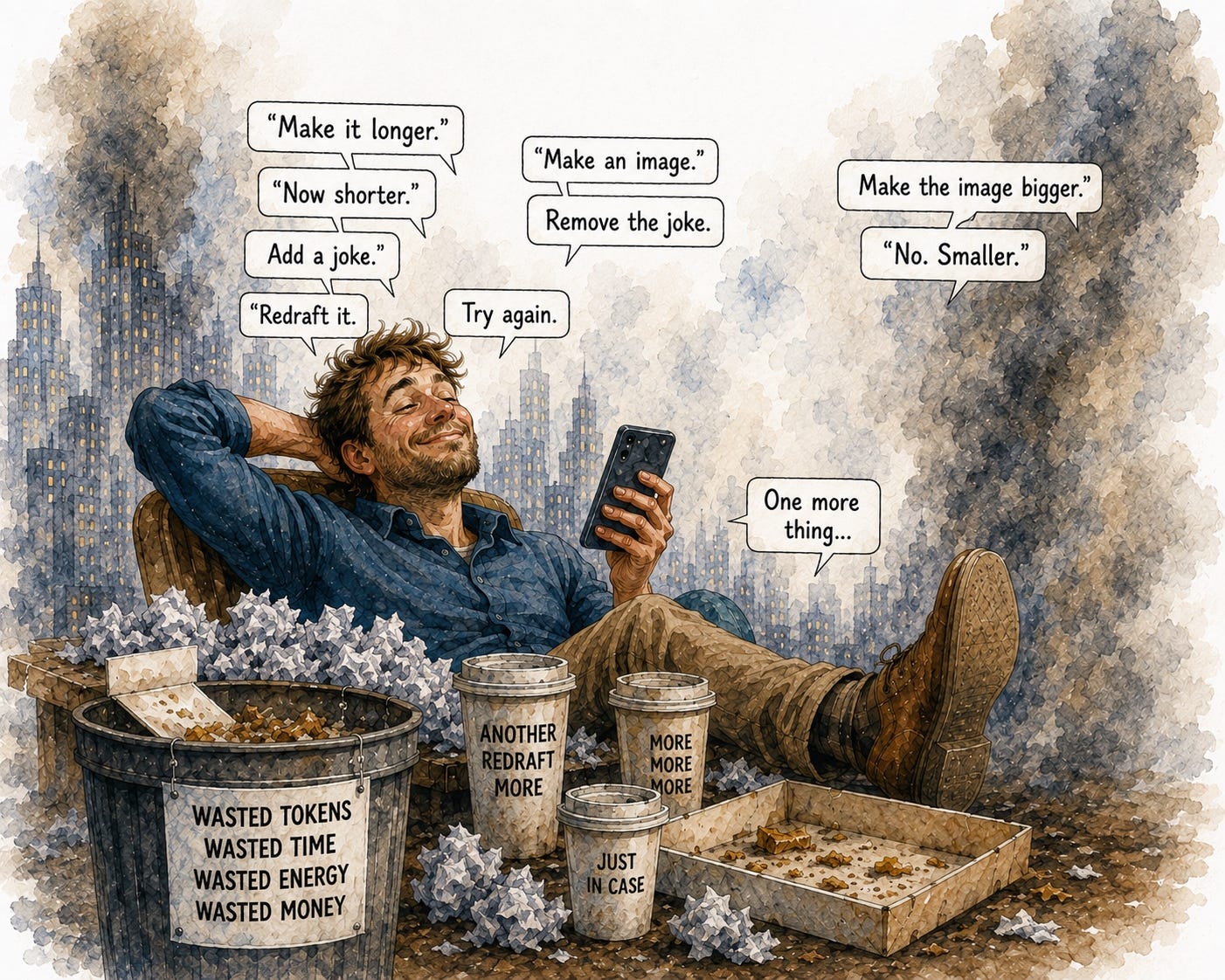
Most people pay for AI access through a flat monthly subscription—$20, $100, $200 a month depending on the service. Ask Claude to redraft your contract seventeen times. Ask ChatGPT to make an image, make it bigger. No wait, make it smaller. Add a joke. Remove the joke. The price is the same. You feel no friction because you bear no marginal cost.
But friction is information. It’s the mechanism that forces you to decide whether a task is worth doing.
Labor gets respect. AI does not.
Good employers are rarely careless with human labor. They scope the job, estimate hours, ask whether the output justifies the effort and cost. Likewise a contractor at $150 an hour concentrates the mind beautifully. You don’t ask him to repaint the living room three times because you changed your mind about beige.
AI on a subscription plan gets no such discipline. Users fire off redundant queries, half-formed prompts, and do-overs that a two-minute think at the outset would have prevented. The AI is a resource. It runs on electricity—significant amounts of it. It occupies server time that has capital costs behind it. None of that registers when the price is fixed. Heck, you don’t even need to apologize to AI for wasting its time.
Token pricing changes the calculation—maybe.
An alternative is token-based pricing. A token is roughly four characters of text. When an AI model processes your prompt and generates a response, it consumes tokens at both ends. The API (application programming interface) prices those tokens per million. A single well-framed prompt with a clean adequate response from AI might cost a fraction of a cent. A sprawling, repeat-everything-back-to-me session with multiple redrafts and filled with the AI explaining its edits (and repeating itself) can add up.
That cost—if the user feels the cost—changes behavior. Token-paying users front-load their thinking. They write tighter prompts. They don’t re-ask the same question hoping for a luckier response. In redrafting, they start new chats to keep the chats short. The pricing structure enforces the discipline the subscription model removes. The user treats the model as a scarce resource, not a free vending machine that refills at midnight.
There’s a catch. And it’s a doozy. In most corporate deployments, the employee is the one using the AI tokens while the company foots the bill. The decision-maker and the cost-bearer are separated again. If the employee cares about the company bottom line, he thinks before he types. But be realistic: the employee won’t care, or won’t care much. Token pricing doesn’t cure the disease of moral hazard—it just moves it up the org chart.
Moral hazard is not a minor inefficiency. It’s the central mechanism that underlies the failures of the US and socialist medical systems. Too-big-to-fail mentalities create trillion-dollar financial crises. Foreign aid produces dependency instead of development. The same dynamic, playing out across millions of AI users, wastes real resources, including electricity and capital. And the companies that use AI are noticing.
Some will win. Some will lose.
Moral hazard doesn’t mean people are dishonest. It means the incentive structure produces lots of waste. Fix the structure and the waste drops—not because people become more virtuous, but because the price is telling the truth again.
AI is a brand new sector of the economy. It’s moving so fast that I doubt most decisionmakers—focused on deploying AI in their organizations—are yet thinking much about how harmful AI moral hazard is to their sustainability.
But organizations on the receiving end of the moral hazard can make a killing. Hospital organizations do just that. Who in the AI ecosystem will be the beneficiaries of the moral hazard?
The answer is already visible.
Hospitals learned to feast off moral hazard by hiking list prices to levels no cash patient could pay and installing electronic medical records for the primary purpose of maximizing billing codes. The result is an industry whose administrative overhead alone exceeds the entire GDP of most countries. And to those who lord over their growing medical empires, moral hazard is their angel.
In AI, the benefits of moral hazard go to the infrastructure layer. Nvidia sells the picks and shovels. The cloud giants—Amazon, Microsoft, Google—collect on every token processed whether the query was brilliant or pointless. The model companies collect subscription revenue whether a subscriber uses the service or not. If Anthropic or OpenAI is charging enough, waste becomes their margin.
The losers are the companies whose employees deploy AI tools on the corporate dime without discipline, the startups that burn investor capital on bloated AI costs, and eventually the subscribers themselves when the hype-funded pricing ends and the unsubsidized, fully-burdened bills start arriving. AI used to be entirely free, remember? Now only a little bit of candy is offered for free.
The hospital analogy holds. The beneficiaries of medical moral hazard are certainly not the patients. The US medical system was not built to serve patients. It was built to harvest the moral hazard that government subsidies and mandates created. In AI, that fortune belongs to whoever owns the infrastructure.
In the free market, the moral hazard of AI will correct itself. CFOs will start tracking AI spend line by line. Usage policies will get written. The companies using AI will put the brakes on waste—it’s already happening—and the cloud giants will find they built more data centers than they need.
But we don’t have free markets. We have government. And the cloud giants—the companies with huge influence on politicians and bureaucrats—will not sit idly by if their massive new data centers are sitting idle. So don’t be surprised if governments come in and declare AI access a “right” of all people and start taxing and spending. They’ll just be following in the destructive footsteps of how politicians screwed up medical care. And, in that case, don’t worry. The cloud giants will then do just fine.
As government screws up the economy, it creates a slow crisis that someday will be a fast crisis. We consider gold one of several components necessary to survive and potentially thrive in a crisis. So, tomorrow, as my first recommendation to readers of our premium Crisis Investing subscription service, we will be presenting for your consideration … wait for it … a gold mining company. Shocker, huh? But this is not just a story of a miner. This story is a compact education in mining and speculation and investment, with a grand opportunity for upside. Join us by subscribing.
Sincerely,
John Hunt, MD
Moral Hazard for sure is built into the system, the incentives are not aligned with the greater good and things get worst, ultimately for everyone, but last, much later, for the fat cats living off the hazard. Too true. Well written. Let's all open our eyes and push for correction and restraint.
Extremely interesting. Thank you, John.