

The 21-mile wide Strait of Hormuz “closed” in early March. It wasn’t closed by a big beautiful wall. It wasn’t blocked (directly) by Iranian fast boats or mines in the water or tankers on fire or by the U.S. Fifth Fleet.
The strait closed because, in the first week of March, the insurance market withdrew. The International Group of P&I Clubs — the mutual associations that cover roughly 90 percent of the world’s ocean-going tonnage — issued cancellation notices on war-risk coverage for Persian Gulf transits.
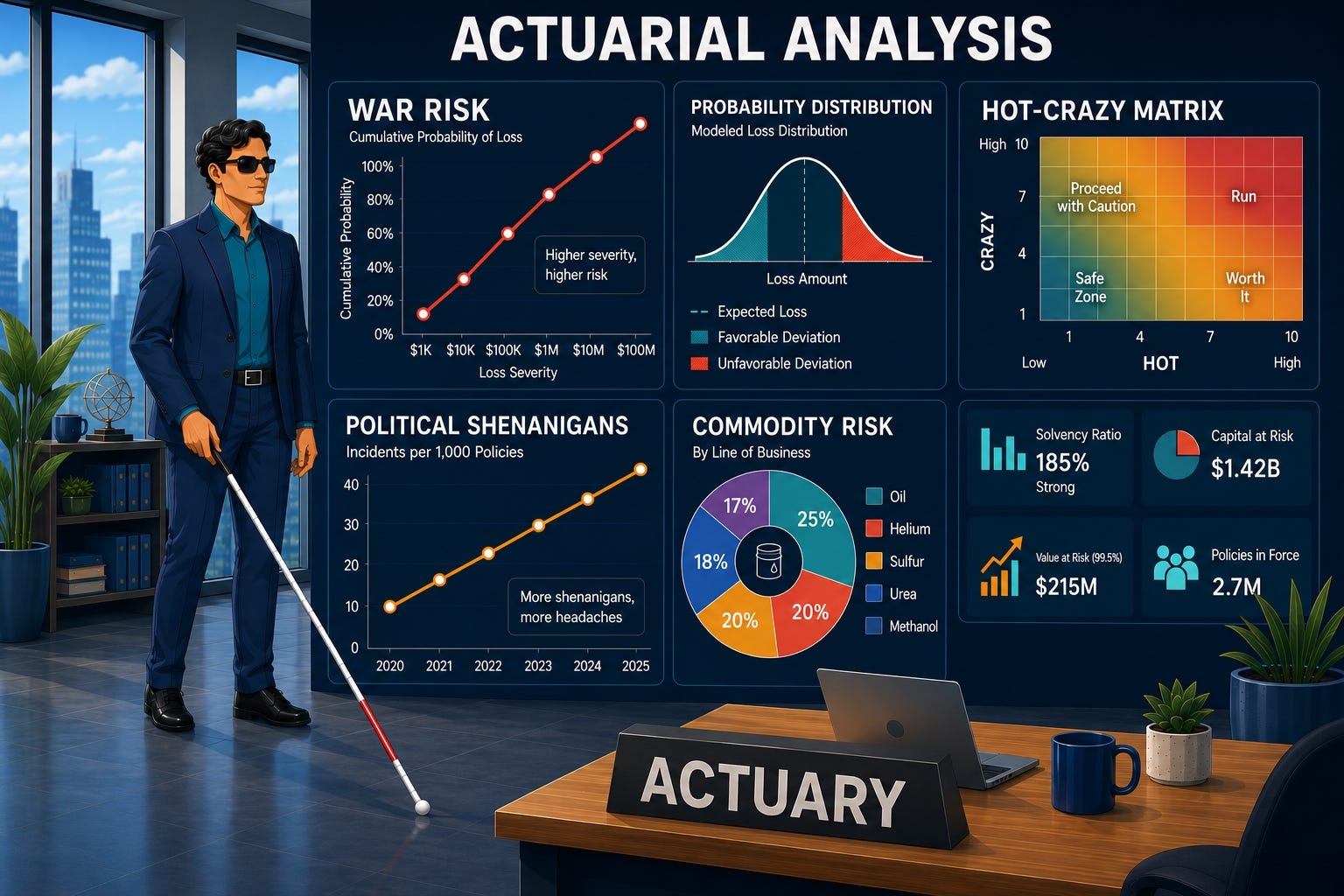
Coverage stopped being available at any commercially viable price. Dylan Saunders-Mortimer, who leads marine war risk insurance for Marsh in the UK, told the press that underwriters “struggle to price risk where there is involvement from the United States or Israel on the basis that it almost removes the fortuity of the risk.” Fortuity of Risk is insurance lingo for “accidental.” Translation: when the risk is controlled by policy and military whims of over-empowered politicians, the actuaries cannot model the loss probability. A hundred underwriters in London, Oslo, and New York were left blind, and naturally stopped quoting.
War was no longer a risk, but a manifest reality.
Common sense told captains and owners that the risk was higher than normal. So in the face of a modest possibility of real danger, and no availability of any financial protection in the event of calamity, tankers idled outside the Hormuz chokepoint. Even if Iran sent them an engraved invitation for unmolested passage, the ships still had to wait for someone in London to sell them an affordable policy. Those who loaned money to buy the ships would insist that their collateral was insured or they’d call the loan, the same way that you are required to have comprehensive insurance on your car if you have an auto loan.
The net effect is that the lack of availability of relevant insurance was a proximate cause of the shutdown of twenty percent of the world’s daily oil supply. And Sulfur, and methanol, and helium, and urea.
Washington figures there is nothing that can’t be fixed by more government intrusion.
On March 6, the U.S. International Development Finance Corporation (DFC) announced a $20 billion maritime reinsurance facility with Chubb as the lead underwriter. By early April, the facility had been doubled to $40 billion with six additional partners — Travelers, Liberty Mutual, Berkshire Hathaway, AIG, Starr, and CNA. President Trump declared the program would help restore maritime trade through the strait.
Three months later, the U.S. Congressional Research Service summarized the result in a single sentence: “It is unclear if DFC has provided any coverage yet.”
The application portal has not opened. No vessel has received a policy under the facility. Forty billion dollars in committed reinsurance capacity has sat on paper. The vessels still moving through the strait are operating with Iran’s permission, paying tolls in yuan or Bitcoin to the Persian Gulf Strait Authority that Iran founded on May 5. Those shipowners are not interested in handing the U.S. Treasury a clean documentary trail that will be used against them later.
What moved into the vacuum.
Political distortions in the markets are where speculators provide service to the world while creating profit. To a great extent it is non-Western insurance providers coming into the market, speculating on how much they can trust the Iranians, and how well they can avoid the US Navy and dodge around Secretary Bessent.
While the Western insurance market sat closed and the DFC facility sits mired in its own mire, a parallel market expanded. China’s PICC Property and Casualty, China Re, and COSCO’s captive insurance arm continued writing coverage. Russia’s Ingosstrakh and the Russian National Reinsurance Company — both built specifically to operate outside Western financial architecture, and both expanded substantially after the 2022 sanctions wave to handle the dark-fleet business — were already in business. Even Iran launched its own platform in mid-May. It is called Hormuz Safe. It is settled in Bitcoin. The regime estimates it could generate $10 billion in annual revenue. Hormuz Safe does not cover damage from military attacks. It covers inspection, detention, and confiscation — meaning Iran is selling vessels insurance against Iran’s own political shenanigans. Good gig if you can get it. (Although, for sure, it is morally repugnant).
As of May 20, the Persian Gulf Strait Authority was authorizing about twenty-six vessels in a twenty-four-hour period. Russian and Chinese vessels are getting through. The strait is not closed. It is operating at perhaps a fifth of pre-war volumes, and it is running on a non-Western insurance and tolling system that did not exist three months ago.
Western insurance came back. Sort of.
By April, Western insurance single-transit premiums had come down from a peak of 10 percent of hull value to roughly 2 to 6 percent of hull value. (Pre-war, they were about 0.25% for a single transit of the Strait). The Lloyd’s Market Association issued a statement on March 23 arguing that insurance is technically available — and they are technically correct, the way a $100 cup of coffee is technically purchasable. For a $100 million tanker, 2 to 6 percent is $2 to $6 million per transit. The Western insurance market reopened at a price point that excluded most of its former users.
The Net Effects
Every week this persists, the non-Western insurance pool consolidates relationships, contracts, and reinsurance capacity that did not exist before. When Hormuz reopens, the Chinese and Russian capacity will keep some or much of the business it absorbed. After all, they provided service when others would not.
Markets route around obstacles. The Western insurance market closed Hormuz to its own users. The U.S. government made a pretense of filling the gap with $40 billion of printed “capital” that has, so far, insured no cargo. Non-Western alternatives absorbed the volume.
It’s a sad state of affairs when the US government is the force of whimsical political perversion of markets and the Russians and Chinese insurers are the ones taking the risk and keeping the trade moving.
In the next letter, we will get into government actions— the naval blockade, the OFAC designation of Iran’s transit authority on May 27, and the rest of the pressure campaign Treasury Secretary Bessent calls Economic Fury. Is the US government really trying to open the Strait of Hormuz, or is it trying to keep it closed? Whether it is brilliant and coherent strategy, or bureaucratic incompetence and malfeasance, the actions politicians and bureaucrats are taking are reshaping global shipping and supply/demand dynamics in ways that we strive to discern.
If our commentary and analyses are useful to you, please forward it to anyone in your life who you care about and suggest they subscribe to our free service. And if you want to be a part of profiting from awareness of the trends we see in the world, join us in our premium Crisis Investing service.
Sincerely,
John Hunt, MD
"...Washington figures there is nothing that can’t be fixed by more government intrusion..."
Brilliant, hillarious quip that would be a worthy comment from Will Rogers or Samuel Clemens.
Interesting. Saw a post from that Policy Tensor guy couple weeks ago. He demonstrated how the U.S. was caught off guard about the effectiveness of Iranian missiles. I am comparing this article with that.
When you see this crap happen it’s sometimes difficult to believe our leaders could truly be this stupid. Articles like this confirm that they are as opposed to carefully masterminded our destruction (Great Reset).
So this is grand. We can all rest easy knowing the boys in DC aren’t trying to kill us off. Take comfort knowing they are just stupid.