
The Strait Just Got Shut Twice—Time to Buy This Oil Stock Again
'Crisis Investing' Alert

Dear Reader,
The Islamabad talks are dead. After 21 hours of negotiations between the U.S. and Iran this past weekend, the two sides failed to reach an agreement. The sticking points were exactly what you’d expect: Iran refused to end uranium enrichment or fully reopen the Strait of Hormuz without charging tolls. The U.S. refused to accept anything less.
Within hours of Vice President Vance announcing the collapse, President Trump posted on Truth Social that the U.S. Navy would begin blockading the Strait of Hormuz — effective today, Monday.
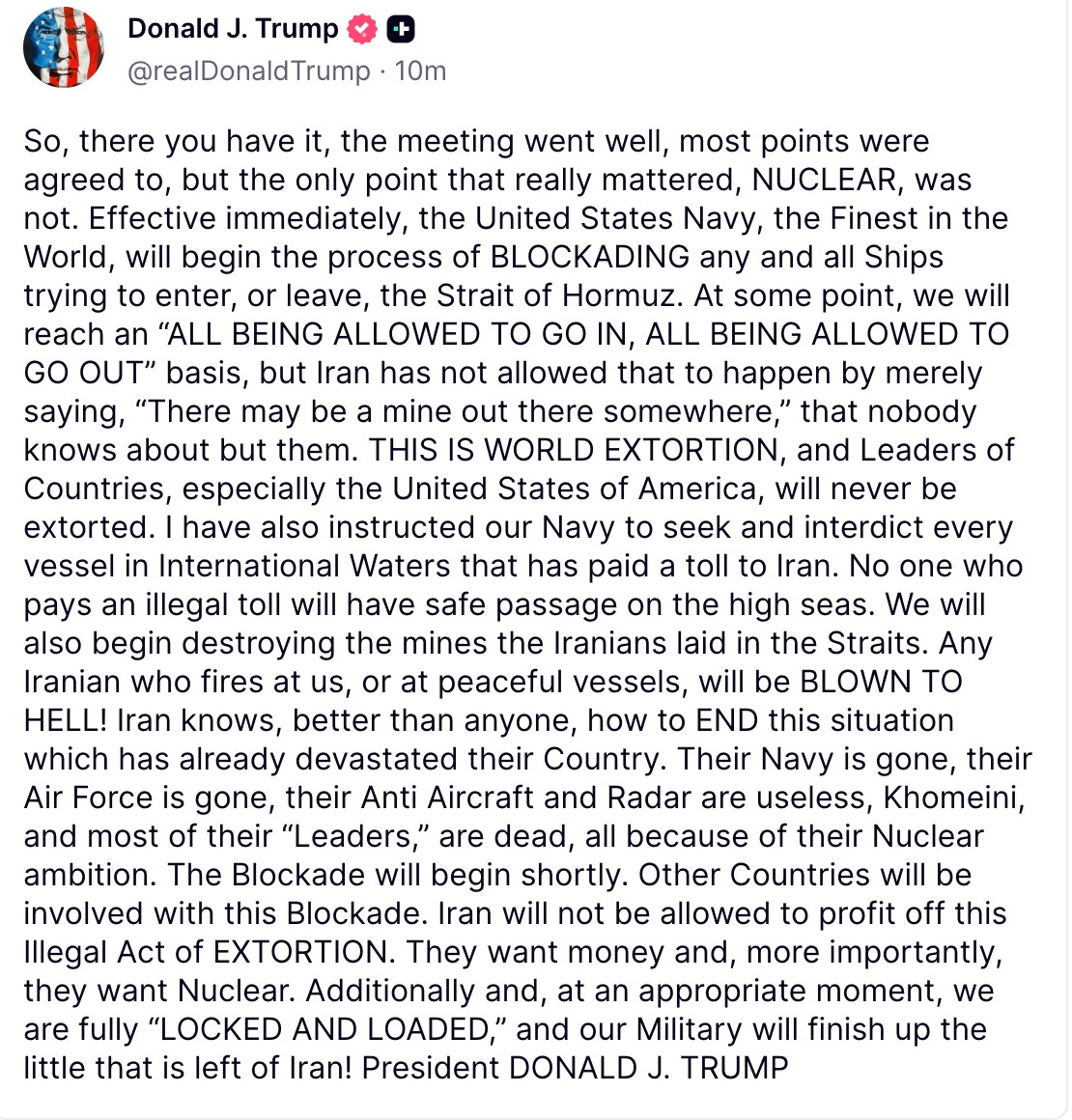
Let that sink in for a moment.
Iran shut the Strait six weeks ago. Now the United States is shutting it again — from the other side. The official justification is to intercept ships that have paid Iran’s tolls and block traffic to and from Iranian ports — which almost certainly includes Chinese tankers, the biggest buyers of Iranian crude. In practice, Trump is blockading a waterway that Iran already blockaded. He’s closing the strait to reopen it.
That’s an unprecedented escalation.
Oil is telling you how serious this is. WTI crude surged above $104 this morning. Brent futures crossed $102. But those are the paper prices. The physical market — where actual barrels change hands — tells a more honest story: dated Brent hit $144 per barrel last week. And that was before Trump announced the blockade.
This is the largest disruption to global oil supply since the 1970s. And by some measures, it could be the largest in the history of the world oil market. Unlike the 1973 embargo, where OPEC simply chose to withhold supply, this one involves an active shooting war, a closed strait, and now a formal U.S. naval blockade layered on top.
Over the weekend, Doug emailed me about a position we’ve had in the portfolio — a producing oil company he knows well. Now, I know for a fact that Doug owns a significant chunk of this stock personally, and he told me he’s planning to buy more. In his own words: “oil is likely to stay well above $100, maybe a lot above $100 — and we probably ought to re-recommend it.”
I agreed. The company is an oil and gas producer with producing offshore assets in Africa — where the deepwater sector operates on an entirely different level than onshore — alongside international majors like TotalEnergies, thousands of miles from the Strait. Those barrels don’t need to transit anything to reach global markets. In a world where Persian Gulf oil is effectively trapped — Iraq, Kuwait, Qatar, the UAE are already shutting down fields as storage capacity runs out — African offshore crude has become premium supply.
So, today we’re upgrading this position from Hold back to Buy. Here’s the full reasoning.