

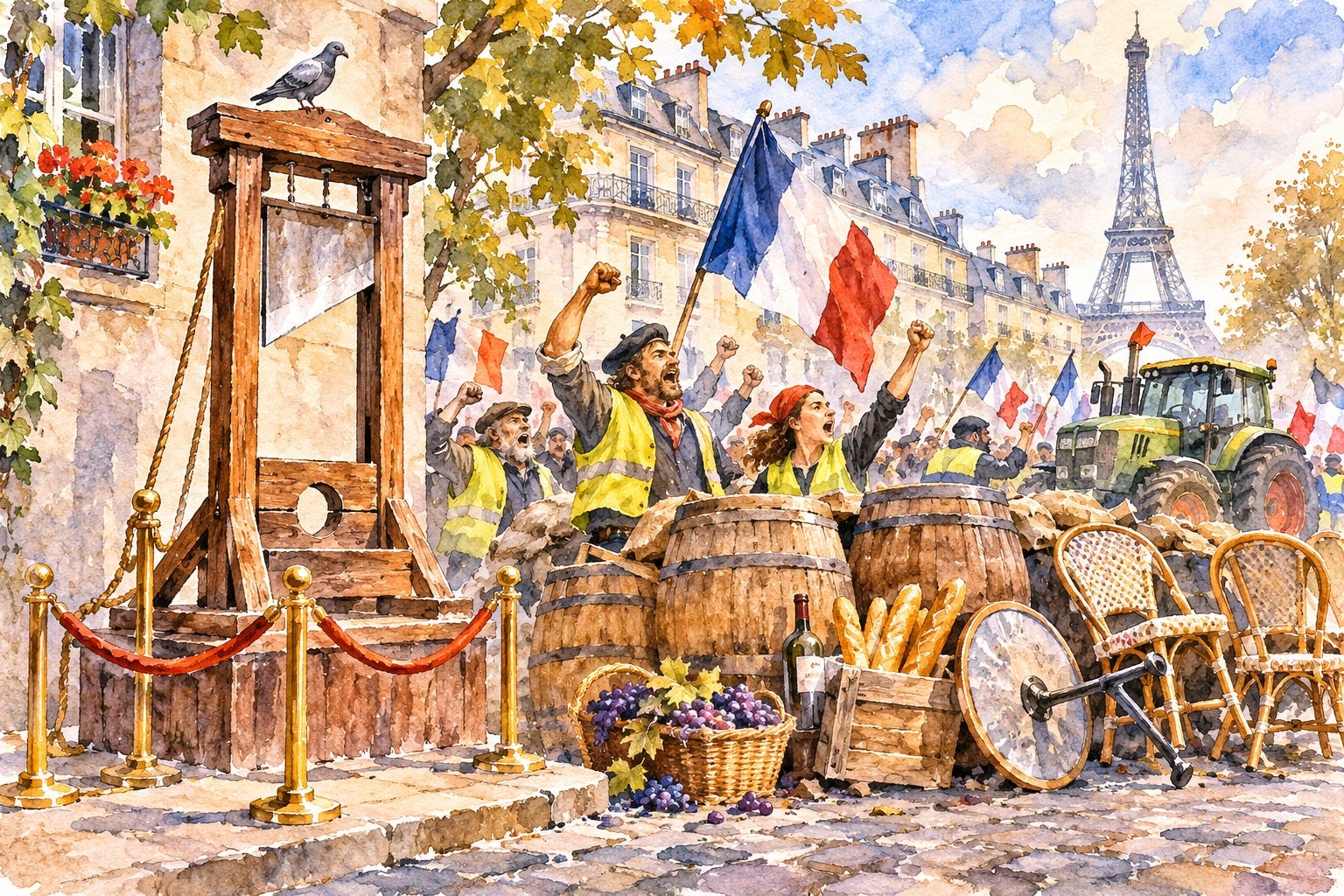
Student blockades and teacher strikes have closed or crippled about a third of France’s high schools. Unions have called a second general strike for November 17. The Eiffel Tower closed for a day.
University students have joined in to bitch that the government isn’t spending enough on their schools. How are they supposed to learn Marxism in schools short of teachers? How are they supposed to be the future leaders of the nation?
The money has to come from somewhere, and the political reflex is to go find a billionaire. Bernard Arnault, chairman and CEO of LVMH, the luxury-goods group that owns Louis Vuitton, is the obvious candidate. Just take his wealth and spend it. That’s the plan.
Marxist students who deserve precisely nothing whatsoever are whining. And here and there burning and looting. Mobs can start behaving like chimpanzees. When individuality is lost to the mob, morality is lost too.
Nothing is new here.
France has been revolting since 1789.
1789: The Bastille. On July 14 a Paris mob stormed the fortress looking for gunpowder. Bread was expensive, the king was broke, and a too-powerful government had run out of other people’s money. King Louis XVI lost his head in January 1793.
1793–94: The Terror. Maximilien Robespierre, a provincial lawyer leading a too-powerful new government, sent about 17,000 people to the guillotine. In July 1794 the guillotine ended him too.
1790–96: The assignats. The revolution (now the government) financed itself with paper money backed by church land seized by a too-powerful government. By 1796 the paper was worth close to nothing, of course.
1795: Vendémiaire. Royalists who wanted to take control of the powerful government marched on the Convention. A twenty-six-year-old artillery officer named Napoleon Bonaparte met them with grapeshot. Four years later he ran the country.
1830: The July Revolution. King Charles X, leading a too-powerful government, censored the press and dissolved the legislature by decree. Three days of barricades later, he left. Louis-Philippe took the throne and called himself the Citizen King. It’s good to be the king.
1831 and 1834: The Lyon silk weavers rose twice over pay. The army won both times. Government is powerful.
1832: The June Rebellion. This is Les Misérables. The funeral procession of General Lamarque turned into barricades across Paris on June 5. The army cleared them in about two days. Victor Hugo, thirty years old, lived through it. The rebels lost to the power of government.
1848: February and June. Louis-Philippe was overthrown and General Cavaignac put down a workers’ uprising with artillery. Thousands died. In December the voters elected the old emperor’s nephew, Louis-Napoléon Bonaparte, who made himself emperor four years later.
1871: The Paris Commune. After Napoleon III’s capture and a Prussian siege, Paris governed itself for two months. Adolphe Thiers, head of a too-powerful government at Versailles, sent in the army. Bloody Week left thousands dead.
1907: The winegrowers’ revolt. Adulterated wine, including wine made of sugar water and grape skins, flooded the Languedoc market, prices collapsed, and honest growers went broke. Crowds estimated at half a million marched through Montpellier. Government made a law against wine fraud. Government likes to reserve legalized fraud for itself.
1936: The Popular Front. About two million workers occupied factories to get a government-enforced forty-hour week and two weeks of paid vacation. A too-powerful government forced the factories to abide.
May 1968. It began with student protests over university rules, including whether men could visit women’s dormitories. Soon, ten million workers were on strike. The protesters came away with a bunch of slogans and a 35 percent jump in the minimum wage, enforced by a too-powerful government.
1995: The Juppé strikes. Prime Minister Alain Juppé proposed changes to pensions and Social Security provided by a too-powerful government. Three weeks of strikes later, transport had stopped and Juppé backed down on the railway pensions so people would still get their government-forced pension.
2005–06: Clichy-sous-Bois and the first-job contract. Two teenagers died in a power substation while fleeing police in October 2005. Three weeks of riots followed and roughly 9,000 vehicles burned. Prime Minister Dominique de Villepin proposed a contract letting employers fire anyone under twenty-six without cause—you know, something that sounds like voluntary commerce. But students shut the universities until he withdrew it. Too bad the universities didn’t stay closed.
2010: Sarkozy’s retirement age. President Nicolas Sarkozy raised the minimum retirement age from 60 to 62. Strikers blockaded the refineries and filling stations ran dry. The law passed anyway.
2018–19: The gilets jaunes. It started November 17, 2018, over a fuel-tax increase under a too-powerful government led by President Emmanuel Macron. Protesters ransacked the Arc de Triomphe on December 1, and Macron cancelled the tax. They kept marching on Saturdays for months. The too-powerful government of France requires a yellow vest in every car. Good uniform.
2023: Retirement at 64. Macron raised the retirement age from 62 to 64 and pushed it through Parliament without a vote. Garbage piled up in Paris for weeks as people wanted the too-powerful government to keep giving them their free stuff. Doesn’t matter where the stuff comes from.
2024: The farmers. Tractors blocked highways around Paris in January and manure appeared outside government buildings. They were pissed off about the too-powerful government increasing taxes on their diesel fuel and creating outrageous amounts of paperwork. Concessions arrived within weeks. Maybe a win?
2026: The students, the unions and the vests again. Guess it had been too long for France. This one began in September over staff shortages at a high school southeast of Paris and spread into a nationwide student movement, augmented by various other sorts who, whether pissed off or not, decided to join in the fun of looting businesses and burning cars. On November 5 there were fires and clashes with police in Paris and violence in Lyon, Nantes and other cities. That same day, hundreds of thousands struck and marched for higher wages, complaining about the cost of living, and about a third of high schools could not operate normally. Gilets jaunes are back on weekends.
The second general strike, set for November 17, falls on the eighth anniversary of the gilets jaunes. Plan for fun! The lousy government school system, run by a too-powerful government, has not provided the education necessary for these people to understand why the cost of living has gone up so much. So they protest to get more of the same poison that has been making them sick.
The diagnosis
There is a pattern here: too-powerful government. It doesn’t explain every episode in which the French were revolting. But it explains most of them.
It’s what makes the current protests—Marxist-led no doubt—all the more revolting. Because they are protesting that the too-powerful government—the one they are complaining is doing such a lousy job managing the schools—needs to be more powerful. Their predecessors in 1936, 1995 and 2023 made the same silly demand.
There are plenty of problems the protesters could justly bitch about. Government spending runs about 57 percent of the entire nation’s GDP. That’s insane. But the protesters want more spending, not less. They want more currency taken from private citizens to flow through the government to pay for their schools and their wages and their academic indoctrination. It’s an extreme entitlement mentality. If the French government complies, it will be stupidity—an unwitting tendency to self-destruction, both on the part of the protesters and on the part of the government.
The thing we must remember is that Marxism’s default method to accomplish its goals is through force. Marx called force the midwife of the new society. Coercion is hardwired into a Marxist’s brain. It is ethical because it is necessary, in their minds. For them, the ends justify the means no matter how stupid the ends nor how immoral the means. And that’s why Marxism too often leads to profound violent oppression of anyone who revolts against it. Stalin, Mao, Pol Pot. They weren’t aberrations. They were examples of what happens when the state gets enough power to impose a lousy ideology by force.
The revolting protesters want their candidate to run the too-powerful government. That’s what this is about. And if it happens, the too-powerful government will violently oppress the next round of protesters.
These protests are nothing special. But they are revolting.
Nothing to see here. Move along.
Sincerely,
John Hunt, MD
Editor, Doug Casey’s Crisis Investing