

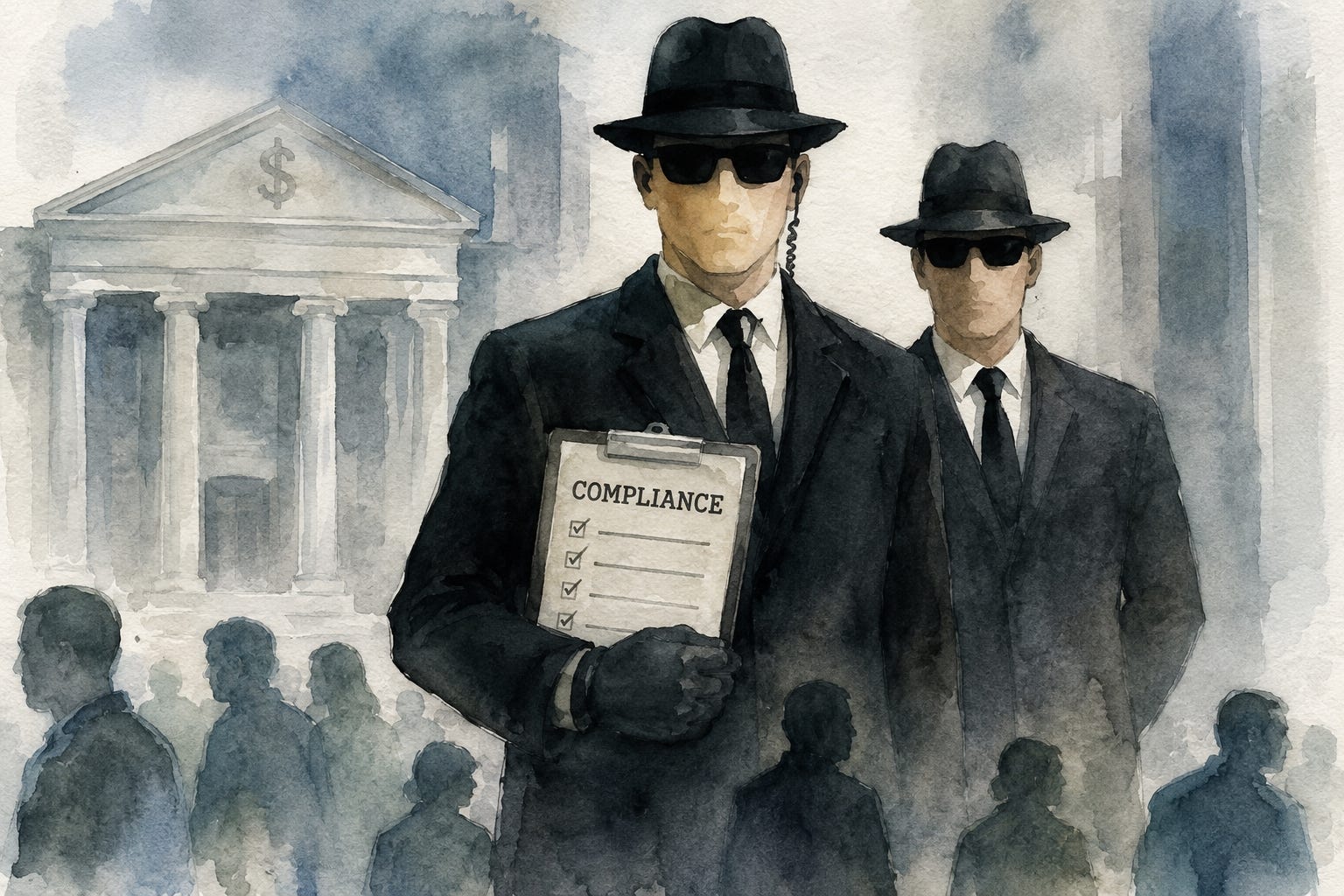
Every bank, brokerage, hospital, and insurance company employs a department of people that sell nothing, earn nothing, provide nothing, and take their orders from someone other than their employer. Shareholders and owners fund them. They work to expand the intrusion of the Washington (or Ottawa or Brussels) bureaucrats into private enterprise.
With a tad of paraphrasing, Agent Zed from Men in Black describes them well:
They are above the System.
Over it. Beyond it.
They’re “them”. They’re “they”.
They are the Compliance Men in Black.
Compliance. The Compliance Department. The Chief Compliance Officer.
That’s “them.”
Deputized
The Bank Secrecy Act (BSA) of 1970 imposed reporting and recordkeeping requirements on banks, including cash transactions over $10,000. The USA PATRIOT Act of 2001 expanded the anti-money-laundering (AML) regime and required financial institutions to designate a Compliance Officer. Broker-dealers report to the Financial Industry Regulatory Authority (FINRA), a private corporation wielding public power. Insurers answer to fifty state commissioners.
Government writes the rule. The regulated firm pays for the enforcement. Surveillance of customers, retention of their records, and reporting of suspicion about them are performed by private employees, at private expense, without a warrant.
A Federal Bureau of Investigation (FBI) agent needs legal process to read your account history. The Compliance Officer at the company you work for or bank with? He just does it.
Incentivized
Consider the incentives facing that Compliance Officer.
File a Suspicious Activity Report (SAR) on an innocent customer and nothing bad happens to the Compliance Officer. The customer never finds out: federal law prohibits the institution from even telling him it was filed.
But fail to file on a customer who later turns out to be dirty? Under the BSA, “willful” violations expose the officer, personally, to civil penalties of up to $69,733 per day.
Thomson Reuters found that every institution sanctioned over SARs was sanctioned for filing late or not filing.
Nobody has been sanctioned for filing too many reports on innocent people.
So these compliance people follow the incentives and file lots of reports to the government. On you.
In fiscal 2024, American financial institutions submitted 4.7 million SARs, 12,870 a day, alongside 20.5 million currency transaction reports. Even more were filed in 2025. That’s a heck of a lot of suspicion.
A culture of obedience to a cockroach with a massive inferiority complex
It gets far worse, because of the culture of compliance. The risk aversion is palpable.
In my experience, the Compliance Officer is not just helping the company obey the law. He is calibrating his efforts to whoever the examiner might be. Most regulators are just common bureaucrats with chips on their shoulders and some years left before pension. But the Compliance Officer gears his efforts to assuage the worst whims of an imaginary, future, unknowable, horrific, psychologically bent, worst-possible regulator boogey-man who is armed with a reverberating carbonizer with mutate capacity.
The Compliance guy spreads fear about the regulators and their imagined powers, exaggerated far beyond the law or reality. He speaks into the CEO’s ear while the risk-averse General Counsel nods his bobblehead in concurrence. And so the avoidance of imaginary worst-possible-risk becomes internal policy far stricter than the statute.
Firms end up governed by rules Congress never passed and no agency ever published.
Broad recognition that compliance outruns law crystallized on August 7, 2025, when the White House acknowledged that banks had been closing the accounts of lawful businesses, gun dealers, crypto firms, churches, on no statutory authority at all. It took a presidential order to stop conduct that no law had ever required. Reputation risk was never a statute. It was a phrase in a manual—a regulatory guidance—that private compliance departments mutated into their corporate policy.
Government doesn’t need to control every decision in a regulated business. It only needs to make the business terrified enough to control itself, beyond the bureaucrats’ wildest dreams.
This stuff costs a lot
LexisNexis Risk Solutions and Forrester put just financial crime compliance in the United States and Canada at $61 billion a year, with 99% of surveyed institutions reporting rising compliance costs.
The St. Louis Fed found that smaller community banks bore disproportionately high compliance costs. Small banks end up selling themselves to big banks.
Compliance Officers infest every company under regulatory oversight, and even doctors’ offices. Doctors sell out their private practices to hospitals to avoid paying yet another compliance enforcer man.
And it is far more than just money. I was a C-level exec in several medical ventures. Addressing fears of regulatory intrusion—as presented by Compliance—consumed about 40% of C-level effort. And that trickled down to lots of lower-level staff. Instead of serving the needs of our customers, we were serving the whims of a regulator as imagined in the nightmares of our own compliance staff.
What a waste.
Does any of it work?
Ronald Pol’s 2020 study suggests that AML enforcement touches less than 0.1% of criminal finances, and that compliance costs exceed recovered criminal funds by more than a hundred times over. The United Nations Office on Drugs and Crime estimated that roughly 0.2% of laundered proceeds get seized.
All that compliance work, all that invasion of privacy, for pretty much nothing.
From the other side, if you can trust them: the Financial Crimes Enforcement Network’s fiscal 2024 review reports that 32% of active FBI complex financial crime investigations and 40% of its organized crime drug investigations were “linked” to SARs or currency transaction reports. Internal Revenue Service Criminal Investigation says 87% of its prosecution referrals had a related filing. A related filing…. Hmmmm.
The government’s data show that SARs can be useful leads. What they do not show is that those millions of reports reduce crime enough to justify the cost.
How it impacts investors
First, on the equity side, regulatory cost is a driver of consolidation. It rewards scale and punishes the small. Small entities in regulated sectors get gobbled up by the big guys.
Second, regulation doesn’t produce safer markets; it produces markets dominated by institutions that can afford armies of compliance personnel. Think Big Pharma, Big Medicine, Big Agriculture, Wall Street banks. And they’ll be too big to fail. Big Anything loves Big Regulation and Big Compliance.
Third, assume every regulated intermediary holding your assets is also reporting on you, at your expense, under standards you can’t determine exist. So hold some portion of your wealth in forms that require no intermediary. Metal you can touch. Property with a deed. Maybe a business too small to interest a government.
Whatever company you work for or own a share in is paying the Compliance Officer who works not just for the government, but for imagined versions of the worst regulators of every government entity.
If you think any organization is smart enough to avoid the self-inflicted compliance trap, remember that organizations are collections of people.
Then remember what Agent K said:
“A person is smart. People are dumb, panicky, dangerous animals, and you know it.”
Sincerely,
John Hunt, MD
Editor, Doug Casey’s Crisis Investing
"The government’s data show that SARs can be useful leads. What they do not show is that those millions of reports reduce crime enough to justify the cost." Exactly so. Suspicious Activity Reports by paranoid compliance officers are a hazard to say nothing of so many related costs which you quite acurately describe. "How to improve this shared world without basically dropping out?" is an ongoing and significant question.
Well framed, John. This type of role attracts the worst personalities. Just picture a medium to small town Code Enforcement Officer with a whiney, nasal voice and a pencil neck. An extreme passive aggressive to boot, and is angry because no one invites him to any dinner parties. Or anything for that matter. (I hope the Compliance guy at substack does not read this!!)