

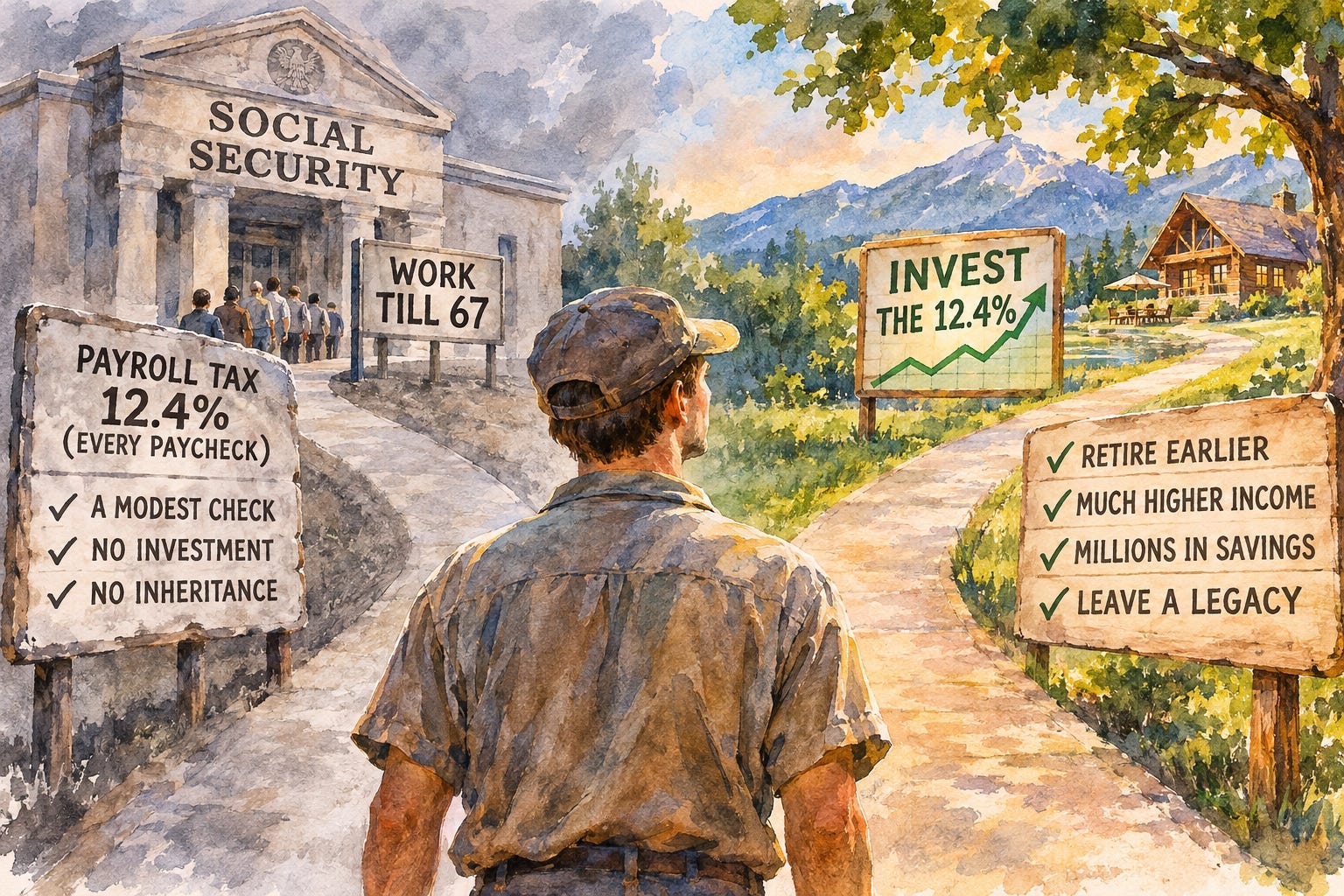
Yesterday we talked with Murray Sabrin on our weekly call with our gang of men from all over the world. Murray mentioned his calculations of Social Security returns. I have done those sorts of calculations myself over the years on many occasions. Given the rise of democratic socialism and the impending insolvency of Social Security, it is time to do the calculations again.
Today’s Scenario
A hypothetical low-skilled laborer starts work at age 20 earning only $7.25 an hour (federal minimum wage). Let’s say that every year his pay rises with the CPI and not a penny more. This is the very bottom of the working class. And always at the bottom.
If he retires at age 67, Social Security will start sending him $4,537 inflated dollars a month.
But if Social Security hadn’t taken 12.4% of every paycheck, he could have retired at age 49 and received at least the same income and be a whole lot richer. Or he could have retired at 67 and receive far higher income.
But Social Security stole his wealth and potential wealth from him. And from his progeny.
Let’s do the math.
The Setup for the Calculations
We’ll use nominal dollars here throughout.
Take the federal minimum wage, $7.25, for 2,080 hours a year: $15,080 a year. His raises match CPI, which has averaged about 3% a year over the past century, so by 67 he earns $28.24 an hour, or $58,737 a year. The total Social Security tax is 12.4%, and the employer’s half is money that would otherwise sit in his wage. He pays into Social Security $1,870 the first year and $7,283 the last year, about $187,700 in all.
For stock market returns I use the nominal return of large U.S. companies with dividends reinvested: it averaged 11.8% a year over the last 50 years. I show a lower case of 8% beside it because it could happen, although absent Social Security’s negative effect on the economy, stock market returns would likely be higher, not lower.
What Social Security Will Pay Him
At retirement, the Social Security Administration indexes his best 35 years of earnings to national wages and averages them. His check at age 67 will be $4,537 a month, or $54,449 a year, and it rises with CPI after that. If he starts his retirement earlier, at 62, the check shrinks 30%, to $32,878 a year.
Live to 85 and he collects a total of about $1.27 million from Social Security during his life (again, inflated dollars), against the $187,700 he paid in (in less inflated dollars). Seems like a good deal for the guy, right? Everyone should be grateful for Social Security, right?
Hell no.
What He Could Have Built Instead
Let’s imagine a happy dream in which the paternalistic government didn’t have the socialist program called Social Security, and didn’t force us all to pay into it for our entire working lives. Take the same 12.4% of each paycheck that Social Security steals, and let the minimum wage worker stick it into a stock index retirement fund every year and leave it alone.
Here’s the comparison:
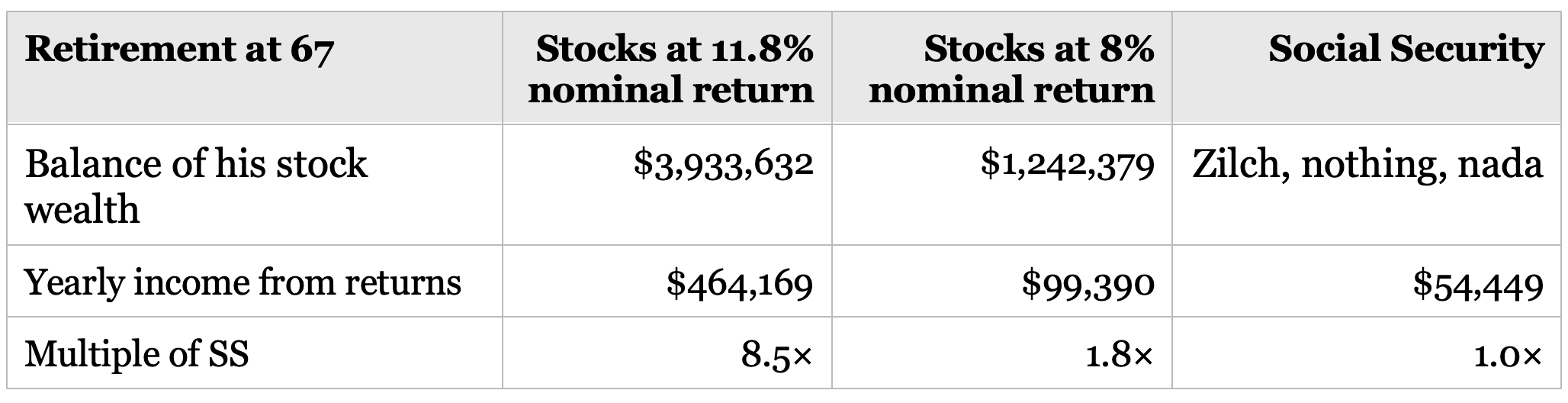
“Yearly income” is the return alone, never touching the principal. At his death at age 85 the account still holds $3,933,632 that he can leave to his family, and it would have paid him $464,169 a year in the meantime, and growing (compared to the Social Security check, which starts at $54,449 a year and reaches $92,697 a year by 85). If, instead, there is only an 8% return on the stock market during his working life, he’ll still be a millionaire ($1,242,379) and still be paid almost twice what Social Security would send to him each month.
Or He Could Retire Early
$54,449 a year is what Social Security will pay him if he retires at 67. But if he didn’t have Social Security draining his paycheck for all his working career, then, at an 11.8% stock market return, his stock account alone would be paying him $57,776 a year ($4,815 a month) already, at age 49. That is more than the $4,537 a month Social Security pays at 67, and he gets it 18 years earlier and in stronger dollars. Indeed he would retire before 50 and more than replace the income he made each month laboring. Plus he would have about $489,625 in his stock account that he never touches.
If the market generates only an 8% return, it takes until 60 before his account pays him at least what Social Security would send at 67, but (absent Social Security) he already would have $690,467 to his name. Remember, this is for the lowest-paid laborer.
What He Leaves for His Family
Social Security’s death benefit is $255. Congress set that number in 1954 and has not touched it since.
If he wasn’t burdened with Social Security taking the fruits of his labor, the investor’s children can inherit his full stock account upon his death. Before he dies, he can live on the returns alone with far, far higher income, and his family inherits the full $3,933,632 whenever he dies, or $1,242,379 if the stock market does poorly.
If instead of living ridiculously high off the hog, he waits and retires at 67, and lives off 4% annually from his growing holdings (a common rule of thumb) instead of all the income, then he will still have nearly three times the income he earned when he was laboring, his stock account will keep growing and will reach, get this, $15 million at age 85 at the average market return (or $2.38 million at an 8% market return). That 4% income starts at $157,345 a year and grows to $561,938 a year by age 85.
And $15 million is a whole lot of money to leave to his family. For a minimum wage laborer who never climbs any financial ladder.
At an 8% stock market return and drawing only 4% a year, half the return, his retirement can start at 67 at $49,695 a year, a little under the $54,449 annual Social Security check that begins the same year, and grows to $95,241 a year by 85, a little over the $92,697 annual check that year. If he dies at 85, he leaves $2.4 million to his family.
With Social Security, he will get a paltry income and, at most, only $255 to leave to his family. Boy does that stink.
Four Caveats
First, I assumed wages across the economy rise only with CPI. If they rise faster, his Social Security check shrinks against the formula and the gap widens even more.
Second, Medicare stays separate here. An early retiree has to buy his own coverage until 65.
Third, the market does not deliver 11.8% eacy year precisely. The S&P 500 lost about 18% in 2022, and the last 50 years include the long boom of the 1980s and 1990s. That is why the table shows 8% as well. A man who retires in a bad decade needs a cash reserve, and 47 years of contributions give him time to build one.
Fourth, let’s keep in mind that all the money that Social Security steals from our pay currently gets blown down the hole of wasteful government spending, though supposedly it goes toward payments to earlier contributors to the Ponzi scheme that is Social Security. In the happy world without Social Security, that money would be invested in growing the economy, supplying funds for new endeavors, creating new wealth for all. In other words, the stock market would be growing far faster than it has. And that would make the low-paid minimum wage earner all the more wealthy absent Social Security, even compared to these calculations.
Indeed, Social Security has been a profoundly destructive force on each individual worker, and on America as a whole. That’s what socialism does.
We’re stuck with it, as even so-called conservatives insist that, because they paid into Social Security, they deserve to get everything they were promised even though that means stealing from the younger workers and continuing the horrific destruction that Social Security has wrought.
Little do they know that what they were promised was a giant parasite sucking their lifeblood.
So what do we do? We try to make up for some of the damage Social Security has caused by investing wisely and growing our own capital, which also grows the nation’s supply of capital. Produce more than we consume, save the rest as capital, and invest it. And protect it as well as we can from those who inflate the currency and use government guns to steal wealth so they can spend it on their priorities.
Paid subscribers get the Crisis Investing stock recommendations and the full portfolio tracking. Sign up when you can.
John Hunt, MD
Editor, Doug Casey’s Crisis Investing