

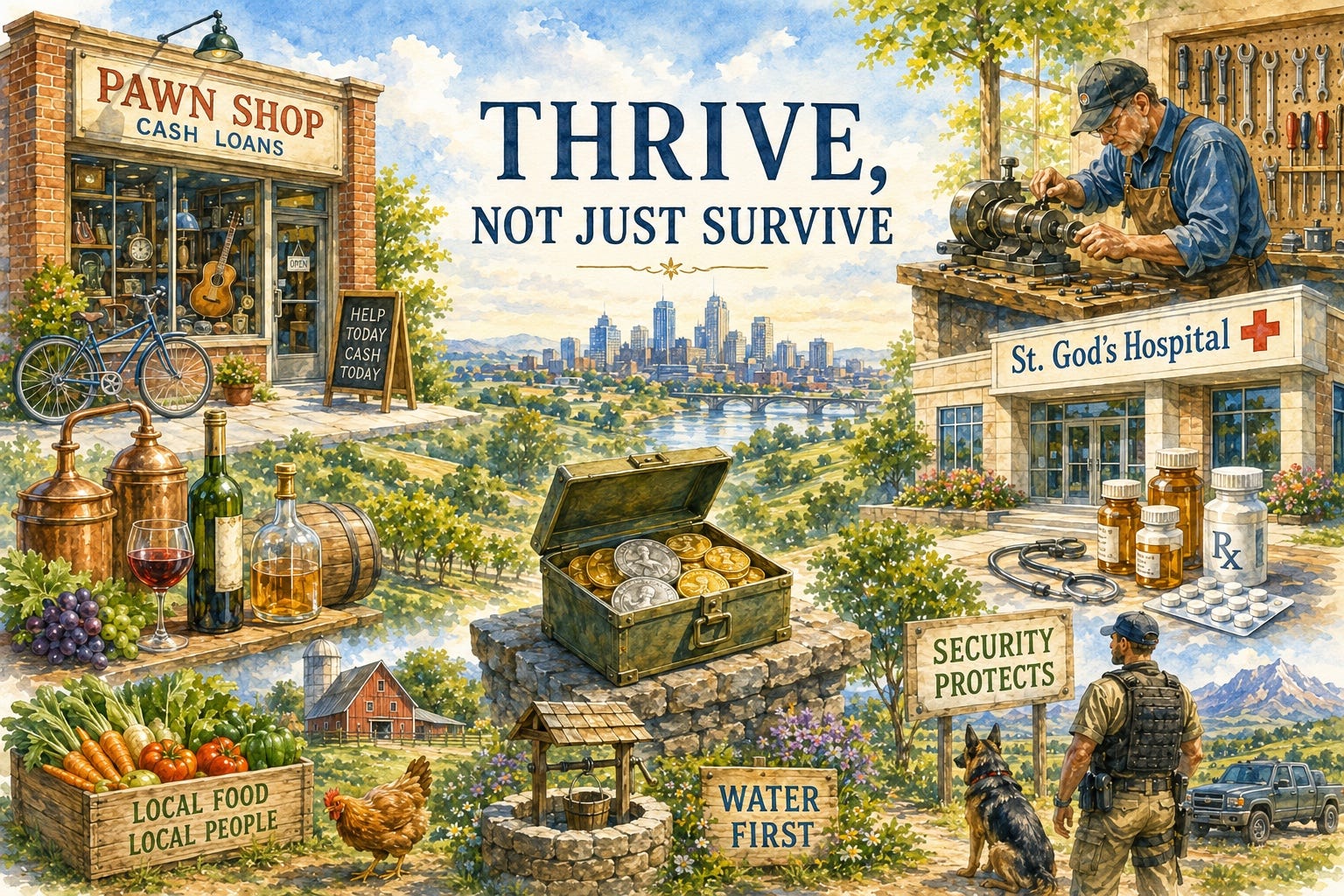
Rome fell: the blacksmith kept working. Weimar collapsed: the bartender kept pouring. Argentina defaulted eight times: the pawnbroker kept brokering.
We know we want to be the guy who sells shovels during the gold rush, sure. But when the crash comes, money is made from buying the shovels back for cheap and selling them again for the funerals.
Blood in the Streets Isn’t Here Yet
Baron Rothschild and Doug Casey—two people philosophically miles apart—still agree that the time to buy is when there’s blood in the streets.
Our metals stocks are off their highs. Sure. That’s a pullback, not a massacre. Blood in the streets means good companies trading for multiples less than their cash on hand. It means margin calls cascading through the system. It means the guy who sold at the bottom telling you he’s never touching stocks again. War on our shores.
We are not there. In the broader markets, we’re still toward the opposite end from there, and in the AI realm, despite the decline, we are likely still above a top.
But this bubble — in equities, in sovereign debt, in the assumption that central banks can print their way out of anything — doesn’t have to pop gracefully.
When an avalanche occurs, everything gets buried. Bad companies, good companies, your favorite mining stock, the boring index fund your brother swears by. All of it. The instinct is to run and hide. Sell everything into cash. After all, there is a strong desire to survive. But for those who want to thrive, that is not the moment to run to cash. That moment came before the avalanche.
The avalanche is the moment cash was made for. Not just as a bunker, but as a weapon. One point of holding dry powder through the calm years is so you have it loaded when the bloody days sooner-or-later show up — when a company you’d have paid forty dollars a share for is trading at four bucks because the market has panicked. You don’t want to be raising cash in that moment. You want to already have it, sitting there, waiting. A crisis investor can’t invest in a crisis when he is illiquid.
When Companies Die
In boom times, people who produce nothing can feast at the trough or rise with the tide or find some other metaphorical way to get by. Unfortunately, a depression or a real bout of civil unrest doesn’t just discount stocks. It can kill the companies themselves. Supply chains break. Courts stop enforcing contracts. Currencies get repriced by decree. Companies get nationalized. The equity you bought at four bucks can go to zero if the underlying business can’t operate.
So a question to ask is not only what to buy when the market bleeds. It’s what to own or what to do that generates income when the market is dying.
If you are wealthy now, and are confident you can hold onto at least some of that wealth when the avalanche hits, good for you. If that’s not you, and it rarely is, then there is a bit more work to do.
The Forever Businesses
Crisis doesn’t kill demand for necessities.
Pawn shops thrive on desperation. So do repo services, debt collectors, and bankruptcy attorneys. All of it is recession-proof, because someone always owes someone money, and someone always needs cash faster than a bank will give it. Funeral homes never see a downturn.
Of these, perhaps only a pawn shop could be a fun business to be in. The rest, not so much. Pawn is the original crisis bank, collateralized lending with no committee and no bailouts. Pawn serves an essential purpose to keep an economy moving when the suits can no longer borrow and have no clue what to do other than print and spend.
Make alcohol. Winemaking, brewing, distilling are some of the most proven recession-proof and war-resistant businesses. Alcohol sales rise in recessions. Tobacco too. People don’t quit their habits when the market or the entire economy crashes — they lean into them harder. We have a vineyard, a farm winery and stills. Borderline businesses in normal times, they can serve as part of a crisis-tolerant portfolio.
Fix broken things or own the business that does. Small engine repair, appliance repair, auto mechanics, cobblers. 12-volt electronics for cars and boats. Fix circuit boards. In a boom, people dispose of broken stuff with new stuff. In a depression or war, people want it fixed. Skilled trades are desirable. Electricians, welders, plumbers. A diploma doesn’t fix a generator. Competence does, and competence is the one asset no government can inflate away or confiscate at the border. The repairman won’t lack customers.
Grow or raise food and sell it locally. A working farm, fishing, a market garden, a flock of laying hens — these produce something people need regardless of what currency they’re pricing it in. Barter survives when banking doesn’t. Inefficient and perhaps even a luxury during boom times, local food production is critical during crises. It doesn’t happen by magic.
Doctors and allied medical providers. About as monetizable a field as there can be in most any crisis.
Generic and off-patent medicine, and the pharmacists who dispense it. Antibiotics first and foremost, but also insulin and other critical meds. Cholesterol drugs? Not so much (or not at all). But beware, because government will come in and screw with this sector in times of crisis.
Water. Wells, filtration, delivery. Water is the first thing on the hierarchy of needs. Nothing shuts a household down faster than the tap running dry, and nothing commands a premium faster in a real disruption.
Security and armed protection and their essential tools. Make a profit renting out Guido and Luigi during normal times, and then during SHTF times, pull them home to protect your family and sources of income.
Serve the people who still have money. Wealth doesn’t just evaporate in a crisis — it also concentrates. Someone still owns the land, the gold, the working business. That someone needs (or wants) contractors, land managers, private security, concierge medicine, and people who can quietly maintain or move what they own. Find who knows how to keep their wealth, and make yourself indispensable to them.
Hard Money, Hard Land
Paper promises fail in a crisis. Physical things don’t. Gold and silver aren’t investments in the usual sense — they’re insurance policies against the people running the currency into the ground. Buy them, hold them, and don’t check the price every day.
In a crisis, land that produces something — food, timber, water — outperforms land that produces only a view and a property tax bill. A working farm, an orchard, a vineyard or a woodlot: tough businesses in current times, sure, but these will supply you and your neighbors when the supply chain seizes up, and they don’t care what the Fed does with the overnight rate.
Thriving
A bunker or a bug-out bag provides opportunities for survival, not for thriving. Thriving requires understanding that the concept of value doesn’t vanish in a crisis. It become honest, and it migrates. It moves from paper to hard assets, from financial gimmicks to production, from nice to necessary. Thriving requires having the cash ready for the day the streets run red.
The people who profit aren’t the ones who panic. They’re the ones who 1) can produce value themselves, and/or 2) have the liquid resources necessary to buy the distressed assets that go up for auction and to hire the most capable people.
We all hope the good times keep rolling. But hope is not a plan. Do you trust the people running this circus? I don’t.
Our newsletters aren’t focused on prepping, but rather on preparation. We aren’t focused on surviving, but on thriving. If you think this article will prove helpful to people you care about, please forward it on and suggest they join us.
John Hunt, MD
Editor, Doug Casey’s Crisis Investing
You're right. Now, as always, is the right time to think clearly and practically, pragmatically around your own home, first, and family, friends, community. We're all in this together, or should be. At least be sure to be in this with those you love and need and can depend on.
Excellent and APPROPRIATE Read! It’s also Important. Thanks