
Socialism or Death
Cuba did not run out of socialism. Socialism ran out of Cuba.

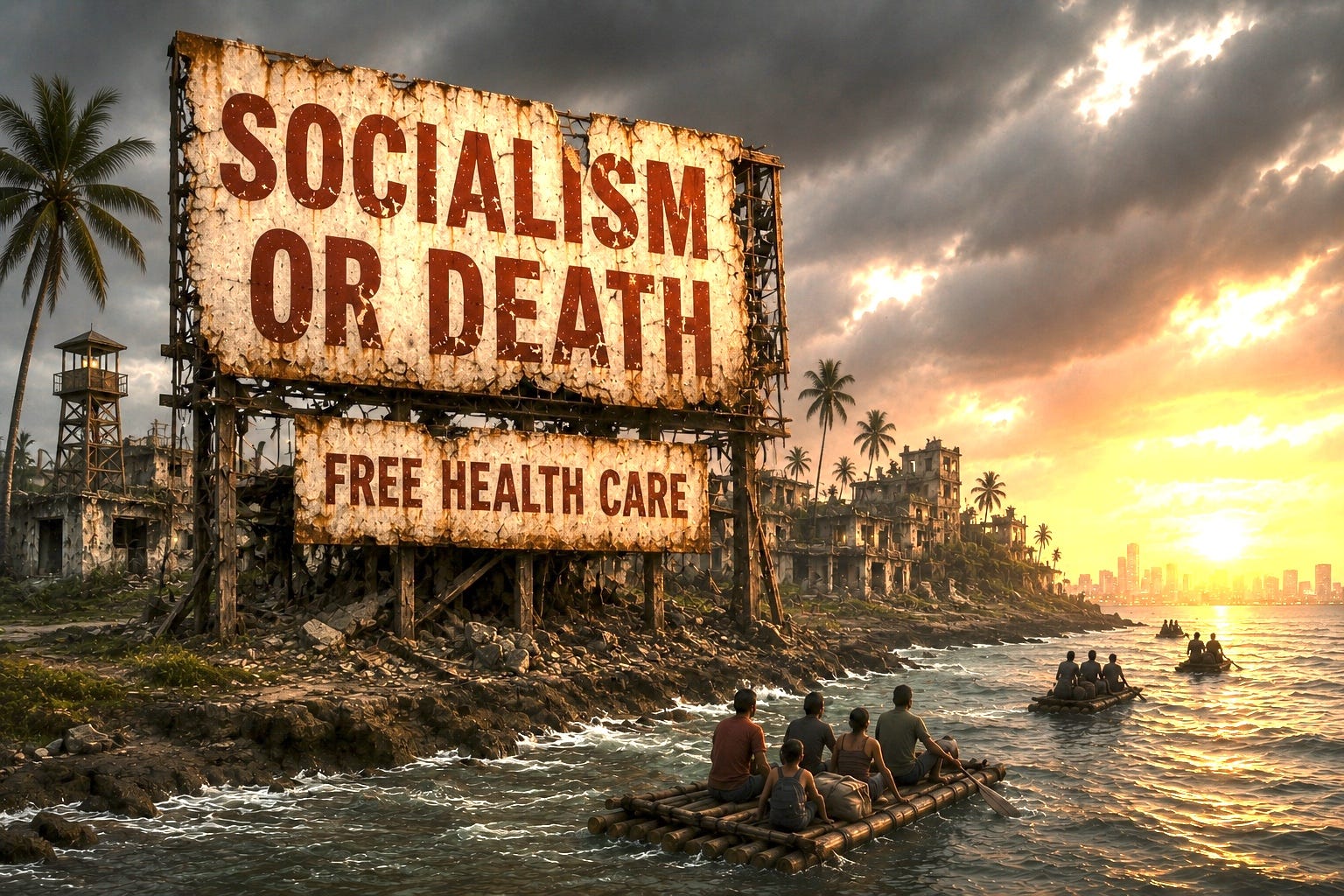
Motorcyclists come in two kinds: those who have gone down, and those who have not gone down yet. Socialist countries are the same.
Miguel Díaz-Canel just closed a Cuban legislative session that gutted socialism by shouting Fidel Castro’s old slogan: “Socialism or death!” He had just approved 176 measures to dismantle the thing he said he would die for.
This is not a Cuba story. Cuba only volunteered to play the corpse. It’s a story about socialism, and it always ends the same way: promises, then blackouts, then the secret police, then the rafts.
And death.
WHAT HAVANA JUST ADMITTED
Prime Minister Manuel Marrero unveiled the largest rollback of state control since 1959. Foreign investors no longer need a state partner. Private firms become legal. Cubans may run more than one business and sell things at prices they choose. Havana spent sixty years calling the exiles in Miami traitors. This week it asked them to wire money home and called them investors.
The Communist Party of Cuba has concluded that the cure for socialism is capitalism. Let Díaz-Canel say it in his own words: the island’s troubles, he admitted, come not from the blockade but from the slowness, the paperwork, the rules that punish any Cuban who tries to produce something. He named the disease and called it a symptom.
WHY SOCIALISM ALWAYS FAILS
Forward this part to the nephew in the Che shirt and the daughter who came home from college fluent in Marx.
A price is an essential piece of information and it’s important that it be accurate. The price of bread tells a farmer three hundred miles away to plant more wheat, or less. Millions of these messages cross the economy every second, telling every stranger what to make, how much, and for whom. No one designs this. No central planner runs it. It runs on the willingness of strangers to trade.
Socialism’s founding act is to switch the information off and to make the prices inaccurate. It begins with the smarmiest words in politics. Free healthcare. Free tuition. Free housing. Free everything. A price of zero sets demand to infinity while encouraging zero supply. The shelves empty. So the planner, with the police behind him, orders quotas, then subsidies, then, when neither conjures the missing goods, compulsion. Every road that starts at “free” ends at a man with a clipboard telling another man to work until he bleeds. Men used to call that slavery. Socialism calls it solidarity.
Once the prices are gone the planner is blind. He must decide how much bread to bake for a city he cannot see, how many cardiac surgeons to train, how many pencils to make, for millions he will never meet. He has a job no man can do and the narcissism to think he can do it anyway. Ludwig von Mises explained why in 1920, before the first Five-Year Plan starved its first village. Cuba just ran the experiment again and got the same answer.
But maybe it will work in California or New York.
THE LESSON IGNORED
New York just made Zohran Mamdani its mayor, a smarmy self-described socialist. His program: freeze the rents, free the buses, open government grocery stores where the politicians decide what reaches the shelf. The universities taught a generation to call this compassion. It is not compassion. Havana spent sixty years proving that it is the road to serfdom.
The West is sliding toward collectivism, the socialist face and the fascist one, two masks on the same head. And so crises will come. The fiat currencies that prop them up will fail, as they always have.
The Cuban peso, the Venezuelan bolívar, and the Soviet ruble each took a turn dying. The dollar will follow them down. Count on it. Gold kept score the whole way, as each currency unit bought less of it on the road to the dustbin. Gold needs no permission, no five-year plan, and it does not care which slogan the man at the podium is shouting.
As for the Marxist at your dinner table, do not argue with him. Socialism or Death. Denial this deep does not yield to debate, any more than an alcoholic is reasoned out of the next drink. It takes years to undo the brainwashing and destructive psychological defenses.
So get him to sign up for Crisis Investing. He already thinks everything is a crisis, so the name might catch his eye. Read enough of these, and he may even learn. Truth outlasts the lie.
And while he learns, Cuba may open. My bet is the Cubans will thrive. The embargo ends, the laws fall, and the expats go back to reclaim the property the regime stole, carrying with them the money they earned in America by working and investing. Cuba could be awesome again.
New York City and California? Let’s hope they don’t wait sixty years before reversing course.
Sincerely,
John Hunt, MD
Cuba ran out of other people's money.
It's a drug, and they will go through withdrawal.
You are correct to note that Cuba's latest reforms amount to an implicit admission that extensive central planning has failed. However, the deeper lesson is that modern civilization rests on institutions that were never consciously designed.
The economic and social order of the West emerged through a long process of cultural evolution. Property, contract, commerce, freedom under law, and the moral restraints that make peaceful cooperation possible were not invented by planners. They arose spontaneously through the selection of practices that enabled some societies to prosper and grow. As Friedrich Hayek argued, this "extended order" exceeds the understanding of any individual mind.
This helps explain socialism's appeal to intellectuals. Intelligent people naturally place great faith in reason and design, leading them to believe that society can be rationally reconstructed. Yet much of the knowledge sustaining civilization is embedded in traditions and evolved practices whose functions are imperfectly understood.
Furthermore, I disagree that the West is only now "sliding toward collectivism." That trend has been underway since the nineteenth century, driven by the growing influence of rationalist and socialist ideas among educated elites. Nor is the current reaction best described as fascism. Much of it is better understood as tribalism for being a response to the social tensions and cultural fragmentation associated with mass immigration and multiculturalism, who underestimated the importance of shared cultural traditions, collective identity and, saliently, genetic heritage.
Thus, that hope that Cuba will now be transformed into a bastion of freedom and free market capitalism by riding the wave of capital and enterpreneurship of the returning Cuban exiles is undoubtedly a pipe dream. The only way Cuba turns intself into a developed and wealthy country is if it manages to attract folk of European stock or, alternatively, Eastern Asians, who are the only ones capable and compatible with First World status. Just look at the Emirates, Qatar or even Saudi Arabia to find out how they did it.