

In 1941, Hitler rolled into Russia with 3400 tanks and 625,000 horses. You don’t see the horses in the movies. Those horses fared poorly.
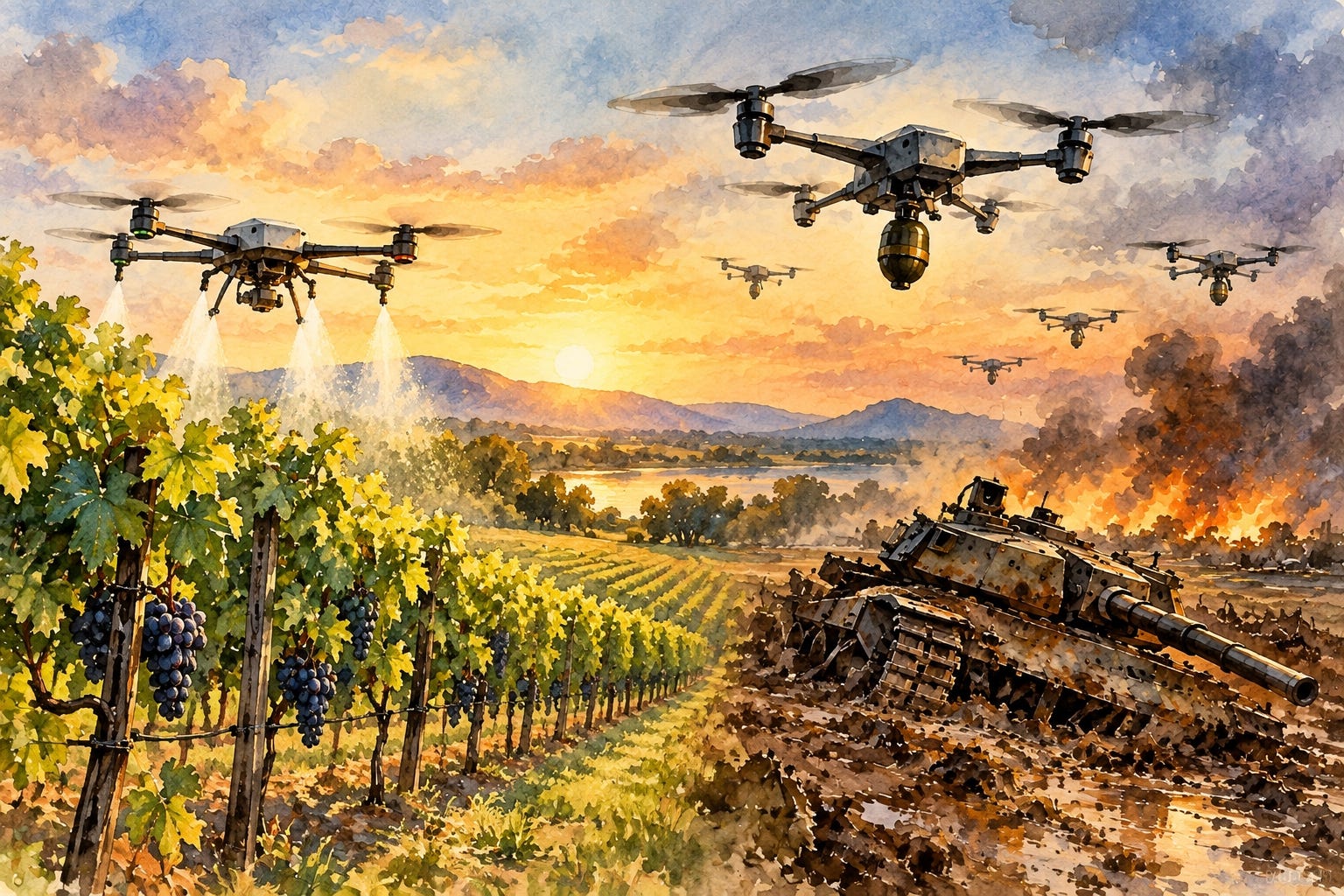
In February 2022, Russia rolled toward Kyiv with 1,700 tanks. Those tanks fared poorly. A large share of them now sit in scrapyards and muddy fields. Quadcopters that retail for a few hundred dollars, with a grenade taped to the bottom, took out battle tanks that cost four million dollars each.
Government creatures move slowly to recognize and act on that well-displayed reality. But the Ukraine war has taught military procurement officers throughout the world that cheap flying robots beat expensive armored steel and that drone watercraft can both defend and threaten large ships. And, albeit slowly, these government officials will move.
We detest war. We detest the governments that finance it by debasing the money their citizens are forced to use. Richard Nixon closed the gold window on August 15, 1971, in the midst of the Vietnam War and the Great Society era, effectively ending dollar convertibility into gold and removing an important constraint on U.S. monetary policy. Every dollar printed since has been a continuation of that decision.
Currency debasement and war have always traveled together — the Kaiser’s government financed World War One on printed marks instead of taxes, and the Weimar Republic finished the job a decade later; the Roman denarius lost its silver in step with the empire’s border wars.
When the money goes bad, the state’s remaining tool for holding power is force, and force needs hardware. Currencies built on nothing eventually fail, the failure gets blamed on an enemy, and the enemy gets fought. With the dollar being the global reserve currency, the US government spends like a drunken sailor and, in compliance with the military-industrial complex, buys big stuff like aircraft carriers. But countries with fiscal sense realize that the new technology is small, smart, cheap, and unmanned.
Drones.
And after drones, the robot revolution is assuredly coming, and it will change the world, including the US military-industrial complex. Robots will do the work we don’t want to do. They will also do the work we want to do, if they are cheaper and better at doing so. And we humans will need to find different work that we want to do.
My concern is that the robots and AI will end up doing all the productive work, while we humans are relegated to filling out regulatory paperwork to appease government bureaucrats, and spending the rest of our day dealing with the personality disorders of other humans. But I also see the huge upsides. Soon, we will have robots doing the work we humans don’t want to do: work that is dull, dangerous, dehumanizing.
We’ve been inundated for our lifetimes with sci fi books and movies about how humans and robots might interact. We now will be watching it happen in real time, in our lives. What an interesting and exciting time to be alive.
But while we wait for the boon to come, of robots mated with AI enormously expanding productivity and creating wealth sufficient for the parasitic class to feast off of while incentivizing the productive class to create new wonders, while we wait for this, we will have wars.
Because wars are what politicians produce. And we have allowed our politicians to have far too much power, and the democratic socialists want to give the politicians even more power. That won’t end well.
The Aircraft Carrier Is a Big, Expensive Target
A Gerald R. Ford-class carrier costs $13 billion to build and $700 million a year to operate, and it exists to project airpower a few hundred miles past a coastline. In the Red Sea, Houthi fighters armed with Iranian-designed drones and anti-ship missiles costing a few thousand dollars each forced the U.S. Navy to burn through multi-million dollar interceptor missiles. In 2020, Azerbaijan’s Bayraktar TB2 drones shredded Armenia’s Soviet-legacy armor in Nagorno-Karabakh in six weeks with hardly a manned aircraft involved. Ukraine now sinks Russian Black Sea Fleet vessels with unmanned surface boats that cost less than a house.
To match this, the carrier’s air wing increasingly needs to be a swarm instead of a squadron, and the money is following that logic.
It seems to me that the winners of the next decade of defense spending will include the companies that build the sensors, lasers, and airframes — the picks and shovels of the drone wars, and soon thereafter, the picks and shovels of the robot wars.
Today we are introducing six companies in this space. Each is substantially overvalued by any Graham & Dodd analysis. Most of them get graded as a C on a modified version of the 10 Ps analysis. The PE ratios mostly suck. Their prices are all on downward trends, and in some cases cliffs. Each is likely to go even further down in a tech market correction or when the AI bubble pops, or heck, just on momentum.
So why on earth would I be recommending such stocks as these?
First, because the share prices have nosedived. And I’m a natural contrarian. With most of these companies, I missed their big boom last year, and so I also didn’t participate in their big decline this year. But the prices, although still outrageous as most tech stocks are, are at least approachable now.
Second, because these companies are all seeing big revenue increases.
Third, because they all have solid options chains, and on a weekly basis we can hop from one to another generating premiums going up and going down.
Fourth, because every one of these six companies also sells a version of the same technology into a peaceful market: rail networks, farms, mines, warehouses, factory floors. And we may get lucky and have peace.
Fifth, because these companies employ the people who know what they are doing when it comes to supplying the parts, sensors, systems, and technology for drones and robots. And they have IP (a subject for another day). And they have deals with others and are visible to the Department of War.
And one thing I know for sure (or as sure as I can be) is that robots and drones are the future. Indeed, the robot revolution has two potential meanings. The scary one is a description for when the robots decide to not be regulated by the government regulators (with which I can empathize). Or when they decide to kill us. That’s a topic for another day. The other meaning is only a bit less scary for some and exciting for others, and is a meaning in line with the term industrial revolution—indicating a profound change in the way economies and societies operate.
These companies are going to be a part of that profound change, and change happens very fast these days.
And this is going to be fun, even though the stocks I’ll be presenting might raise eyebrows.
That is the apparent contradiction in this letter: I think the stocks are expensive, risky, and capable of falling much further—and I also think the underlying industry will become enormous.
If you are a free subscriber, consider upgrading so you can see how crazy I am. And maybe why I am not so crazy after all.
If you are a premium subscriber, read on.