

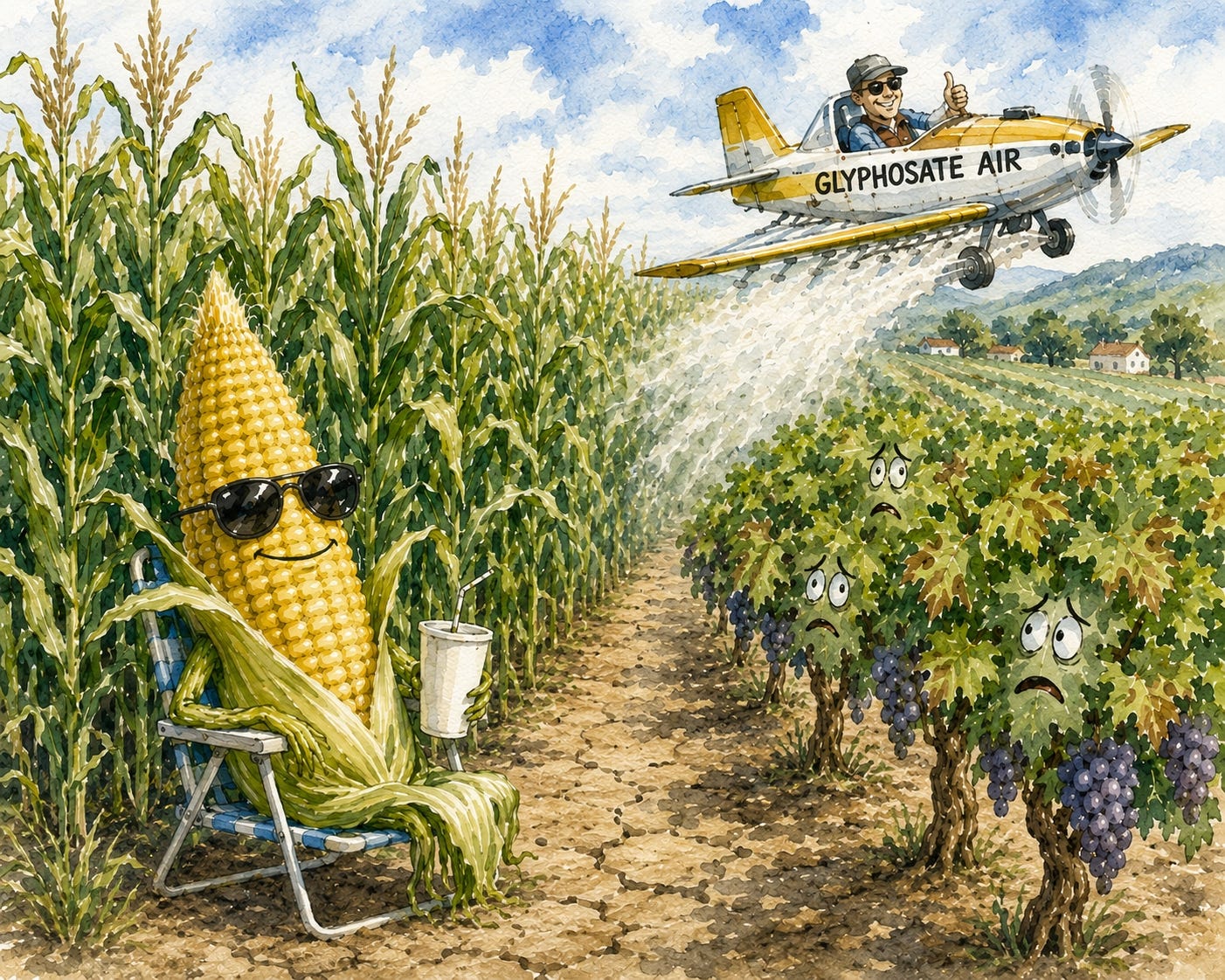
The corn field bordering our vineyard did something odd this year. We were deep in drought—the kind that cracks the clay—10 weeks of no rain—and the corn came up anyway.
That’s modern agronomy working as designed. The farmer drilled his corn in the midst of drought at a density that would have caused a 1990s farmer to shake his head. A crop that shrugs off three dry months and still fills out the ear is something special.
It is GMO.
If you reflexively despise GMO, try to hang tight for a minute or two. It’s okay to acknowledge when something or someone bad does something good.
Genetically modified crops earn their keep.
Insect-resistant Bt corn has cut insecticide spraying across millions of acres — meaning less tractor use, less pesticide drift, and fewer dead pollinators. Drought and heat-tolerant varieties keep yields from collapsing in droughts that would have wiped out a farming family a generation ago. Golden Rice, engineered for beta-carotene, was built to address vitamin A deficiency in children in the developing world. When I was a pediatrician in West Africa, I saw how Vit A deficiency blinded and killed kids. And those people ate rice most every day. If only it had been Golden Rice. Greenpeace and others worked hard to block Golden Rice. I wonder how many kids could have been saved by the stuff. We may never know.
Thirty years of data on the genetic traits themselves—not the herbicides sometimes paired with them—have not produced convincing evidence of human health harm. Not yet at least.
Skepticism is warranted too
Some skeptics are spooked by science they don’t understand. They of course speak loudly and confidently. Some even believe that they are being genetically manipulated themselves when they consume meat from cows fed GMO corn. That’s hogwash.
But many have more valid reasons that often involve malincentives more than any inserted gene.
For context, it’s good to know that sweet corn (the yummy stuff we eat) is less than 1% of total US corn acreage and only a small fraction of that is genetically modified. In contrast, the corn that is almost entirely GMO is field corn—used for ethanol, feeding cows, and making oil and high fructose corn syrup. That stuff is over 90% biotech since the early 2010s.
About 37% of American corn is headed to the ethanol blender. The Renewable Fuel Standard and the crony farm bills turn a food crop into an inefficient and destructive fuel. I wonder if they can GMO up a few smarter congressmen who can finally stop this travesty.
Herbicide-tolerant GMO crops let a farmer blanket a field in glyphosate without killing the crop, and that has driven a large increase in glyphosate volume applied per acre over the past two decades. Glyphosate makes weed control easy. Very easy. I can tell you from personal experience that trying to deal with weeds on a lot of acreage, while avoiding glyphosate, costs a whole lot in terms of human labor. But I’m a glutton for punishment, so I don’t use the stuff. Yet.
Glyphosate use has led to glyphosate-resistant weeds — marestail and waterhemp among them — which pushed farmers toward heavier and more frequent applications of older, harsher chemistries like dicamba and 2,4-D. Those two compounds are notorious for drift; volatilized vapor can travel and injure sensitive crops days after application. It’s done exactly that to our vines in the past.
Then there’s the seed supply itself. A handful of companies control the genetics for most of the corn and soy planted in this country, which concentrates pricing power and narrows genetic diversity in ways that make the whole system more fragile to a single new pest or pathogen. That’s a legitimate concern about economic and agricultural resilience, but it has nothing to do with whether the DNA edit itself is safe to eat.
Sound and unsound
The GMO trait did its job. The technology worked. The crops themselves have not earned the level of fear commonly directed at them. Those who oppose GMOs rationally should focus their concerns on the herbicide regime riding along with the seed, the drift risk to neighbors who didn’t plant resistant crops, the weed resistance it’s generating, the consolidation of who controls the genetics in the first place, and the government interventions that lead to unexpected and troublesome outcomes.
The science behind the trait is sound, but the agricultural system built on top of it is unsound. Anyone who tells you it’s simply the herd being irrational hasn’t stood next to a vineyard downwind of a corn field in late August. Anyone who tells you that GMO is poisoned seeds of corporate conspiracy hasn’t looked at what that corn did in a summer with no rain.
As usual, the danger is in collectivizing
“GMO” is not one thing. It’s a label slapped across drought-tolerant maize, Bt cotton, Golden Rice, glyphosate-tolerant soybeans, and a dozen other traits that share a lab technique and nothing else. Treating them as a single category — good or bad, safe or poison — is not high-quality thinking.
That kind of collectivist thinking encourages us to judge categories rather than individuals, technologies, or facts. Once something is sorted into the “good” or “bad” pile, thinking stops.
That collectivist reflex isn’t unique to this argument, and it isn’t unique to one side of it. The grassroots organic-only church and the biotech-government GMO-abundance church are running the same operation. One manipulates with fears of GMO, another with fears of hunger. Categorical hate is easier to sell, easier to fundraise off of, and easier to organize tribal emotions around than a case-by-case judgment ever will be. That’s the point of it. Herding people by category serves the herder, not the herd — whichever pasture the sheep think they’re standing in.
There is a planned segue here: AI-brained robots are coming for most everything, including controlling weeds and bugs. And it’s gonna be a wicked fun ride. It’s time to start paying attention to how your life may be intersected by the pending Robot Revolution.
Not a stock recommendation, but you might want to know that John Deere (DE), AGCO (AGCO), and CNH Industrial (CNH) all have their own answers to the herbicide drift/overuse problem. Each has developed precision-spraying systems, to spray only the weed, not the whole field.
Then there are several private robotic agriculture companies that I keep my eye on.
● Greenfield Robotics -- Makes small autonomous robots (BOTONY) that mechanically cut weeds between crop rows instead of spraying them. Equity crowdfunded.
● Carbon Robotics — laser weeding robots (burns weeds, zero chemical). Seattle-based.
● FarmWise — row-crop mechanical weeders.
● Ecorobotix — Swiss; also spot-sprays only the weed itself rather than the whole row, with claims of up to 95% herbicide reduction.
● Naïo Technologies — French; their robots are purpose-built for vine rows, doing mechanical weeding between vines instead of herbicide.
And there are probably dozens more.
As I like to make things difficult for myself by avoiding herbicides on or near our grapevines, these robots are interesting to me.
We will soon have another good way to lose money in the vineyard business.
Subscribe to Doug Casey’s Crisis Investing to stay updated as any of these become interesting speculations or investments. They aren’t yet.
John Hunt, MD
Editor, Doug Casey’s Crisis Investing
John, as an 88 year-old retired dryland wheat farmer residing in Western Colorado, I found your article interesting and likely factual. The problem I'm having accepting "this future Ag picture" is pure and simple. Who is going to do the actual farming? Our average USA farmer is 60 years old, their children are not interested in taking up where Mom and Dad left off. Plus, one does not make money farming, you make money owning the farm, its called land value. My 2500 acre farm sits completely idle as I write. We are in a severe drought and no family members to take over. If and when the land is sold, it won't be to raise wheat or any ag product.
I urge your readers to watch some of the many videos of the modern mid-west farmer, and try to comprehend the investment they have in land, equipment, and their individual life time commitment. As a young farmer, one does not succeed by hiring on today or joining the family operation, with the idea of moving on a year or two later if a better deal comes along.
It still takes, sunshine, moisture, land, tons of money, and a life-time family commitment to have a nation-wide successful agricultural community. We are going downhill fast, and I just don't think we can engineer our way out. Economics 101 rules!
Nice try Dr. Hunt and the Casey Crisis Investing team but with all due respect, Collectivism is at least as bad as Naivety. When it comes to Glyphosate aka Round Up, this "Weed Killer" Kills Everything it is sprayed on as I personally have direct knowledge of using Glyphosate when I worked in the Ag Industry---Glyphosate is a desiccant, meaning it drys up any crop it touches, not as much as it is a straight up chemical to "Kill Weeds"--I met and my entire team did with the distributor of Round Up which I did use as an Ag worker--Monsanto is or was the sole manufacturer of Glyphosate. and it is a Known carcinogenic and a deadly poison. It was Illegal to allow it to sold to the general public until about 1983 or in that area---when I finally observed it being sold on the shelf at The Home Depot, I almost had a Cardiac Arrest as I knew what a dangerous and Deadly substance it was.
When I did spray Glyphosate, I was required to wear a Full Tyvek suit, tyvek head covering, high rubber boots and high rubber glove along with a Full Filtered Complete Face Mask with 2 filters-This Highly carcinogenic and desiccant is now being sprayed on Freshly Harvested wheat crops due to it's high desiccant properties---which avoids having to lay it out in the Sun to dry it out as it once was.
Now enter Crony Capitalism which Mr. Trump is the Grand Master of--when I observed him writing a Executive Order that protected Monsanto from liability law suits, including but not limited to Cancer, it verified what I had always suspected--Most folks including his deluded MAGA Groupies, which is rightly waining as it should. Most folks view Mr. Trump as a Real Estate magnate when in fact, the Roots of his "Business Enterprises is that of Organized Crime, NOT Real Estate. His Mentor, not business associate or partner but MENTOR-was Roy Cohn, a well known attorney for The Mob and others.
The outbreak of "Died Suddenly" many of those of Cancer. is not always from the CV19 Jab but from consuming food stuffs sprayed with Glyphostate. Geo-Engineering also comes into play here as far. as "GMO's" which Had the potential of growing healthy crops but now Monsanto is the Sole provider of selling seeds that will grow in Nano-Particulate Aluminum--folks used to save seeds from say corn or tomatoes and start new seedlings with them, but thats useless now--You MUST now purchase seeds that are able to grow in Aluminum Saturated soils which are sold by who? Monsanto, of course.
That is all I have to say at the moment as my Blood is Rightly on fire at the moment.
I may have offended some here--so be it. I am not a Diplomat, I am just a Man.
God Bless.