
Investing, Speculating and Gambling
The rise of prediction markets.

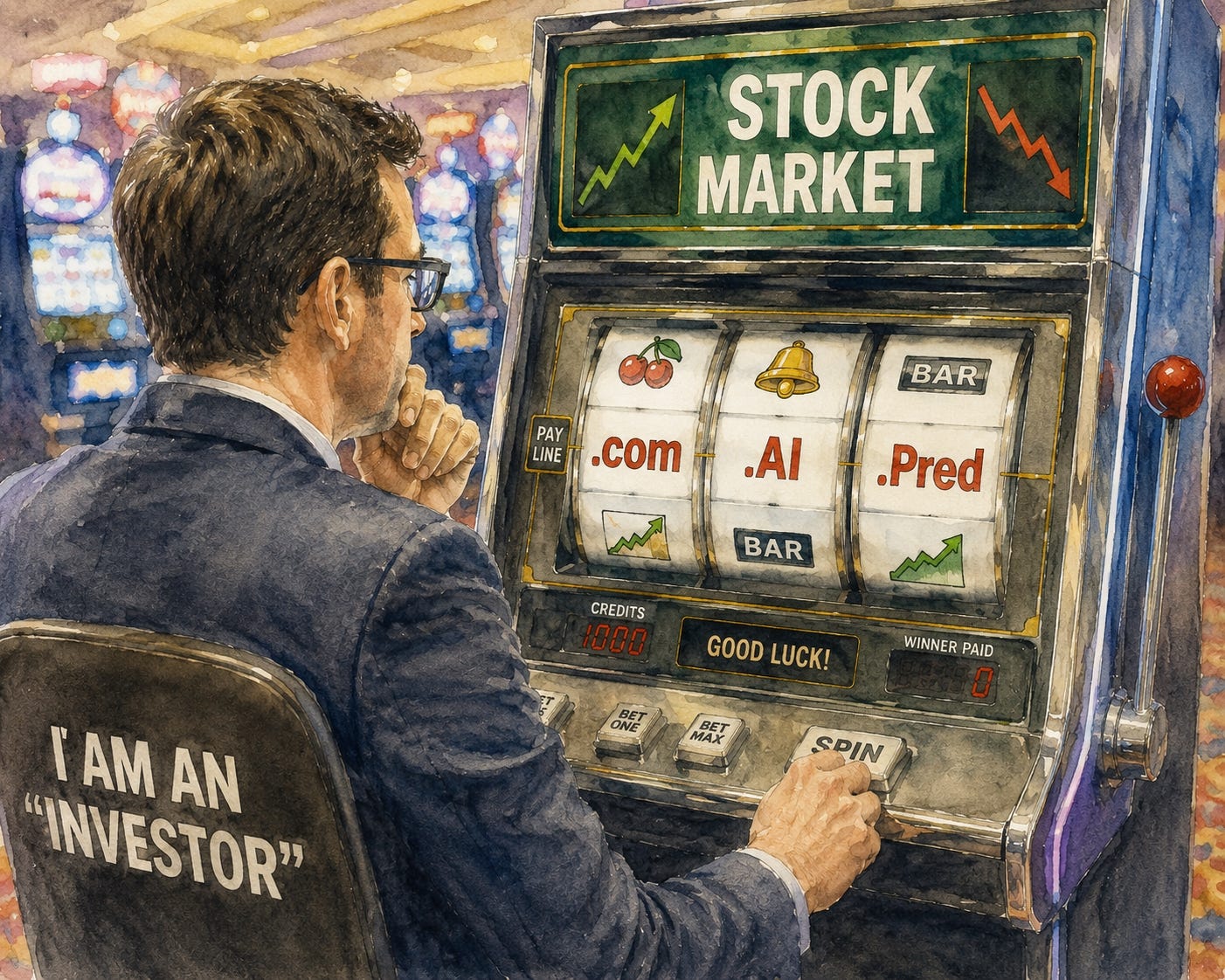
I expect that economic history books will teach that ridiculous stock market dynamics accompany late-stage fiat currency decay.
Over the last decades, people have moved from being investors, to speculators, and now—with the full deployment of prediction markets—gamblers.
What’s the difference?
As an investor, your capital flows into an enterprise—a critical mineral mine, an oil rig, a robot manufacturer, a spaceship builder—and the enterprise uses it to try to create more new value. Your funds are used to build a facility to process ore. A well drilled to pull stored energy from the ground. A robotic system’s new skill set. Or a communication system and transport platform to Mars. In the pursuit of profit, investment helps direct capital to the most efficient producers of needed or desired goods and services.
At IPO or in a private placement you are directly providing funds to a company. When you buy in the open market, it is different. You are either: 1) deploying your capital to own dividend-producing shares—essentially building your own cash mining operation; or 2) speculating that the company’s stock price will rise.
But in either case you are entrusting your wealth (directly or indirectly) to people who have fiduciary obligations to make more money for you by producing those needed or desired goods and services.
Which takes us to … the speculator.
A speculator seeks disturbances in the market prices—often caused by government officials—and provides liquidity to help smooth out what could otherwise be financial tsunamis. He’ll buy when no one else is buying. His carefully researched analysis that gold, or uranium, or oil, or sulfur (or corn or bitcoin or tungsten) is too cheap leads to his willingness to buy the underpriced commodity, which nudges the price toward the truth. His efforts help discover the price of goods. A true price tells miners when and how much to dig, and that improves productivity and smooths out business cycles.
The biggest government-created disturbances in the market are war and fiat currency. Accumulation of monetary metals and their miners are speculations on the continued debasement of currency. Indeed, much of the stock market is a speculation that the governments and central banks will keep inflating their currencies. That is why the stock market rises on even hints of central bank loosening (creation of new money).
But other government interventions are rampant. Subsidies of green energy. Mandates to buy health insurance. Wait—the list is so long it is not worth typing. Most everything is now subject to government intrusion into the markets. Speculation is therefore what most people are doing when they buy stock.
Then there is the gambler. Prediction markets are the new rage. But most of the time, they create only entertainment value. Betting on whether your World Cup team advances provides liquidity to no productive enterprise, discovers no price that directs capital, takes on no risk that someone needs to shed. Betting on whether Taylor Swift gets engaged this year creates no goods or services. The implied probabilities that the prediction markets create coordinate no useful economic activity. No mine opens. No spaceship is built. These bets aren’t even derivatives. They’re slot machines generating money for the house, and the house is your brokerage. There are no corporate execs with fiduciary obligations to help you make money. There are just those who either want the whole pot, or 2% of every pot.
How did a casino end up inside your brokerage account? The way most changes happen: slowly, then all at once.
In 1988, three University of Iowa economists built a small market where people bet real money on elections. Five dollars and a modem got you in. The Iowa Electronic Markets were an experiment in whether betting markets could produce accurate election forecasts. And they worked—from 1988 to 2004 their prices beat the polls about three times in four. People putting money on the line out-forecast the pollsters.
Then the thing got scaled and diversified. Intrade carried it online and died in 2013 after US and Irish government interventions. Crypto revived it—Augur, then Polymarket—global, always-on. Kalshi got itself federally licensed in 2020. And in September 2024 a federal judge freed up the industry, ruling the CFTC had no power to call election contracts “gaming.” The dam broke.
What poured through wasn’t the price discovery created by speculation. It was sports outcomes, then everything else. Kalshi listed Super Bowl contracts. Robinhood, Crypto.com, and Interactive Brokers piled in with thousands of events to bet on. Arguing the losing side in court, the CFTC’s own general counsel called it “an online casino.” The casino won, and it now sits one tab away from your retirement account.
The scale is growing from marginal toward enormous. Robinhood ran roughly $3 billion through its prediction-market book in one month this spring. In the sector, volume went from under $100 million a month in early 2024 to north of $13 billion a month by the end of 2025. Projections run to $1 trillion a year by 2030 — about what Elon Musk is worth after a lifetime building cars and rockets. One trillion created by production. The other churned for entertainment.
Over the long term, the steady investors and the hard-working speculators create wealth for the world and themselves. In contrast, as the house nibbles off a fraction of the probabilities in an otherwise zero-sum game, the gamblers in the prediction markets will lose money.
The investor and speculator put capital at risk in service of production. The prediction market gambler spends money for entertainment. When a financial system migrates from the first two to the third, it stops financing the producers of the world and those who fix government economic disruptions, and instead starts consuming wealth purely for entertainment.
I’m not suggesting that gambling or entertainment in general is wrong. Heck, as AI and robots take over most labor, humans will put more and more of their time into consuming entertainment. All good. But the purveyors of prediction markets will endeavor to conflate in your mind the consumption of entertainment with the production of new financial wealth. It’s not.
It’s gaming. It’s goofing off. It’s fun. Whee….
While you have fun, keep (or start) investing and speculating so that you add value to yourself and the world. That’s fun too. Subscribe to Crisis Investing. And please forward this email on to people who will benefit from what we write and do here.
Sincerely,
John Hunt, MD
Excellent article!
Excellent piece. Degeneration of society in one of its clearest forms