
Insurance Is for Catastrophes, Not Inconveniences
Spend Less on Insurance. Fund Your Portfolio with the Savings

Last week, the premium subscribers read about my system of selling options as a means to fund an investment portfolio without sending a wire to a brokerage. Today I present another way to pull cash out of thin air.
Every dollar you don’t hand to an insurance company is a dollar you get to deploy yourself. Use it to 1) stock up your emergency cash reserve, and then to 2) augment your dry powder (liquid assets) to take advantage of the next crisis or downturn, and then to 3) grow your portfolio of investments and speculations.
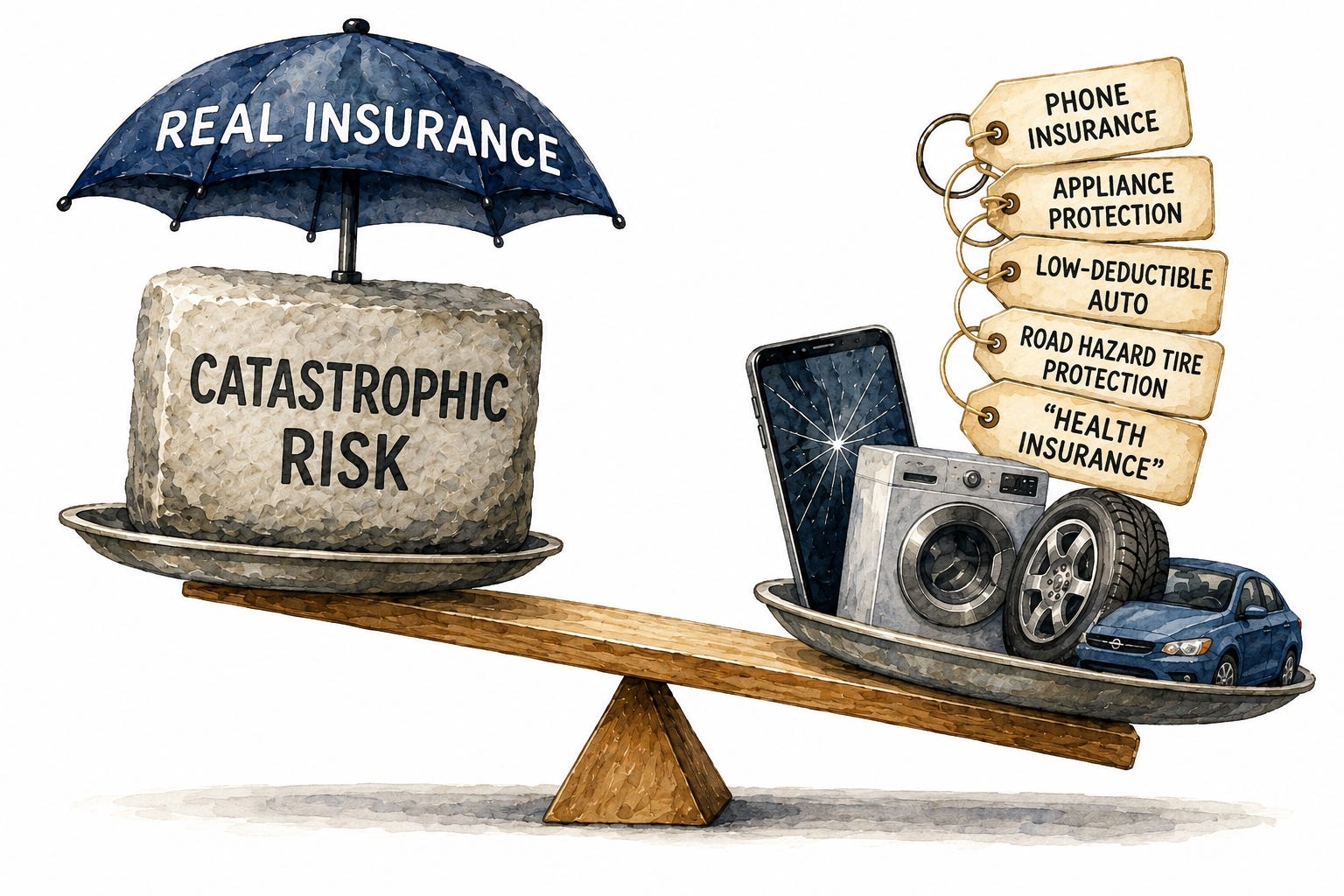
A lot of dollars can be saved by being more selective on what you insure. In this regard, the purpose of true insurance is to transfer catastrophic financial risk onto the insurance company.
Insurance is a financial product that should protect you and those you love from financial calamity. That’s it. Those two words need to be together. Financial calamity. Separate them and you’ve misunderstood what insurance is for.
Insurance should not be used to protect you from every financial impact. Nor will it ever protect you from non-financial aspects of calamity. It won’t eliminate the severe stress that occurs when your house burns down or you’re hit with a cancer diagnosis.
The failure of the education system and the resulting financial illiteracy of people is evident in the proliferation of “insurance” products that have nothing to do with protecting oneself from financial calamity.
The Little Stuff People Are Insuring Anyway
Start with phone insurance. AppleCare and its equivalents run sixty to two hundred dollars a year to protect a depreciating product built to be obsolete in two years, sold to you as if it were a Fabergé egg. That’s not risk transfer — it’s an expensive warranty sold to you at the point of sale, while your guard is down.
Extended warranties on appliances work the same racket. A six-hundred-dollar dishwasher dying before its time isn’t a financial calamity. Self-insure instead: park the warranty price in a liquid investment, and you’ve got more emergency cash for when real disaster strikes and more dry powder to invest when markets are low.
Comprehensive auto coverage falls into the same trap. So—if you need it at all—it seems wise to maximize the deductible. Doing so will shrink the premium and shift small, frequent claims back onto you, where they belonged before someone tried to convince you that the best insurance covers everything that happens. Most people avoid filing small claims anyway, since premiums get jacked afterward. Older vehicles often aren’t worth insuring at all, except for liability.
Health Insurance: The Worst Offender
In the US, health insurance hasn’t been insurance since the Clinton administration. What Americans call health insurance is a prepaid medical spending plan that you pay way too much for.
Real health insurance would provide funds to help you pay the six-figure surgery, the cancer diagnosis, the ICU stay: the events that bankrupt a household. It would carry a high deductible and a premium so small you’d barely notice it. You’d pay cash for most medical interventions the way you pay for an oil change. And as a result (and this is the most important bit), you’d shop around for best value for the money, which would push prices for actual medical care down everywhere.
Instead of that wonderful free-market process, the government both subsidizes and coerces us to purchase a lousy financial product (so-called health insurance). Premiums are high and medical costs are hyperinflated, because insurance kills price transparency and results in thick layers of administrative waste.
What people need and what makes sense is catastrophic medical insurance. To protect against financial calamity. But Obamacare made that type of insurance somewhere between illegal and wicked expensive. Obamacare is stupidity on steroids.
The Test
Ask what happens to your finances if the bad outcome hits with no insurance at all. If the answer is mildly annoying, consider self-insuring and banking the saved premium. If the answer is ruined, it’s wise to buy a policy with the highest deductible you can stomach, so the premium is low and the protection sufficient.
What’s Actually Worth Insuring
Real insurance provides peace of mind by protecting against catastrophic financial losses. Get liability coverage sized to your actual net worth, not the state minimum. Umbrella policies make sense once your assets exceed what your auto and home liability limits would cover in a lawsuit. And in the event you are sued, it’s like hiring your insurance company’s attorneys to fight for you, for free.
High-deductible homeowner insurance is needed for mortgages, sure, but also because total losses happen. Life insurance is valuable to provide financial security to other people who depend on your income, especially if there is a mortgage. Catastrophic medical insurance with very high deductibles is valuable to most people (but totally unnecessary for Bill Gates). But, in the US, few people fit the limited Obamacare criteria that allows them to purchase catastrophic insurance. Consider joining a medical cost sharing organization or an entity such as Crowd Health instead of paying for so-called health insurance.
The best insurance for small and large problems: family and friends who care about you and are willing and able to help you out when you aren’t able to help yourself. That bridge goes both ways.
Insuring things you don’t need to insure means handing your capital to insurance companies to invest in their portfolios instead of you investing it in yours. Keep the premium and make the profit yourself.
Before the next crisis is the time to assure your emergency cash reserve is fully stocked, and then to accumulate dry powder. To do so doesn’t mean you have to sell stocks you like or get a second job. Just stop wasting money on stuff you don’t need. Like most insurance and warranties.
And when you’ve got enough liquidity put aside, start sticking the continued monthly savings in your portfolio.
Someone you care about may never have heard this before. Send it on, and suggest they subscribe to Crisis Investing.
Sincerely,
John Hunt, MD
Editor, Doug Casey’s Crisis Investing
too much common sense
doubt the populace inclined to absorb it