

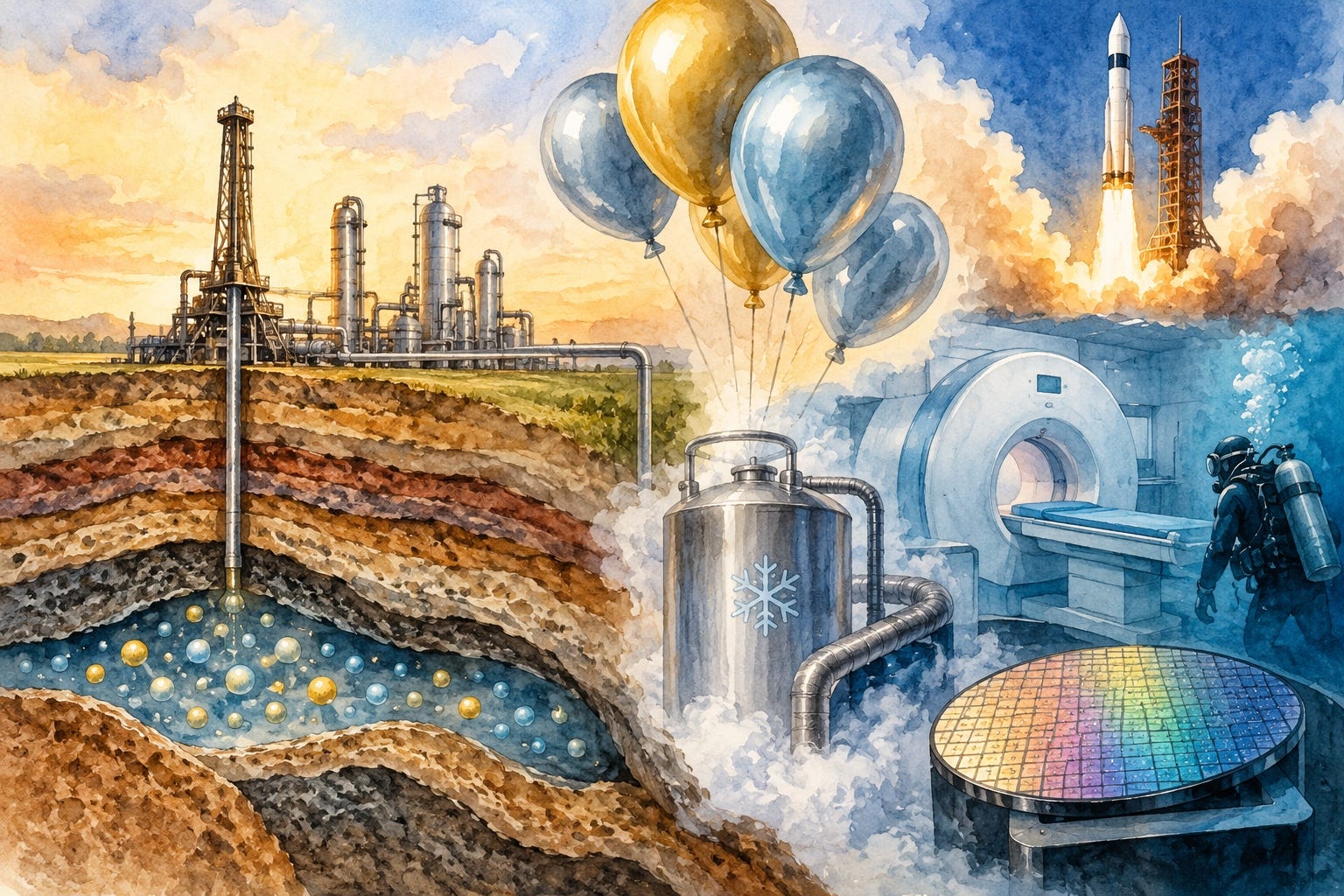
Helium is the third most abundant element in the universe—after hydrogen and stupidity. But it is rare on Earth, because when it gets out of the crust and into the air, it rises up through the atmosphere and leaves the planet.
On October 23, Energy Secretary Chris Wright designated helium a critical material. The Department of Energy has noticed helium. We should notice it too.
Where It Comes From
Helium is made by nuclear fusion in stars, and by radioactive decay on Earth. Uranium and thorium in ancient granite released alpha particles, and an alpha particle is a helium nucleus. It picks up two electrons and becomes an atom of helium-4. Granite a billion years old has been slowly making helium for a billion years.
Helium dissolves poorly in water. When a stream of methane, nitrogen or carbon dioxide moves through the rock, the helium leaves the water for the gas and rides along. The gas rises until a seal stops it: salt or dense evaporite rock over a structural trap. The seal has to be exceptional, because helium atoms are small enough to slip through rock that holds methane. These structural traps are rare.
Commercial helium is usually a byproduct of natural gas production. Most natural gas carries well under 0.1% helium. Fields above about 0.3% begin to be worth stripping for helium. The helium-rich ones share four things: old uranium- and thorium-bearing basement, a carrier gas to move the helium, a tightly sealed trap, and enough time for it to build up.
Natural gas burned without stripping sends its helium up the flue and out into space.
What Helium Is Used For
Helium boils at a lower temperature than any other element and is chemically inert. Superconducting MRI magnets generally depend on liquid helium. Semiconductor manufacturers use helium for heat transfer and process control. Rocket makers use helium to pressurize propellant tanks. Welders and fiber-optic manufacturers use it in controlled atmospheres. Utilities use it to detect leaks. Deep-sea divers use helium in breathing mixtures to reduce gas density, and doctors use helium-oxygen mixtures to help patients breathe through obstructed airways. Grocery stores fill balloons with it, and people occasionally inhale one lungful to make their voices sound ridiculous.
For some of these uses, the Department of Energy’s notice calls helium non-substitutable. Presumably that means at any price. Even a price set by the government.
A Century of Price-Setting
The Army built the first extraction plant in 1915 to strip helium from natural gas. The Helium Act of 1925 banned exports of the gas as a national defense resource. Germany, shut out of American helium, filled the Hindenburg with hydrogen.
The government then ran the helium business for most of a century.
You just know that’s gonna work out well.
The Bureau of Mines fixed the price at $35 per thousand cubic feet in 1961 and raised it to $37.50 in 1982. A fixed price in an inflating currency punishes anyone who might have produced the gas. Decades of government-administered pricing taught users that helium was cheap and gave producers little reason to look for more.
By 1995 the program owed $1.4 billion. That was back when a billion dollars meant something. Bill Clinton signed the Helium Privatization Act of 1996 to wind it down. Obama signed the Helium Stewardship Act of 2013 to continue the sell-off.
In 2024 the government sold the last of the reserve—storage field and all—to a single buyer, the German-owned industrial gas company Messer.
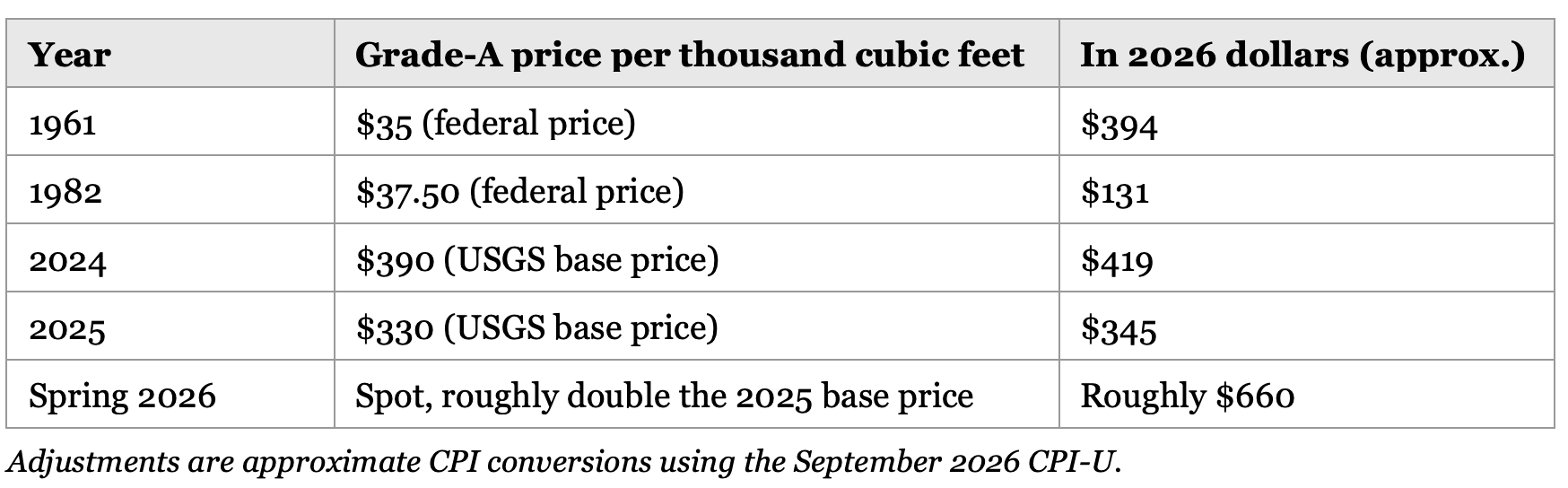
For reference, one industry estimate puts the cost of extracting helium at $90 to $415 per thousand cubic feet, depending on how much helium the feed gas holds. Richer gas costs less to process.
2026: The Qatar Shock
Qatar produced about a third of the world’s 190 million cubic meters (about 6.7 billion cubic feet) of helium in 2025, most of it at Ras Laffan, the world’s largest LNG complex. Drone and missile strikes hit Ras Laffan beginning March 2. Later reports said the damage would take years to repair and would cut Qatar’s annual helium exports by about 14%. The closure of the Strait of Hormuz stranded cargo already loaded. Spot prices roughly doubled.
Russia’s government under Vladimir Putin imposed helium export controls in April that run through 2027. In July, China’s Ministry of Commerce banned helium exports.
Helium-3
Helium-3 is the rare light isotope, and Earth has almost none of it. Commercial supply comes from the decay of tritium in the nuclear weapons stockpile. Demand jumped after September 11, because it is used in radiation monitors at ports. U.S. inventory fell from well over 200,000 liters in 2001 to between 43,000 and 48,000 by 2010. Prices ran above $2,000 per liter.
The uses today are narrow and valuable. Dilution refrigerators, which reach temperatures below 0.01 kelvin and sit inside superconducting quantum computers, need helium-3. One manufacturer’s model required about 15 liters. Neutron detection has been the biggest use by a wide margin. Pulmonologists will remember hyperpolarized helium-3 MRI of the airways, although much of that work moved to xenon-129 when helium-3 went scarce. Fusion researchers talk about helium-3 as a fuel, which is decades away at best.
At more than $2,000 per liter, helium-3 is among the most valuable gases anyone sells. It occurs in natural gas in tiny amounts, measured in parts per billion.
Gas rich enough in helium-4 to be a business may carry the helium-3 as well, but the small quantities mean that it adds only fractional value.
What the Critical Designation Does and Does Not Do
The Department of Energy’s notice says helium supply is at risk of disruption and cites semiconductors and advanced energy technologies. The designation opens the door to more federal financing for helium producers and more regulation and monitoring. It does not create new funding, and it does not shorten the permitting time.
Here’s what it could mean for American developers and producers.
Capital. Projects with drilling finished and land secured are best placed to use federal financing, if it materializes.
Offtake. Chipmakers and industrial gas companies now want North American helium.
Plants. Purification and liquefaction capacity limits U.S. output as much as geology does. The scarce asset may be the plant, not the gas. Richer gas, as noted earlier, needs less plant to make product. A promising deposit is not a business until the operator can purify the gas and deliver it to a paying customer.
Risk. Government could take over the whole helium shebang again. If the Strait of Hormuz reopens and Ras Laffan restarts, spot prices will fall. A designation does not make a project economic. Subsidies attract people who build for the subsidy. Subsidies don’t end well.
It took the Earth a billion years to put this gas into traps we can drill economically. And it took the politicians of the federal government a geological millisecond to profoundly distort the economics and create barriers to production.
Because stupidity is more common than helium.
We have an interesting helium developer moving toward production that we’ve held a position in. We are considering it for the Crisis Investing portfolio, and if we decide to add it, we’ll let our paid subscribers know. Subscribe here.
Sincerely,
John Hunt, MD
Editor, Doug Casey’s Crisis Investing
Disclosure: Some of us at Crisis Investing directly or indirectly hold shares in the helium company mentioned above. The company has not paid us or given us anything of value for this coverage. We may buy or sell shares at any time.
"Because stupidity is more common than helium."
- especially amongst government bureaucrats.
If they had a test for who can become a politician, nobody would ever fail it. They take anybody.