
Can Energy Become Money?
Only if the weather doesn't change.

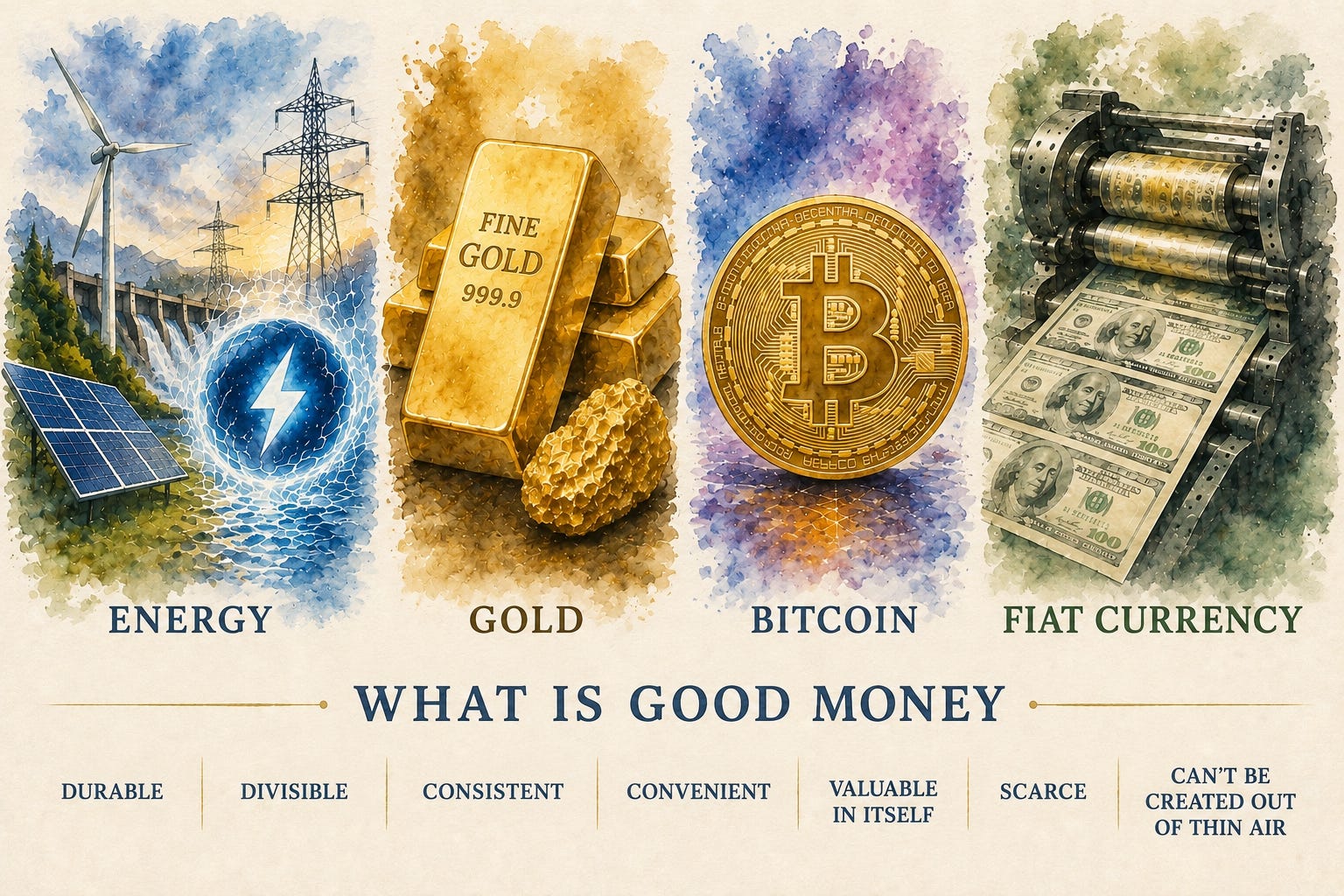
Every few years someone proposes that money is about to be reinvented. This cycle it’s energy. The AI build-out runs on power. Robots will do the work. The car charges instead of fills. So why not make the kilowatt-hour or the joule the unit of account?
It’s an idea with a serious pedigree. A century ago the Nobel chemist Frederick Soddy argued that real wealth is energy and money is a claim on it. Bitcoiners say their coin is energy made spendable. To consider whether energy can be used as money, let’s think about what makes good money.
What money has to do
Money wears three hats at once: a medium of exchange, a store of value, and a unit of account.
Doug has hammered the next part for decades, though Aristotle came up with it. A good money is durable, divisible, consistent, convenient, and valuable in itself. Good money is also scarce. Add another Aristotle didn’t bother to state, because no one in his day thought they could get away with it: good money can’t be created out of thin air.
Gold clears every bar, which is why it has been money for five thousand years.
Where energy is strong
Energy’s case is stronger than skeptics admit. On intrinsic value it even beats gold: gold’s uses are narrow, while energy is the thing every other good and service requires. Nothing moves, heats, computes, or grows without it. It divides to any size. Nobody can counterfeit a kilowatt-hour the way the Federal Reserve counterfeits a dollar.
No, you cannot carry a megawatt-hour in your wallet. But energy can be a measuring stick, with payment settled in claims the way the gold standard let you carry paper redeemable in metal.
Where energy is weak
A good money waits, sitting in a drawer for fifty years and still there. Energy can’t. The second law of thermodynamics says stored energy leaks back toward uselessness: batteries self-discharge, pressurized hydrogen seeps through steel, water pumped uphill evaporates, heat radiates away, none of them able to wait the way money must.
A joule is a fixed quantity of physics. The value of delivered energy is not fixed. If we use the dollar to value it, a megawatt-hour fetches maybe $20 wholesale and $160 retail, and in a cold snap the wholesale spot can run many times higher. Same unit, different number, by where and when it sits on the grid. This is not the dollar changing in value, it’s the energy.
In a way, gold shares the trait. An ounce of gold 200 meters underground in a hydrothermal deposit diluted into 30 tons of rock is worth a sliver of a poured .9999 bar. But once you have the pure gold, it’s a good store of value. The purchasing power of a joule would jump around when the weather changes.
The trick gold and Bitcoin pull
Bitcoin burns enormous energy, but not to store value in the coin. It burns energy to make the supply impossible to forge. You cannot fake the work, so you cannot flood the supply and dilute everyone holding it. The energy is gone the instant it’s spent. What it leaves behind is not stored power but an unforgeable ledger. The electrons were never the point. The scarcity they guard is.
Gold runs the same trick in slow motion. A gold bar is energy a dying star spent billions of years ago, and mining and refining it costs a fortune in work. Gold is difficult to produce.
Which is why energy itself shouldn’t be the money. The day fusion or a small modular reactor on every block makes energy cheap, the wall comes down. Easy money is a problem, not a solution. The same abundance that would bless the world would strip energy of the thing that made it money. Could you imagine powerful people, rich with energy, blocking the inventions of new abundant energy production in order to preserve their wealth? I can.
So where does that leave us?
Energy may never become like cash in your pocket. But thinking it through tells you what we should want money to be: something that can sit still while holding its value over time; something scarce that no one can create at will; something easy to trade, because everyone trusts and accepts it.
It is not me who should decide what is money. Nor Doug, nor Aristotle. Least of all mentally confused politicians and statist central bankers declaring by law what we must use as money. It is you who should decide what is money to you: what you think is the best way to store value, the best way to be paid, the best way to trade for goods and services, and the best unit of account. If it was always all of us, in a free market, deciding what money is, then money would improve over time — the power of competition — instead of being centrally decided by one person or a committee of people, as you might expect to happen in communist countries. Sadly, that is exactly how money is established in the US, and indeed in every country on Earth. It is all fiat currency. Declared by lousy politicians to be money.
If energy is becoming the most contested resource of the era, the investment move isn’t to try to gather up and hold the electrons. It is to own the companies that have the people and systems that produce energy most efficiently and securely, and who identify, mine, pump, or refine the various commodities that store energy or transport it most effectively.
We work through these opportunities in detail in our paid letter. If a friend or family member forwarded you this, you might want to start by subscribing to this, our free letter.
Sincerely,
John Hunt, MD
Excellent logic, history, and conclusion.
Bull. Wasting energy in an economy that needs it desperately is a total moronic store of value