
Big Wheel Keeps On Turning
Writing options as a method to fund your Crisis Investing Portfolio expansion

A Note Before We Start
This month’s article (for paid/premium subscribers) presents the entire Crisis Investing Portfolio in a new table format containing all our active holdings and recommendations, along with expanded information compared to the tables we have published in the past.
We also provide a brief monthly update for each portfolio position.
But those monthly updates only help if you know the rest of the story. So, separately, we will be providing to the premium subscribers (on a different day) a narrative summary of every holding in the portfolio and, where applicable, a compact version of the 9Ps for each company. This has been part of my ongoing 360-degree examination of the portfolio. That darn thing is now more than 80 pages long.
I’m not going to choke you with that part today. Instead, I’ll present it in a more useful format soon. How soon? I don’t know. The content is ready now; it just isn’t presented in a way that I find pleasing.
The Crisis Investing Portfolio has done remarkably well, even in light of the 2026 precious-metals pullback. I’m fortunate to have joined in its success.
Now We Start
Usually, our newsletter provides a new stock recommendation each month. That process is of course one reason why there are so many positions in the Crisis Investing Portfolio. We’ve got a superb selection of companies already.
So, the new recommendation for this month is not for a new stock to cram into the portfolio.
It is instead a recommendation for how to increase your holdings of your favorite Crisis Investing Portfolio positions without adding any fresh capital to your brokerage account. No new funds sent to your brokerage; no wires from your bank.
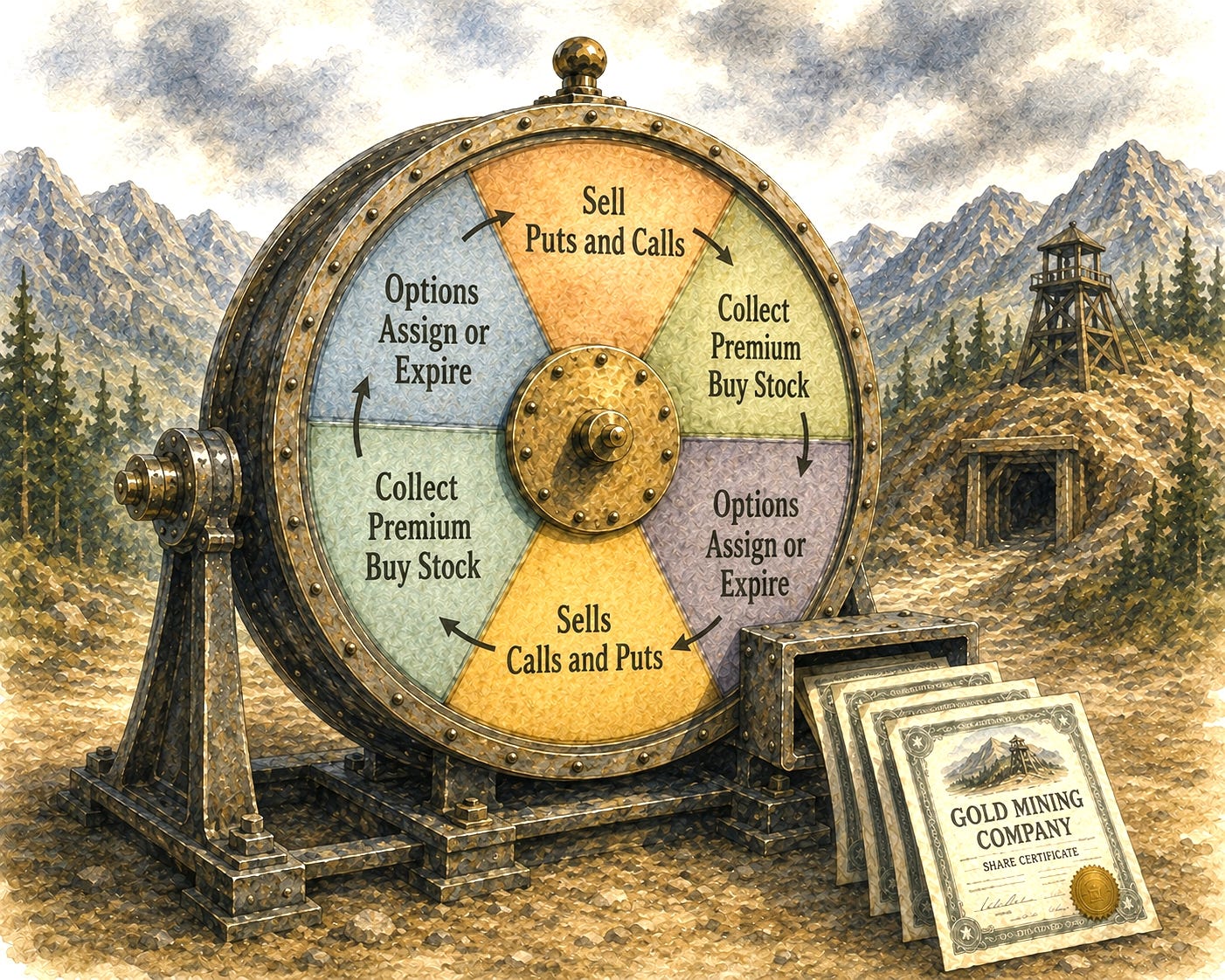
What I will present is my modification of what is known as the options wheel. It’s a good time to start riding the options wheel.
Some of you trade options better than I do. This article is not written for you, and I apologize in advance for the passages where I stop and define a word you learned twenty years ago. For the options pros, skip down to the portfolio comments and the new table, and know that more information on each position will come to you soon.
Everyone else, we’ll start on the wheel: nothing here assumes you have ever placed an options trade. I will define every term the first time it appears, and then use it often enough that it sticks. Once the words stop sounding strange, the mechanics are easy.
I will repeat it here so we don’t forget the purpose. This strategy provides a way to increase the number of shares of stock in your Crisis Investing Portfolio, without wiring in funds to do it.
I. Start Where You Already Are
You likely already do two things that form the foundation of this strategy. You just do them for free.
The first sounds like this: “I would buy Hecla Mining at $15. Not at $18.” So you enter a limit order at 15 and wait.
The second sounds like this: “I would be content selling my Kinross at $30.” So you enter a limit order at 30, and wait.
You already decided what you would pay and what you would accept and that you were willing to wait. The options market will pay you cash, today, to make those decisions binding.
The promise to buy at $15 is known as selling (or writing) a put. The promise to sell at $30 is known as selling a call.
Some people like to buy options. I like to sell them. I have a few reasons for that.
1) Routinely writing (aka selling) options is more like being the house in Las Vegas. People pay you for the privilege of playing. As time passes, you earn money by being at the table. In contrast, routinely buying options is being the gambler at the table. As time passes, they statistically lose money. Casinos make their money from that guy. (Yes, the brokerage is the house too, also making bank on every transaction.)
2) Selling options results in buying stocks lowish and selling them highish. By which I mean that you won’t be buying a stock at the lowest, and you won’t sell at the highest. Buying lowish and selling highish is a strategy consistent with reality: few people know when the low and the high are going to hit. So we might as well earn some dough by accepting that we can’t time the stocks perfectly. Buy lowish, sell highish is a winning and reasonable strategy. Selling options provides the buying and selling discipline so you carry out in fact what had previously only been an intent.
3) Selling options comes with a payment for just … existing. This is called theta, and is discussed below. It’s nice to be paid for just chillin’.
4) For me, selling options is fun, interesting, educational, easy, quick, low stress, and it positions me so that I don’t care too much whether the market goes up or down in a given week. For me, it takes a few minutes of my time, a couple of times a week. That’s it.
5) As the optimist that I prefer to be, I see market downward moves as opportunities, and being on the writing side of options makes income from these opportunities.
6) Overall, selling options is a quick, conservative, and cautious way to either increase cash flow from a portfolio, or to expand a portfolio.
On the other side of your promise (a promise you make each time you sell an option) sits someone who wants certainty and will pay you for it. He may be hedging a position or covering a risk his mandate requires him to cover. Or he may know something you don’t know, speculating on a move (as Charles Knight did in Speculator—the first novel I wrote with Doug). More likely, he’s a gambler, convinced by a dude on the internet that he can get rich in the options game. His reasons are his own business. Regardless of his reason, he pays cash for your promise, and that cash is yours the moment the trade fills, whatever happens afterward.
I’ll use another metaphor. In this arrangement you are the insurance company. He is the policyholder. Insurance companies collect premiums up front and pay claims later. Insurance companies tend to be conservative and profitable.
II. The Words, One at a Time
Some terms. Then we are finished with definitions.
Option. A contract giving its buyer the right, but not the obligation, to buy or sell a stock at a set price by a set date. The seller of that contract carries the matching obligation.
Call and put. If you sell a call, you have given its buyer the right to buy shares from you at a set price on or before a set date. A put gives its buyer the right to sell shares to you. The owner of the call can call your shares away from you; the owner of a put can put his shares to you (sell them to you). To be clear, when you are an option writer (seller) who gets “put on your options” you have to buy the shares. When your shares are called, you have to sell them. The transactions are done automatically by your broker if and when the option buyer exercises his right to sell you shares (the put) or buy your shares (the call).
Contract. One option contract covers one hundred shares. Prices are quoted per share, so an option you sell that is quoted at fourteen cents pays you fourteen dollars. This trips up everyone. Once.
Strike price. The price set in the promise. The $15 in “I would buy Hecla at fifteen.”
Expiration. The date the promise ends. Weekly options expire every Friday. Monthly options expire the third Friday of the month. After expiration the contract is gone and so is your obligation.
Premium. What the buyer pays you for the promise. It arrives in your account the moment the trade fills, not at expiration. It’s cash paid to you in advance.
In the money and out of the money. A $15 put is in the money (ITM) when the stock is below $15. A $30 call is in the money when the stock is above $30. Out of the money (OTM) is the reverse: exercising an out of the money option would be pointless. Almost every option we sell starts out of the money, for reasons that will become clear.
Exercise and assignment. The buyer exercises an option. You are assigned on an option. Same option, same event, opposite ends. If you sell a $15 put and watch the stock close at $13 on expiration, the option will be assigned: one hundred shares arrive in your account and $1500 cash leaves your account. If you sell a $30 call and the stock closes at $33 on the day of expiration, you will be assigned the other direction—your stock will be called, and one hundred shares leave your account and $3000 arrives.
Cash-secured and covered. A put is cash-secured when the money to buy the shares is sitting in the account, untouched, waiting. A call is covered when you already own the hundred shares. Both words mean one thing: you can honor the promise without borrowing. Selling options without that backing is known as selling naked, which is both the technical term and an accurate description of the exposure. I’m modest. I prefer to not be naked.
The words will attach themselves to something real in the next two sections, and that is when they will stay.
This is where the free version of today’s newsletter ends. What follows for Premium subscribers includes:
1) My version of the options wheel: a way that is designed to increase your Crisis Investing holdings without needing you to add new currency, and while buying lowish, and selling highish.
2) Pitfalls to avoid; rules that I have learned by riding this wheel and that others have taught.
3) A list of companies in the CI Portfolio that have options chains amenable to running my style of the options wheel.
4) Updates on the Crisis Investing Portfolio companies including the new table format.
Please join the Crisis Investing Premium Subscribers by signing up here.
Premium subscribers, please read on.