

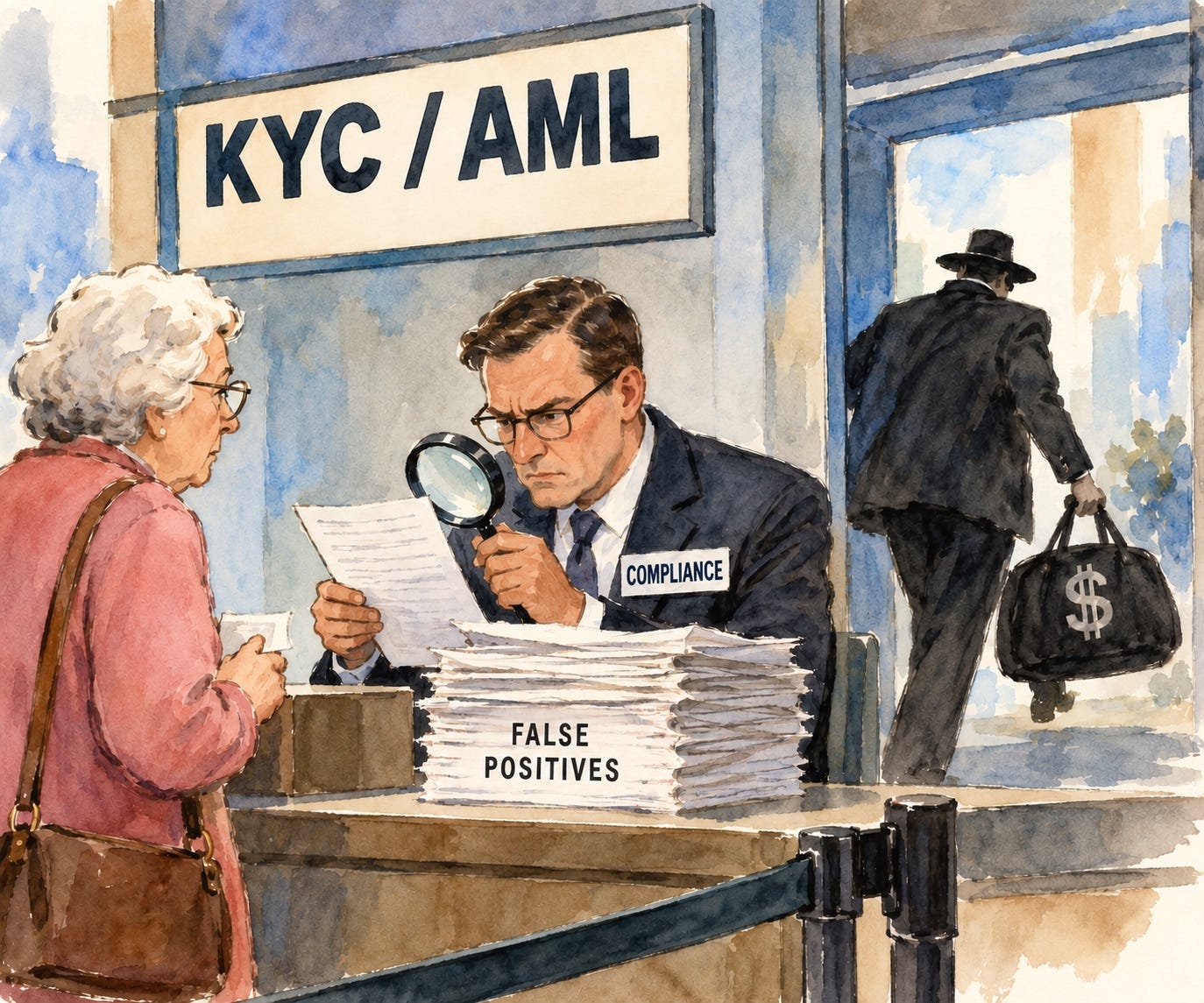
The Compliance-Industrial Complex
US and Canadian financial institutions spent $61 billion on financial-crime compliance in 2024, according to LexisNexis Risk Solutions. That money buys transaction-monitoring software, Bank Secrecy Act officers, training modules, and armies of analysts and compliance personnel who spend their days clearing alerts and acting like we are all criminals.
And we innocent types have to waste time and effort responding to these institutions’ requests for more information about us. It’s called KYC/AML.
Monitoring systems throw false positives 90 to 98 percent of the time. Chasing those flags costs the industry about $3 billion a year, according to Talli.ai’s 2025 analysis, at $25 to $50 per alert investigated. A five-person compliance team at a mid-market bank spends most of its working hours confirming that grandma’s rent check is not a Sinaloa Cartel wire transfer.
And the paperwork this whole machine generates? The Government Accountability Office found that law enforcement agencies accessed fewer than 3 percent of Currency Transaction Reports filed between 2014 and 2023. Banks filed them. Nobody read them.
What the Government Catches
Treasury’s National Money Laundering Risk Assessment, the government’s benchmark figure, puts the amount laundered through the United States at roughly $300 billion a year, mostly tied to fraud and drug trafficking.
Now compare that to what actually gets clawed back. The Justice Department’s Assets Forfeiture Fund, which covers every seized asset from every case in the federal system, drug busts, fraud, laundering, everything, deposits about $2.3 billion a year. Not $2.3 billion in laundering cases. $2.3 billion total, across the entire federal law-enforcement apparatus, for every category of crime subject to forfeiture, combined.
Banks and non-bank institutions spend $61 billion a year filling out forms. The US government collects a couple of billion dollars a year across all crime categories combined, against $300 billion of laundered money. That’s a recovery rate less than one percent. The global anti-money laundering regime is a joke.
Incentives
FinCEN doesn’t get funded based on money recovered; it gets funded based on rules written and forms filed. Your bank doesn’t lose customers over a 96 percent false-positive rate, but it loses its charter over one missed Suspicious Activity Report. So in regard to KYC/AML, the rational move for every institution is to CYA (cover your ass): report everything, verify everyone, and let the $61 billion bill land on the depositor, in the form of fees, delayed wires, and a teller who accuses you of being El Jefe.
The cartels and terrorists, meanwhile, keep moving their money through the system, because a surveillance apparatus built to generate paperwork is far too constipated to stop them.
That $61 billion is roughly three times the amount of additional tax revenue that would come to the federal government if they increased the marginal tax rates on billionaires by 10 points. And it’s roughly the same amount of annual tax revenue that the IRS would receive if Congress created a 5% one-time wealth tax (spread over 5 years) like California is proposing to inflict on its citizens.
In other words, ending the KYC/AML regime would put into the productive economy every bit as much as these new hate-the-billionaires “fair share” taxes would bring in for the government to waste.
It all goes to show you that government is populated with idiots who have way too much power.
So what do we do with this information, the next time we have to go through the stupid KYC/AML process? Pretty much nothing. Are we going to refuse to provide the information? It’s not as if another bank is an option.
Undertaking all your commerce using gold or bitcoin is a possibility, sure. But beware, because the authorities will want to tax those at the time you use them to purchase something. And although bitcoin and privacy cryptocurrencies can provide a way to avoid some of the government intrusion, if you ever want to get back into fiat currency (so that you can pay your taxes on all your ill-gotten gains), know that the on-ramps and off-ramps between crypto and fiat are centralized and regulated and infiltrated by KYC/AML commissars.
So, either do your damned KYC/AML, or become a scofflaw, you dirty money-launderer. So say the bureaucrats.
Respectfully,
John Hunt, MD
Editor, Doug Casey’s Crisis Investing
The Income Tax, the Bank Secrecy Act, and the (so-called) Patriot Act were three of the most devious tactics ever dreamed up to use against Americans. But they aren't the only legislative evils we are up against.
All this in the land of the free!
Jim Marshall