
Why Everyone Feels Poor Right Now—Even If the Government Says Otherwise
Uncle Sam Says You’re Middle Class. Your Bank Account May Disagree.

Matt Smith recently wrote about macro strategist Michael Green’s analysis of America’s poverty line. Green discovered something striking: if you take the government’s own 1963 methodology for calculating poverty and update it for today’s actual costs, the poverty threshold for a family of four isn’t $31,000 like the official number claims.
It’s closer to $140,000.
Green arrives at this number using the same basic formula. Back then, the government calculated poverty by taking the minimum cost of feeding a family and multiplying it by three. Why three? Because food represented about a third of household spending at the time. So if a family spent $1,000 on food annually, multiply by three, and you get $3,000—the poverty line.
Today, food is only 5-7% of most families’ budgets. If you apply that same inverse logic—taking the minimum food cost and dividing it by food’s share of the budget—the multiplier jumps from 3 to around 16. So if a family spends $10,000 on food and that’s 7% of their budget, you multiply by roughly 14 to get the full budget: around $140,000.
To double-check the numbers, Green also takes a second, more straightforward approach. As he put it: “I wanted to see what would happen if I ignored the official stats and simply calculated the cost of existing.” So he built a basic needs budget—no vacations, no Netflix, no luxury—just what families must spend on housing, healthcare, childcare, transportation, and other non-negotiable costs. That calculation landed at roughly $118,000 in net income needed, or about $136,500 gross after taxes. (For the full breakdown, read Matt’s essay and Michael Green’s original piece—both are worth your time.)
Uncle Sam Disagrees
The government, however, insists the poverty line is just $31,000. Which makes a household earning the median income of $80,000 look comfortable—more than 2.5 times above poverty, solidly middle class.
Of course, if the real threshold is $140,000, then that same median household would have been classified as poor under the government’s own 1963 standards.
I don’t know about you, but even if you ignore regional differences, looking at the exorbitant jump in prices over the past few years—housing, groceries, insurance, healthcare—it really doesn’t feel like the median income of $80,000 is middle class anymore. Before COVID? Maybe. Now? No chance.
Even if we assume that the actual poverty line is somewhere around $70,000—half of Green’s $140,000 estimate—the official government figure of $31,000 is still off by more than double. And if Green’s right, they’re off by 4.5 times.
That’s not a rounding error. That’s not a small discrepancy.
That raises an obvious question: how is that possible? How can the official measurements be so catastrophically wrong? So completely removed from the actual experience of what it means to live and work in America in 2025?
Measuring the Wrong Things
The answer is simple: the metrics the government uses to measure economic health don’t actually measure what we think they measure.
Take unemployment. This is one of the Fed’s most closely watched indicators. Economists obsess over it. Politicians campaign on it. The financial media treats every monthly jobs report like breaking news. Why? Because unemployment is supposed to tell us how the economy is actually doing. Low unemployment means people are working, earning money, and the economy is healthy. Rising unemployment signals trouble—recession territory, layoffs, economic pain.
But here’s the problem: when the government reports 4.4% unemployment, they’re measuring one thing and one thing only: do people have jobs? And the answer is yes. But that number tells you absolutely nothing about whether those jobs actually cover the cost of living. It doesn’t capture whether wages have kept up with housing costs that doubled in five years, or healthcare premiums that eat 15-20% of income, or childcare that runs $30,000+ per year. It doesn’t show that people are working multiple jobs just to stay afloat. It doesn’t distinguish between a software engineer making $200,000 and a retail worker cobbling together three part-time gigs to hit $35,000.
Having a job and being able to afford your life are two completely different things. The unemployment rate only measures the first one.
Or take inflation. The Fed’s beloved target is 2% annual inflation. They claim this is the sweet spot—moderate enough to keep the economy healthy and functioning. But let’s think about what 2% actually means when it compounds year after year. After a decade of 2% inflation, everything costs 22% more than it did at the start. Twenty years of this “moderate” inflation? Prices are nearly 50% higher. Thirty years? You’re looking at an 81% increase. This is how seemingly modest 2% annual inflation quietly destroys purchasing power over time. It’s the reason the dollar has lost 97% of its value since the Fed was created in 1913.
Incidentally, current inflation is nowhere close to the Fed’s 2% target. It’s actually running at around 3.0%—and it edged up from 2.9% in August to 3.0% in September. Meanwhile, the Fed has already cut rates three times this year and just announced they’re restarting the money printer.
Regardless, my point is this: the inflation rate only measures how fast prices are climbing right now. It doesn’t measure the total damage already done.
The pandemic years make this painfully clear. Since early 2020, cumulative inflation has pushed prices up roughly 20-25% across the board. So when you hear “inflation is 3% this year,” that’s not your total burden—that’s 3% piled on top of the 20-25% you’ve already absorbed since COVID hit. Your rent didn’t just go up 3% and reset. It went up 3% on top of whatever it climbed during the lockdowns and their aftermath. Same with groceries, insurance, healthcare, gas, childcare—everything.
So when the Fed says inflation is “moderating” while you’re paying 20-25% more for everything than you were in early 2020, the disconnect isn’t just in your head.
And then there’s GDP—the darling of economists everywhere. Seems like everyone from establishment shills to talking heads on CNBC worships at the altar of GDP growth, conveniently forgetting that it’s fundamentally a broken metric. GDP measures spending, not value creation. This is the broken window fallacy in action: if the government spends billions housing illegal immigrants in hotels, GDP goes up. If they hand out debit cards loaded with taxpayer money that get spent at Walmart, GDP goes up. A hurricane destroys $50 billion worth of property? The rebuild spending boosts GDP. None of this represents actual prosperity.
At the end of the day, GDP is just a number that measures economic activity—whether money is moving around the economy. Corporations could be booking record profits through financial engineering. Tech stocks could be soaring on AI hype and share buybacks. The government could be funding another pointless war overseas. All of that gooses GDP. None of it tells you whether the average family can afford a house, save for retirement, or get ahead.
Bottom line: economic activity and prosperity aren’t the same thing. You can have an economy that’s supposedly growing while median households are drowning. In fact, this seems to be exactly what’s happening right now—remember, the Fed projects GDP growing at 2.3% next year, up from their earlier 1.8% estimate.
When It All Started Unraveling
I could keep going through other government stats and figures to hammer the point home. But you probably already see it: none of these statistics are designed to show how the American middle-class family is actually doing.
So the real question becomes: when did this all go wrong?
If I had to pinpoint when things actually started unraveling, I’d point to this chart. It perfectly illustrates the trend. It shows how wages, adjusted for inflation, and productivity rose side by side through the 1950s and 1960s—the heyday of the American middle class. The harder you worked, the more you earned. It was the key to social and income mobility. And it nurtured a healthy middle class.

Then something major happened in 1971. It caused an ever-widening split between work and wages. The chart clearly shows how the real wages of the average person have essentially remained stagnant since the early 1970s.
That’s no coincidence.
In 1971—or more precisely, on August 15, 1971—the U.S. government made a historic move, setting off the gradual extinction of the middle class. What happened was on par with the 1929 stock market crash, JFK’s assassination, and the 9/11 attacks. Yet most people know nothing about it.
This is the date President Nixon killed the last remnants of the gold standard.
Note: I say “remnants” because while the U.S. had already left the gold standard in 1933 for domestic dealings, foreign governments could still exchange dollars for gold at the U.S. Treasury. But by the late 1950s, that privilege was limited to foreign central banks. That was the last remaining discipline against runaway borrowing and spending.
And it all went downhill from there, because the one thing that didn’t stagnate was the U.S. money supply. Untethered from the gold standard, it exploded over the coming decades—as you can see in the chart below.
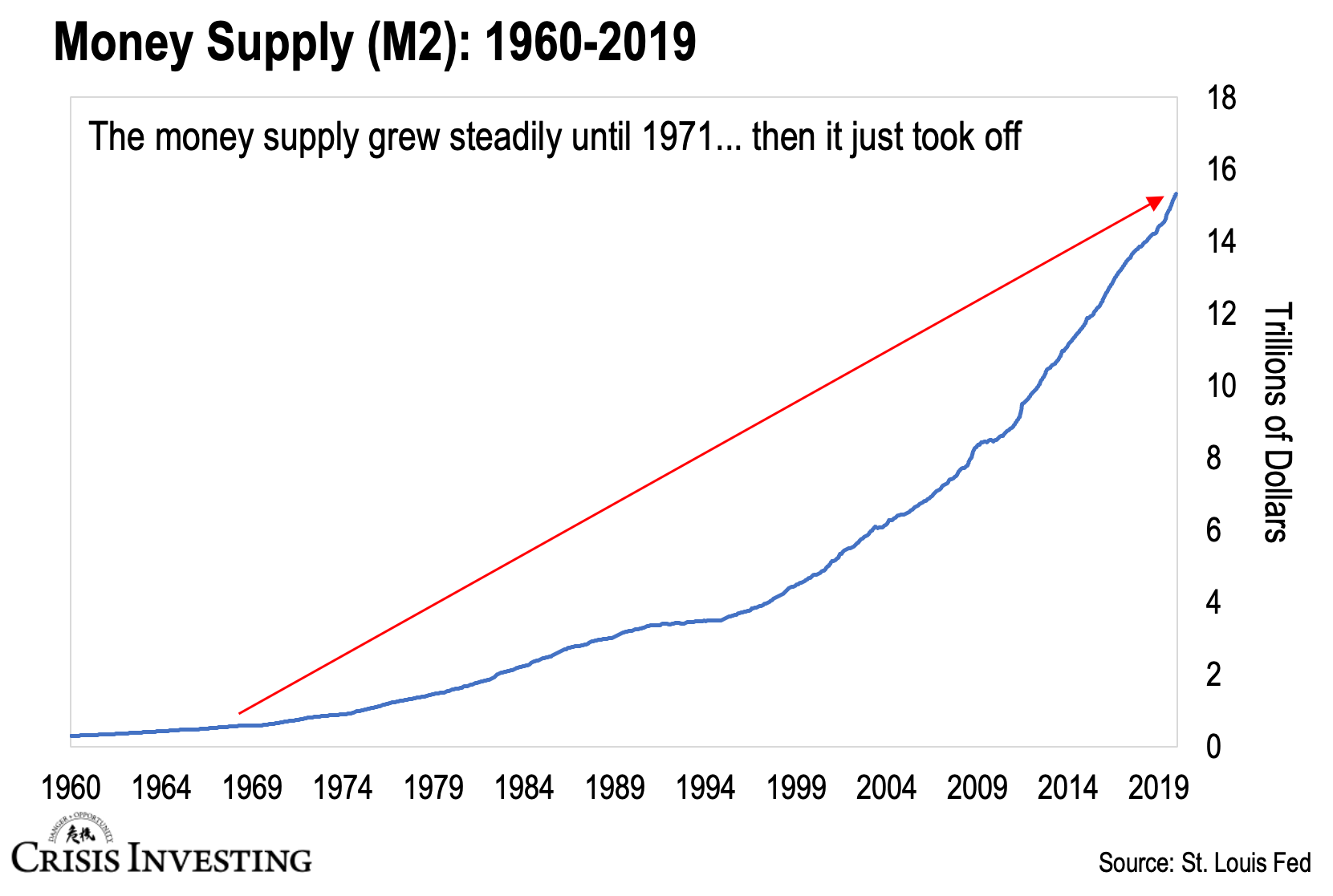
Now, I purposefully didn’t include the COVID years in that chart because that explosion was so extreme it would dwarf everything else.
In fact, the Fed pumped $6.1 trillion into the economy from 2020 to 2021 alone—a 40% increase in just two years. Which is why we’re still sitting on more than $22 trillion total today.
No wonder $140,000 feels like the new poverty line.
But brace yourself, because it’s not stopping.
As I told you in a recent essay, the Fed just announced stealth money printing. Starting last Friday, December 12th, they began purchasing $40 billion in Treasury bills per month. This may sound like technical housekeeping, but history shows that when the Fed starts these kinds of operations—whether they call it “plumbing” or “reserve management” or something else—it’s always the precursor to full-scale quantitative easing.
And so the destruction of the middle class continues.
Regards,
Lau Vegys
P.S. We believe the Fed’s move back into easy money will set off a massive bubble in commodities—especially in precious metals like gold and silver. In fact, gold jumped to a one-month high following the Fed’s announcement, while silver hit a record high above $64 per ounce. Even platinum, a metal not usually thought of as a monetary hedge, climbed above $1,750—its strongest level since 2011. That’s why a big portion of our Crisis Investing portfolio is in mining stocks, which Doug Casey himself owns.
It is unfortunate that this sort of information would never appear in, say, a mainstream media report
If anyone is interested in seeing more illustrations on how the elimination of the gold standard has impacted our economy, check out the website that Matt referenced in The Preparation called wtfhappenedin1971.com.