

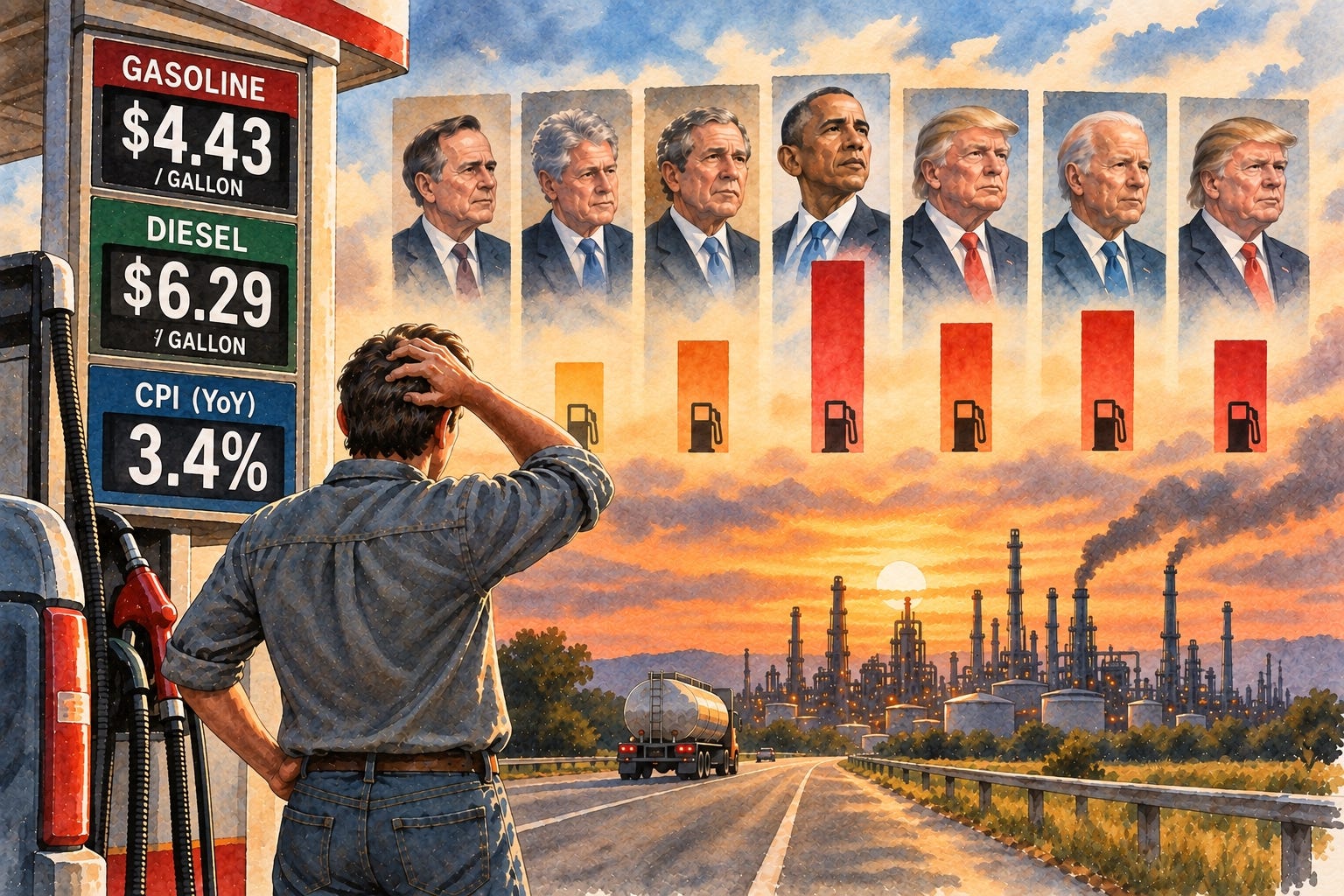
On July 3, 2008, West Texas crude closed at $145.31 a barrel. Convert that into 2026 dollars and you get $221.29. Nobody has paid that much for a barrel of oil before or since. Not in 2011. Not in 2022. Not this month either.
That same summer produced $6.27 gasoline and $7.30 diesel, when reported in today’s currency (2026 dollars), using the CPI-U for the conversion. Both are still the record.
Neither the 2011 Arab Spring spike nor the 2022 Ukraine spike beat the summer of 2008. This year’s Iran war and Saudi pipeline attacks haven’t beaten it. But because the 2008 price crashed within months, alongside the banks, it got filed under financial crisis instead of oil shock. For five months in 2008, Americans paid the highest real fuel prices in four decades of data.
I know the CPI is crappy, but it is how people think. Trying to present fuel costs without adjusting for the currency debasement in some fashion is misleading as hell. So today I am presenting data on fuel prices in today’s currency as translated through the CPI.
Obama wins!
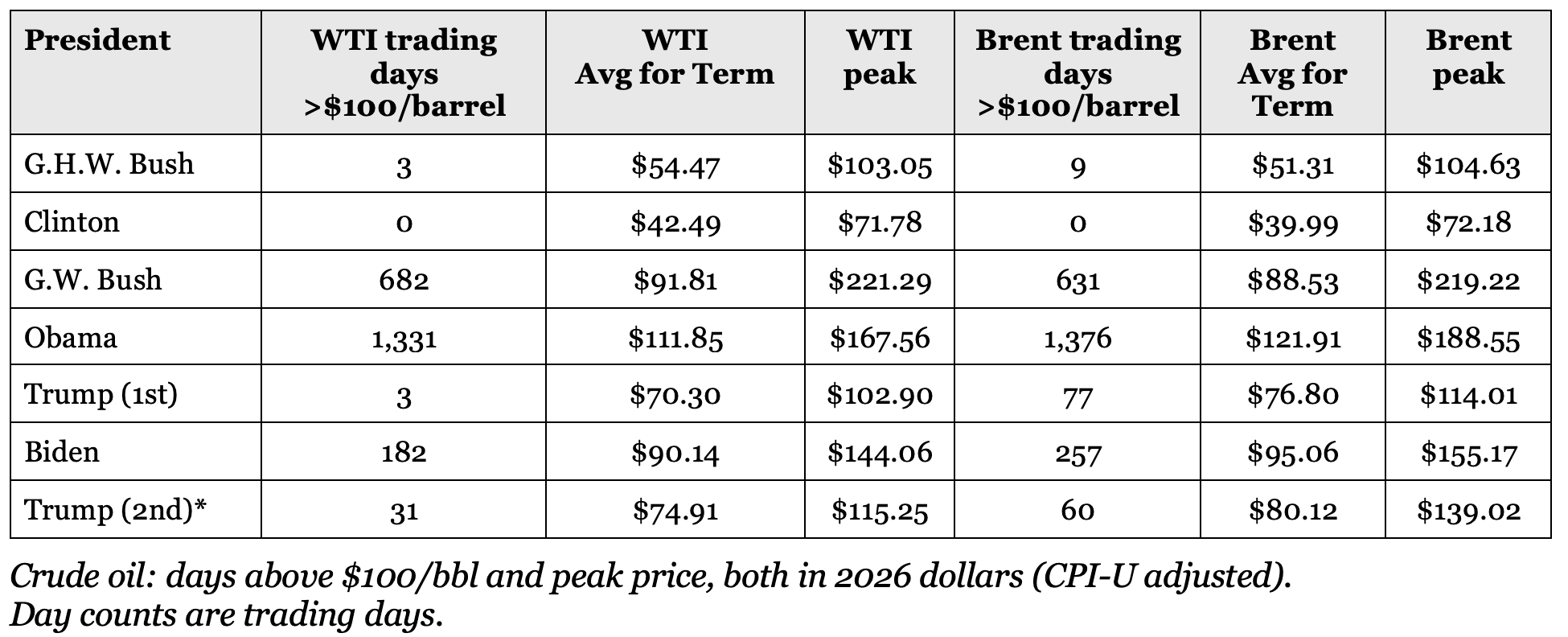
The nominal-price version of history says oil traded “over $100” for about three years under Barack Obama. Run the same prices through CPI adjustment and the real story proves worse: West Texas crude sold above the 2026-dollar equivalent of $100 on 1,331 of the 1,961 trading days of his two terms. That is 68% of his presidency. Oh, and diesel spent 73% of his presidency above $4 when calculated in today’s currency. Obama wins the green ribbon for highest sustained real crude and fuel prices.
Trump’s first term
Donald Trump’s first term gas averaged $2.48 a gallon (nominal price) at the pump, the figure cited as proof that cheap energy is a policy choice. But when converted to 2026 dollars, that “cheap gas” traded above $3 over 77 percent of the time, and diesel priced in at over $4 more than a third of the time.
Biden’s numbers were particularly ugly
Every week of Joe Biden’s presidency, without exception, saw gasoline above the 2026-dollar equivalent of $3. Diesel spent 80 percent of his term above $4.
What the dollar was doing
A 2026 dollar buys a fraction of what a 1982 dollar bought. Compare fuel prices across administrations in nominal terms, and you are mostly tracking the Federal Reserve’s counterfeiting of the currency from one term to the next.
So here are data on crude (WTI and Brent separately), gasoline, and diesel prices presented entirely in 2026 dollars (again, adjusted based on CPI, for what CPI is worth). I show them as (trading) days of the presidency above $100 for crudes, above $3 for gasoline, $4 for diesel, and also the average prices and single day peak price during the entire presidency. I reiterate, all converted to 2026 dollars.
First, the data about crude.
And now the data about distilled fuels. Lest you forget, these are in 2026 dollars too.
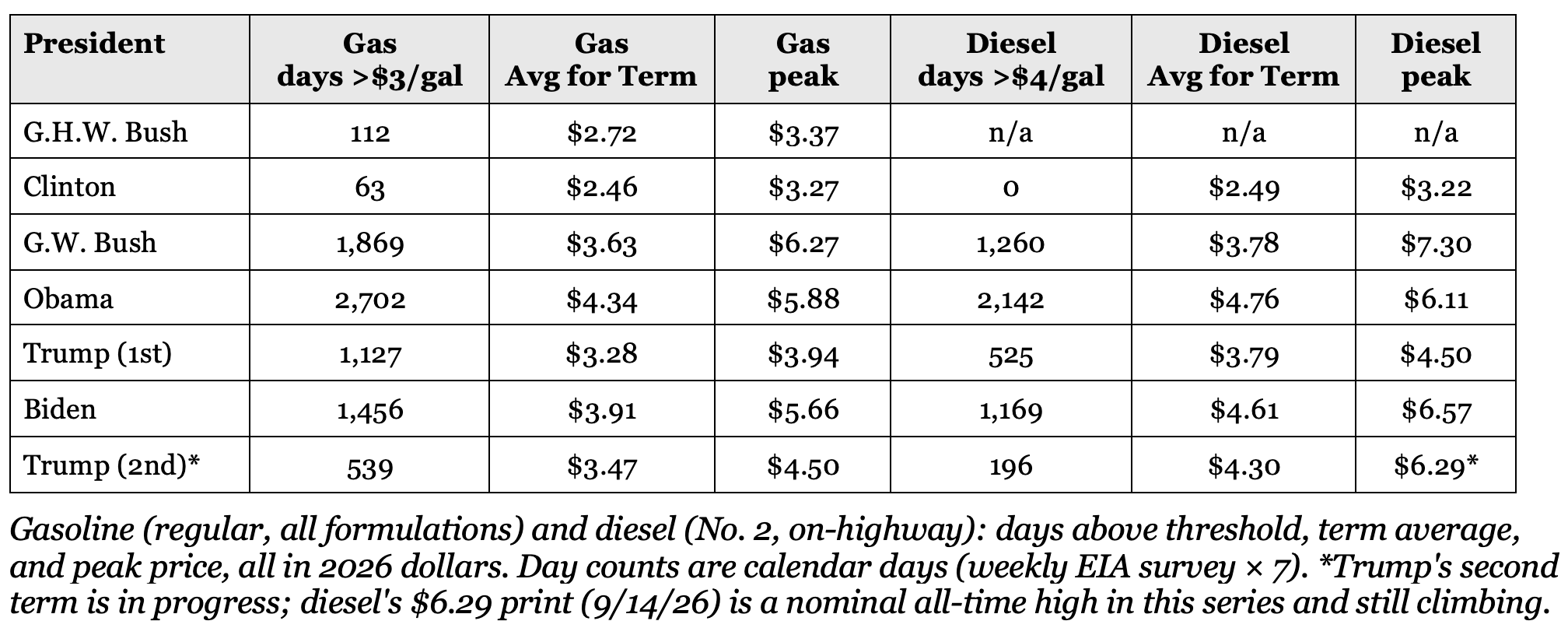
The idea that Trump has made fuel prices the worst ever is not correct. At least not yet. Obama still holds the title. But Trump is closing in on it. We know how Trump likes to win.
Here’s my big summary of the oil markets: War sucks.
The refineries that aren’t offline are maxed out on their capacity. As such, the demand for crude cannot go up much until refining capacity increases (which will take time) or governments start refilling SPRs. Supplies of crude can be reduced, and fear of that is what raises crude prices now.
In contrast, demand for refined fuels will do what it does as northern winter comes, with supplies from refineries not able to respond fully. So prices of gas and diesel and fuel oil will now depend on that demand for a while, until refinery capacity increases.
Looking at the crack spread through the same lens.
So this brings up another number worth a look here: the crack spread. That’s the refiner’s margin—what a refinery earns turning a barrel of crude into gasoline and diesel, using the industry-standard 3-2-1 formula (two barrels of gasoline plus one of diesel, against three barrels of crude). It’s the cut that sits between crude going in and fuel coming out.
Crack Spread (in 2026 dollars):
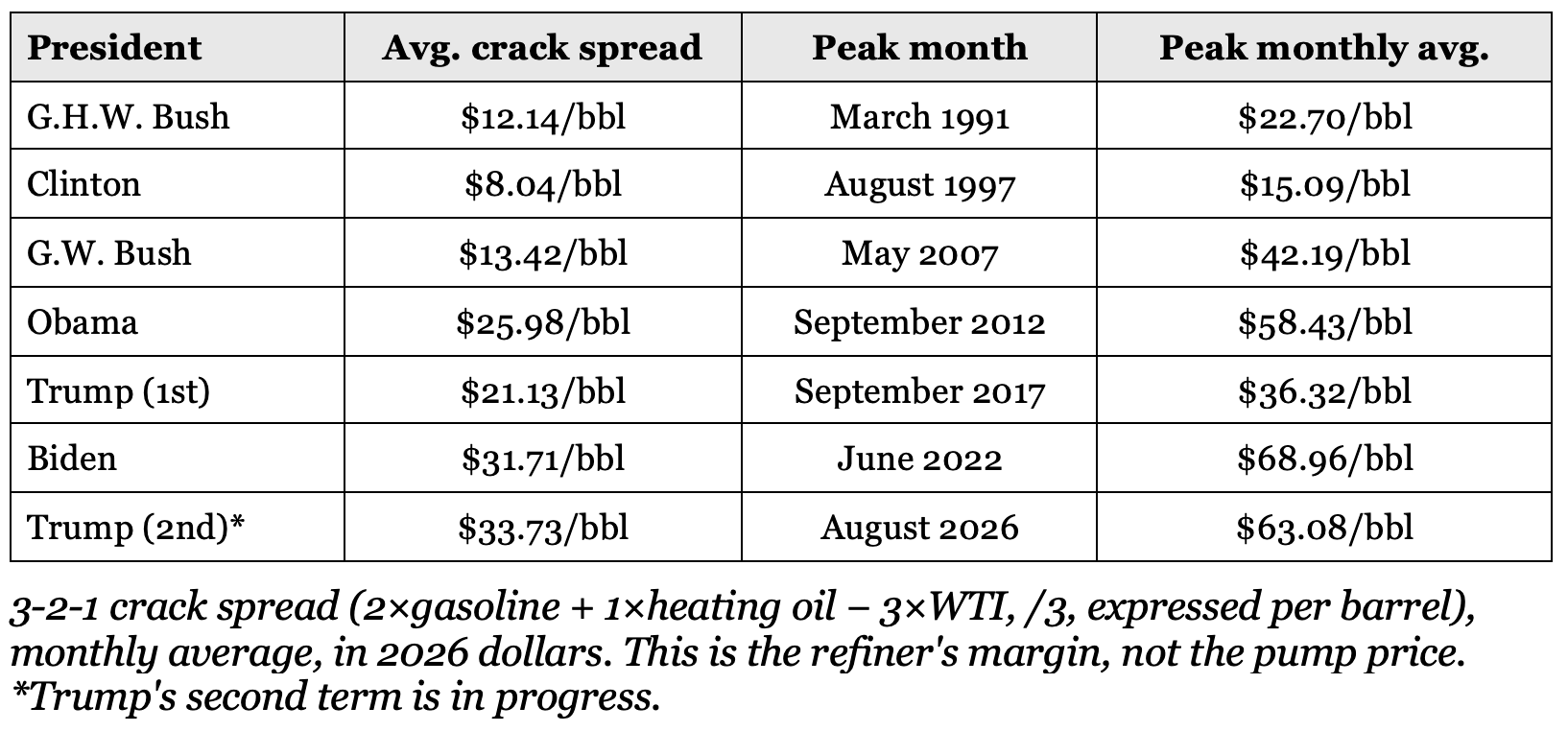
The average margin has generally been climbing, and Biden’s June 2022 month—$68.96 a barrel, in today’s money—is the record. But Trump’s second term is running the highest term-average of any presidency so far.
For Trump to bring down the prices of fuel at the pump—the prices that the everyday person cares about—we need to build new refineries or expand current ones. Trump may help by getting government out of the way of that process. And he could also help by not further incentivizing the Iranians to blow up the refineries in the Middle East.
But we should realize that prices aren’t yet insane compared to the past. Inflation has just decreased the value of the dollar.
One final note. The Fed is raising interest rates to combat “inflation,” that they—with their Keynesian mindsets—attribute in substantial part to the higher fuel prices. But the higher fuel prices are being driven acutely by insufficient refining capacity, not by low interest rates. I wonder if the Fed leadership thinks raising their rate by 25 basis points will somehow increase refining capacity.
I suppose I will keep wondering.
Sincerely,
John Hunt, MD
Editor, Doug Casey’s Crisis Investing
It would be good to have also priced it in gold ounces during that same period. I believe priced in gold it’s still cheap historically. Which goes to show by how much value have we been robbed
We all get it, no worries.
But are they that stupid ! The Fed - the Keynesian mindset. They can't be that far removed from the truth. A disgusting group of men who have the ability to turn it against the US administration or who ever is in office. After all they have been at this for awhile now.