
What the World Actually Runs On—and Why Hormuz Means More of It
Chart of the Week #102

I don’t usually put out a Chart of the Week this early in the week. But we just published our latest issue of Crisis Investing — our coal issue — and there’s a chart I’ve been meaning to share with you that I think deserves its own post.
Have a look.
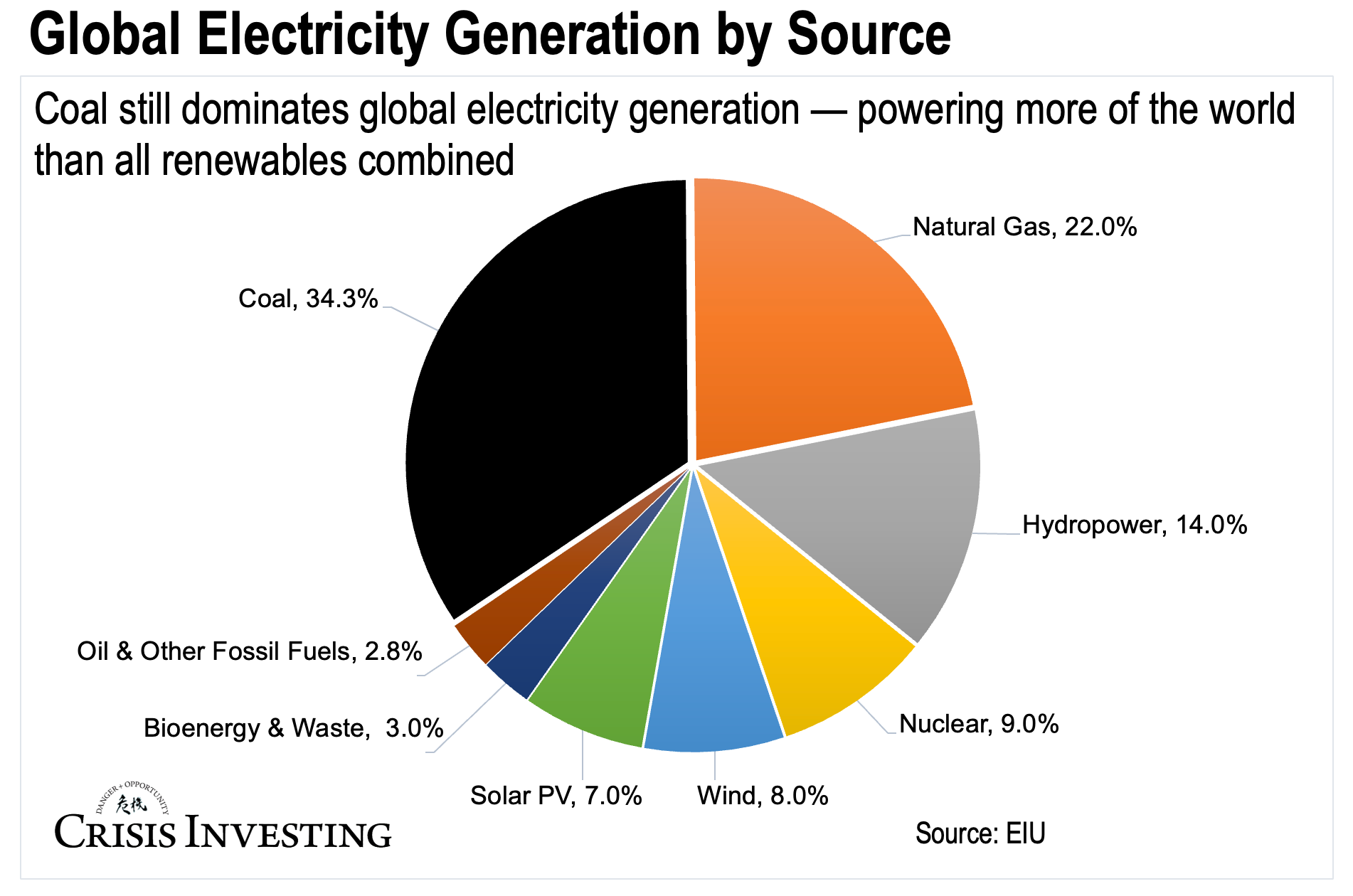
This is global electricity generation, by source. The biggest single slice — 34% — is coal. The single largest source of electricity on the planet, by a wide margin.
For context: that slice is bigger than every renewable source combined. Solar (7%), wind (8%), hydropower (14%), and bioenergy (3%) add up to 32% — and coal still beats them. It’s bigger than natural gas (22%) by half. Bigger than nuclear (9%) by nearly four times.
This is the world we actually live in. Not the one in the brochures.
Now, here’s the thing. This is a snapshot from a normal year. LNG tankers were still moving. Oil was well below $80. The pie reflected that.
Then Hormuz closed.
That is a big problem for resource-hungry Asia.
The region’s largest economies — Japan, South Korea, India, China — all import the bulk of their oil and LNG through that strait. Japan gets 95% of its crude from the Middle East, with roughly 70% of that travelling through Hormuz — putting two-thirds of its oil supply on the wrong side of the chokepoint. South Korea is in essentially the same position. India, 1.4 billion people, imports 85% of its oil with heavy Middle East exposure — call it half on Hormuz routes. China is at roughly 40%.
Now, this oil is all but gone.
So what’s their Plan B? More of everything that doesn’t ship through that strait — and especially coal.
Keep in mind, coal never died in Asia. It wasn’t even seriously targeted there the way it was in Europe. Japan, despite its high-tech reputation, still gets roughly a quarter of its electricity from it. China and India never stopped building new plants — quite the opposite, both have been adding record coal capacity for years. Vietnam, Indonesia, the Philippines, Bangladesh — same story across the region.
Why? Pure Asian pragmatism. Coal sits in the ground in Indonesia, Australia, Canada, the U.S., South Africa. It ships on Pacific routes that don’t run through anyone’s missile range. It’s abundant. It’s proven. It works at 3am when the sun isn’t shining and the wind isn’t blowing.
Of course, this time it’s not the sun or the wind that’s the problem. It’s Hormuz. And now that LNG tankers have stopped arriving and oil is at triple digits, governments are quietly extending the lives of plants they had announced for retirement just months earlier. They’ll burn more coal, build more plants, and lock in longer-term supply agreements with producers shipping on chokepoint-free routes — regardless of what gets said at the next climate summit.
Now, Asia is a lot of people. Billions of them. So the coal slice on the pie above isn’t shrinking. It’s growing.
Regards,
Lau Vegys
P.S. In our latest issue of Crisis Investing, we put forward two new picks built specifically for this thesis. If you’re a paid subscriber, make sure you haven’t missed it. And if you’re not yet on the paid side, the lead — featuring Doug Casey on why coal never really died — is free to all.
Thanks, Lau, for reporting from the real world. That's a telling graph. Jay
Japan, China and Korea don't have a problem importing oil from the ME or Iran. It's only countries supporting the illegal war against Iran that are cut off. So I wouldn't expect any great increase in coal imports from these Asian countries. Don't misconstrue this to mean I support Iran; all involved should be building and supporting life and prosperity, not destroying it.