

Yesterday we walked through how insurance closed the Strait of Hormuz in early March.
What we did not address was who has been keeping it closed since then.
The April Recovery
A ceasefire was announced on April 8. Within days, dark-fleet traffic began ticking back up. Vessels were running their AIS transponders dark, presumably coordinating with Iranian authorities for transit permission, paying fees in yuan and Bitcoin. The transits climbed from near-zero in March toward twenty-eight ships per day by mid-May.
Matt Smith has been tracking them. Here’s a graph from him.
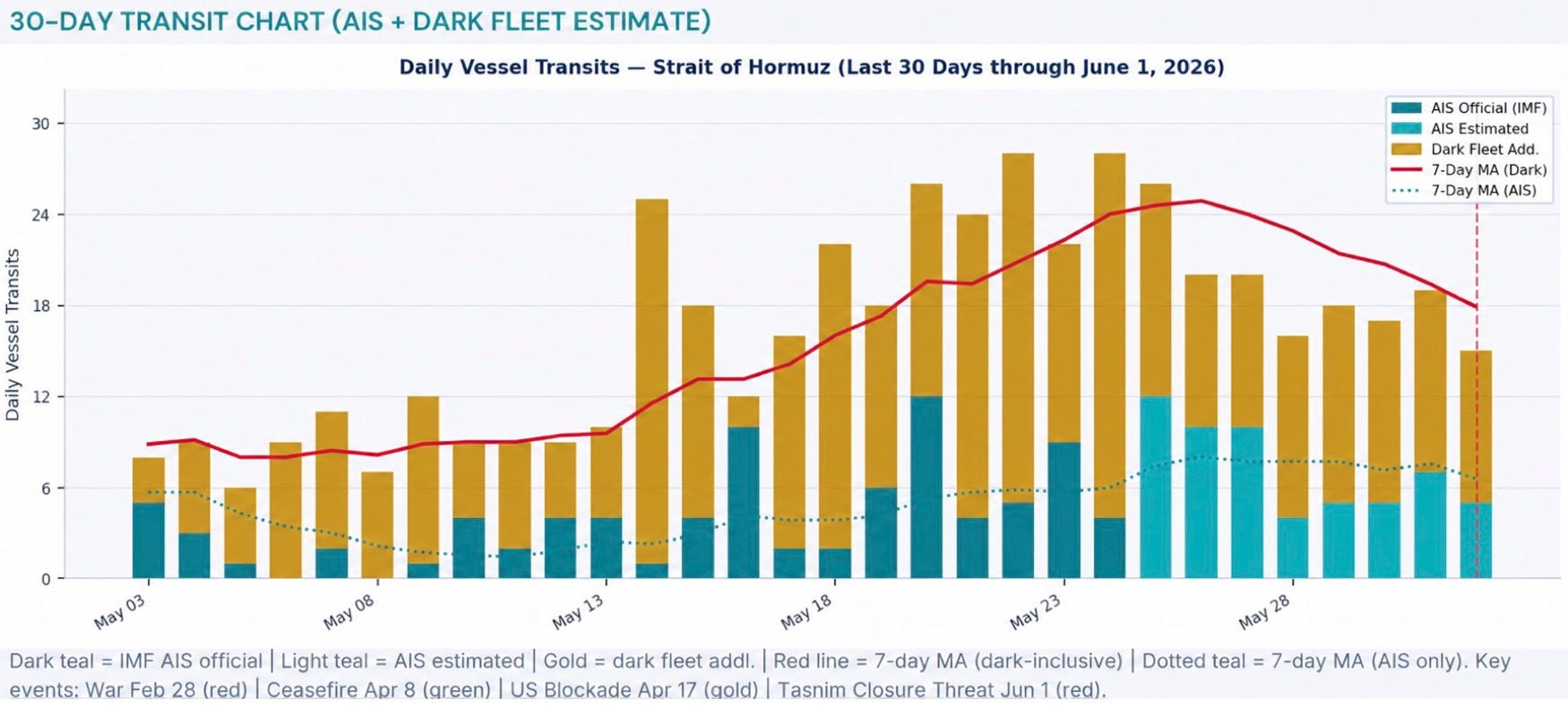
Trade was beginning to flow again. Saudi, Emirati, Qatari, and Iraqi crude were finding their way out.
But Iran was collecting tolls.
Operation Economic Fury
So on May 27, Treasury Secretary Scott Bessent announced the designation of Iran’s Persian Gulf Strait Authority — the new body Iran had set up to formalize transit fees — as a target of what Treasury calls “Economic Fury.” The designation falls under Executive Order 13224, the legal framework used against terrorist financing networks. Any vessel, company, bank, or state entity paying tolls to the PGSA now faces secondary sanctions and risk of being cut off from dollar clearing.
Western ships and shipowners attempting to transit the Strait will either be targeted by Iran or targeted by Bessent.
The DFC/Chubb Paradox
Meanwhile, the $40 billion DFC/Chubb reinsurance facility was supposed to bridge the gap between what Western insurers would write and what Western shipowners could afford. So far it has been unused.
Why unused? Perhaps because the facility’s vetting process requires beneficial ownership disclosure, cargo origin and destination, lender identity, and sanctions screening. Any vessel that actually transits the strait under Iranian permission — paying the toll, accepting IRGC navigation instructions — would fall afoul of Executive Order 13224 and be subjected to Economic Fury.
Whether by design or by uncoordinated agency action, Western-aligned commercial shipping has no legal route through Hormuz right now.
“Project Freedom”
In mid-May, the press began reporting that the U.S. military had escorted seventy commercial vessels through Hormuz with their AIS transponders disabled, under an arrangement CENTCOM called “Project Freedom.” The implication was that the U.S. Navy was getting Western cargo through the strait while bypassing both Iran and insurance limitations.
Several open questions about this are worth holding in mind.
Were the vessels insured? No lender lets a hundred-million-dollar tanker carrying a billion in cargo sail uninsured. The DFC facility’s application portal is not publicly open, which leaves a few possibilities.
1) If a ship had no liens on it, I suppose the captain could risk traversing the Strait of Hormuz naked. (Naked in this context means without insurance).
2) Maybe the DFC facility is quietly writing coverage (or “cover” if you are a Brit) for these specific operations through a non-public channel.
3) Conceivably the vessels carried existing non-cancellable war-risk policies.
4) Maybe the ship captain and owner got sick of waiting, and just drove on.
Was Iran capable of interdicting? Less capable than in March. Operation Epic Fury degraded Iranian radar, coastal defenses, and IRGC fast-boat infrastructure over ten weeks of strikes. By mid-May, Iran’s ability to detect and intercept escorted convoys moving at speed must have been substantially diminished. Trump told us it was totally gone, but he’s a man known to hyperbolize. The Iranian silence on these transits could indicate consent, or inability to detect, or political unwillingness to acknowledge an inability to interdict. All three are possible.
Why were the AIS transponders off? Two possibilities. Iran-coordinated dark-fleet vessels run AIS dark to keep their beneficial owners off Western sanctions databases. But vessels under U.S. military escort would also run AIS dark — to keep commercial ship-tracking services from publishing the convoy’s location in real time and giving Iran the targeting data its own degraded sensing network could not produce.
The reported Strait transits under “Project Freedom” could be real U.S. Navy-escorted commercial traffic. Or CENTCOM might have just rebranded existing dark fleet traffic to impress us. The verified facts — degraded Iranian capability, AIS-off transits, the absence of intercepts — fit either reading.
The Net Effect
We do not know whether the U.S. policy posture in May 2026 represents a coordinated maximum-pressure strategy intended to shake Hormuz free of Iranian control, or four uncoordinated federal agencies swatting at flies. Treasury runs sanctions. CENTCOM runs the blockade. DFC announces insurance facilities. State Department handles the diplomatic communications. Trump trumps.
When governments act, the difference between strategy and incompetence is academic. The market responds to the outcome, not the intent. Western-aligned shipping is filtered out. Non-Western shipping fills the gap. The changes will not unwind when the diplomatic situation eventually normalizes, because the relationships and infrastructure being built now will persist.
Fortunately, the free market will start restoring economic efficiency once the governments get out of the way. That happens about the same time that hell freezes over.
If this commentary is interesting to you, please forward it to anyone in your life who you care about, and suggest they subscribe to our free service. And if you want to profit from awareness of the Hormuz disruption and its diverse global effects (far beyond oil), join us in our premium Crisis Investing service.
Sincerely,
John Hunt, MD
Extremely well written and full of insights into what might be going on behind the fog of war and smoke screens of misinformation and propaganda. The actual markets most certainly will have a freehand once hell freezes over. Thanks for the good humor that runs through this piece despite the distressing facts of the case. Good medicine for the weary reader.
Allegedly, Iran has access to Chinese and Russian satellite ISR feeds. Allegedly, the Imperial Fleet is staying well out of range. Self-evidently, Iran has the drone wherewithal to keep the Strait under direct observation at all times.
The only thing "degraded" appears to be Trump's mental capacity.