
What an Attack on the Dollar Actually Looks Like
Chart of the Week #103

Last month, Khaled Balama — the United Arab Emirates’ central bank governor — sat down with Treasury Secretary Scott Bessent on the sidelines of the IMF spring meetings in Washington. He raised something unusual: the idea of a currency swap line.
A swap line is essentially an emergency credit arrangement between two central banks. They agree in advance to exchange specified amounts of currency at a fixed rate, giving each side access to the other’s currency in a crisis. The Fed maintains permanent swap lines with the Bank of England, the ECB, the Bank of Japan, the Bank of Canada, and the Swiss National Bank. It has never extended one to a Gulf state.
What was unusual wasn’t just the request. It was the implied alternative. If Washington wouldn’t backstop UAE dollar liquidity through the war’s economic damage, Abu Dhabi might have to start settling oil sales in Chinese yuan instead.
Five years ago, none of that would have been imaginable. And it’s not happening in isolation. Just look at what the financial press has been covering over the past few weeks:
“Iran’s Hormuz yuan play: a direct hit on the petrodollar” — Asia Times
“In Strait of Hormuz, Iran and China take aim at U.S. dollar hegemony” — Al Jazeera
“The US-Israel war on Iran is accelerating de-dollarization and America’s decline” — The Guardian
Those headlines describe something already underway — namely, a yuan toll booth that Iran has been running at the Strait of Hormuz since mid-March. Commercial tankers wanting to transit pay a fee — between $0.50 and $1.20 per barrel of cargo, by recent reporting — settled in Chinese yuan, routed through China's CIPS payment system. France, Japan, Malaysia, the Philippines, and Thailand — all U.S. treaty allies — are reportedly among those paying.
Read that again. U.S. treaty allies, paying Iran in Chinese currency to move oil through a strait Trump has spent the past two months trying to pry back open by force — without success.
This is what an attack on the dollar looks like in the actual world — not a BRICS press release, not a Davos panel, but in the real plumbing of how global oil trade actually settles.
And the worst part is the dollar wasn’t in great shape going in.
As of the latest IMF reading, global central banks hold roughly 57% of their foreign reserves in dollars. The rest is in euros (~20%), Japanese yen (~6%), British pounds (~5%), and Chinese yuan (~3%). As impressive as that 57% sounds, it’s the lowest in nearly three decades for how much central banks are keeping in dollars. Take a look at the chart below.
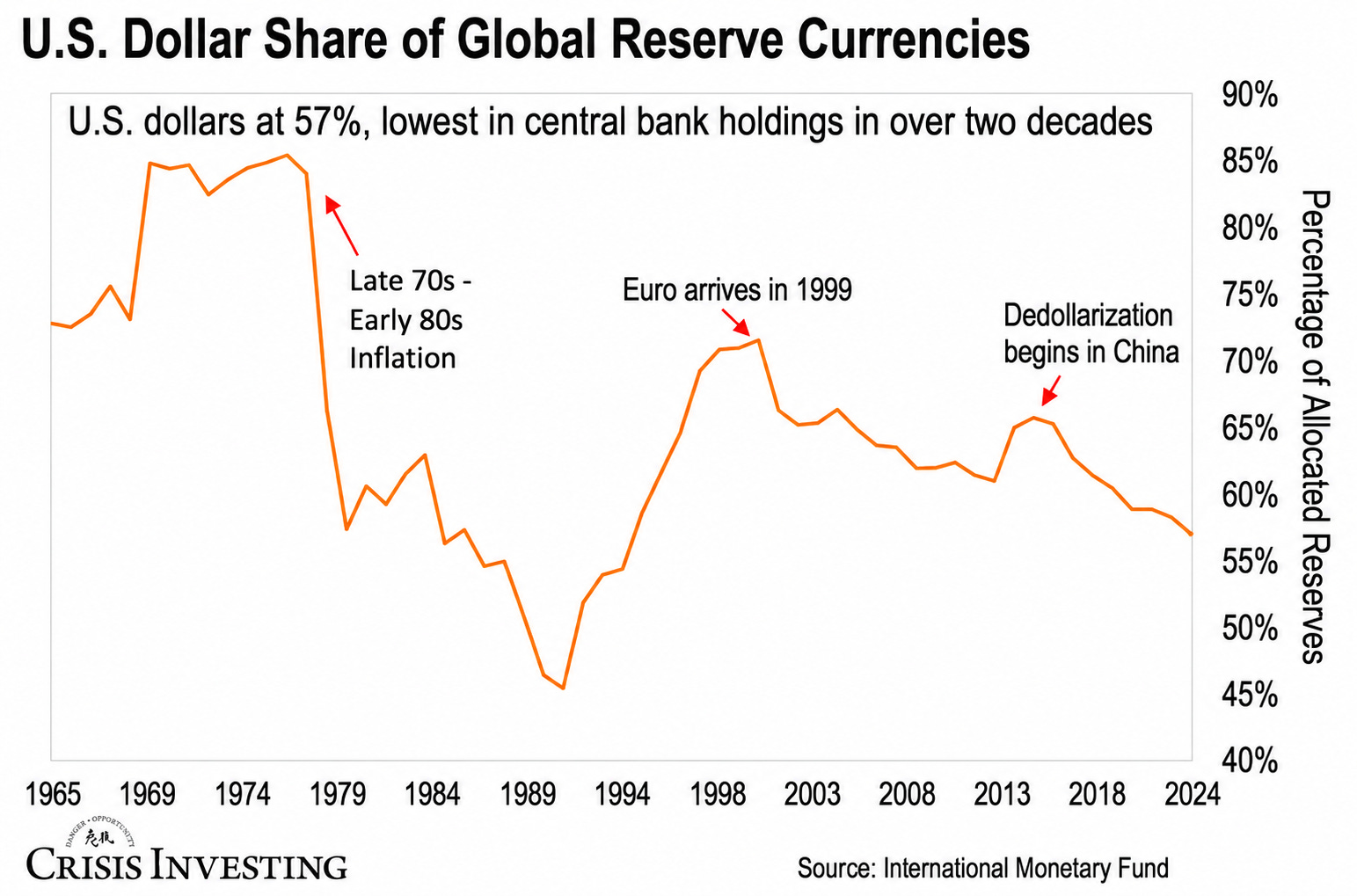
Now, let me walk you through some of the historical context to what you’re seeing here.
Since the 1970s, the U.S. dollar’s share of global reserve currencies has had a bumpy ride. From 1978 to 1991, its share nosedived from 85% to 46%. This drop came after a surge of inflation in the U.S. during the late 1970s, which shook global confidence in the Fed’s ability to manage inflation. Even as inflation eased up in the 1980s, the dollar’s share kept falling.
By the 1990s, confidence in the dollar started to come back, and its share rebounded. But then the euro came along and put a stop to the dollar’s gains. Since then, with the exception of a brief period between 2014 and 2016, the dollar’s share has continued to decline, fueled by China’s gradual shift away from trade in U.S. dollars in favor of the Chinese yuan.
In other words, the dollar was losing altitude long before the Iran war ever entered the picture.
Now, I’m not saying the dollar’s reign is ending tomorrow. But the trajectory is set — and the Iran war has done more in two months to accelerate it than a decade of BRICS posturing ever managed. My bet: when the 2026 reserve numbers land, this chart is going to look meaningfully worse. Probably much worse.
Have a great rest of the weekend,
Lau Vegys
P.S. We recently published the latest issue of Crisis Investing, with two new picks. If you’re a paid subscriber, make sure you haven’t missed it. And if you’re not yet on the paid side, the lead — featuring Doug Casey’s latest words of wisdom — is free to all.
Good chart and data. But, I think it may understate the problem. It's difficult to get an accurate picture due to the peculiarities of how foreign central bank holdings are reported through TIC data.
I know you were focusing on currencies and USD-denominated assets held by foreign central banks. But, if the focus is just on US Treasuries (rather than dollar-denominated assets), then gold meaningfully eclipsed Treasuries as a percentage of foreign central bank holdings in 2024.
But, even then it's difficult to get a real figure. TIC data includes Treasuries based on where they are domiciled, regardless of whether they are foreign central bank owned. So, a Japanese hedge fund that holds Treasuries at a Tokyo brokerage will be counted as a foreign central bank holding, as will Tether Treasury holdings domiciled in the Cayman Islands. If the Japanese Central Bank holds Treasuries but keeps them with a US brokerage, they aren't counted.
I'd be curious if anyone has a decent approximation of Treasuries actually held by foreign central banks. My understanding is that gold held by foreign central banks is easy to count; Treasuries, not so much. This is not my area of expertise, so I could easily be missing something.
Don't be hasty...
The US can continue the Iranian blockade for months. Iran can't wait that long..
US dollar dominance is reinforced thru swap lines. Like we just did in Argentina