
Warsh Announces His Federal Reserve Task Forces
Kevin Warsh promised to shake up the Fed. But shaking up the same ingredients won’t improve the taste.

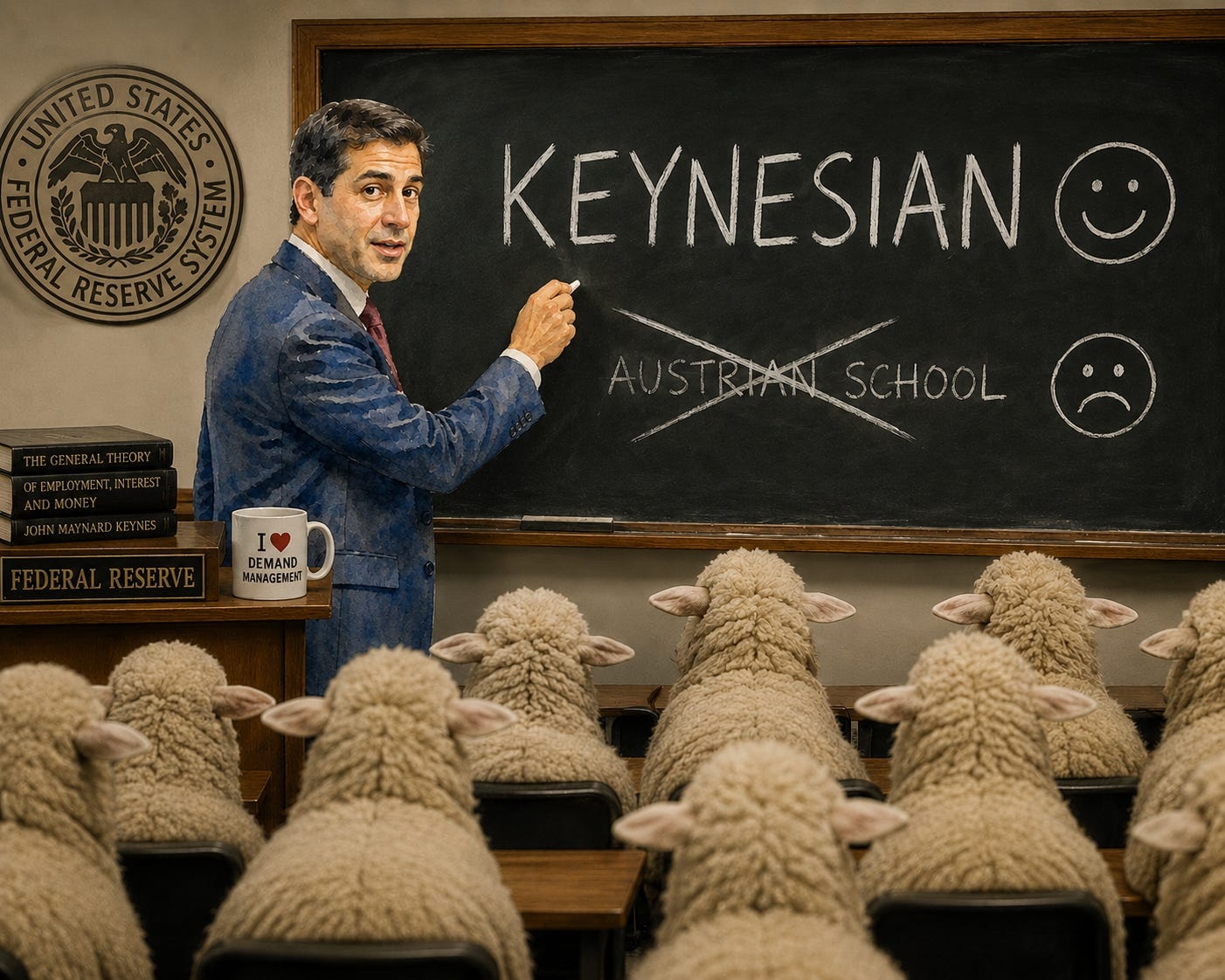
Austrian economists begin from a very different premise than modern macroeconomists. Rather than treating the economy as something to be managed from above through models and statistical aggregates, Austrian school adherents view it as millions of individuals making voluntary decisions. Interest rates are prices, not policy tools. Money is supposed to measure value, not manufacture demand. Austrian economists argue that the boom-bust cycle is driven by central-bank credit expansion and the distortion of interest rates.
For today’s commentary, a key point is this: an Austrian thinker doesn’t define inflation as rising consumer prices. Rather, inflation is the expansion of the money supply. Rising prices are merely one of its consequences.
On July 9, new Fed chair Warsh named fifteen people to sit on five task forces looking at how the Fed talks to the public, how it manages its huge pile of bonds, how it uses data, how it thinks about jobs and productivity, and (most important in my view) how it defines inflation.
I went looking for even one Austrian economist among those fifteen. You know, Mises, Hayek, Rothbard types. I was looking for someone who thinks with economic integrity: skeptical of central planning, and with a morality that approaches Natural Law. I sought people who worry about how fiat money quietly wrecks a nation, as opposed to people excited about the opportunities fiat currency provides to concentrate wealth and power.
I didn’t find one.
What I found instead is a highly credentialed group of central planners who mostly agree on one thing: that a handful of chosen experts pushing on wet noodles can make the economy do whatever they’re sure it should do.
None of these task forces is asking whether a committee of economists should be setting the price of money in the first place. Every panel begins with the assumption that the Fed’s role is indispensable. The only question is how to perform that role more effectively.
Here’s who’s on each team and where they’re coming from. Mostly, I won’t bother mentioning their university credentials.
Communications — Peter Fisher, Arminio Fraga, and Mervyn King. All three spent their careers running central banks or working alongside them. They believe in the standard playbook: set a price level target (which they will call “inflation”), communicate clearly, adjust as needed. Solid, professional team players who will try to make the Fed — as a collective concept — look competent, honest, and unbiased.
Balance Sheet Policy — Karen Dynan, Jeremy Stein, and Raghuram Rajan. Dynan and Stein come from the New Keynesian school, the idea that the economy doesn’t fix itself quickly, so a few old dudes (and dudettes) at the Fed should actively step in and steer it with their brilliance by manipulating interest rates and bond purchases. Rajan leans a bit more market-friendly and earned some credit for warning about reckless bank lending before 2008, but his solutions involve regulation and more Fed involvement, not less.
Data — Raj Chetty, Kevin Murphy, and Doug McMillon. Chetty is known for digging through enormous piles of government data to study who moves up the income ladder and who doesn’t, leaning on the kind of big-data thinking Austrians distrust. Murphy comes from the Chicago school, so perhaps he has more free-market exposure than others on the list. But he still builds his case from data and models, not from the Austrian method of reasoning straight from first principles about human action. McMillon spent his career running Walmart, so he brings business acumen, but sadly not from an Austrian economics background (as near as I can tell). Together they will create more expansive data sets so they can better push and pull on the wet noodles.
Productivity and Jobs — Marc Andreessen, Charles Jones, and Asha Sharma. Jones is a growth economist who builds models to explain why some countries get richer over time and others stall out. Andreessen and Sharma are tech investors and executives rather than economists, but no Austrian lens to help them see straight. Why the Fed is in any way involved in productivity and jobs is beyond my Austrian brain.
Inflation Frameworks — I had some small hope that this task force might squeeze some Austrian thinking into the confused mess that is the Fed. But it ain’t gonna happen. Greg Mankiw, Thomas Sargent, and William White are the group that will shape how the Fed thinks about inflation and the dollar going forward.
Mankiw indeed wrote the New Keynesian textbook that most economics students have learned from for decades. His view: prices move slowly, so a few hand-picked people at the Fed should actively manage demand for the entire economy. Sargent’s big idea: people aren’t fooled for long. If the Fed tries to sneak in a boost to the economy, folks catch on fast and adjust, so the trick stops working. I suppose that means they have to be quicker and trickier. White is interesting. He spent years warning that cheap money and loose lending set up the 2008 crash, a conclusion an Austrian would agree with, even though he got there through his own central-banking path rather than through Mises or Hayek.
Mankiw is about as mainstream a New Keynesian as it gets, and putting him in charge of rethinking inflation isn’t going to produce a framework that does We the People any good.
Across all five teams, the pattern holds: smart people with resumes and one shared assumption that the Fed can and should manage the economy from the top down and use their fiat currency tricks as needed. What’s missing is anyone who thinks the better answer is to do less of that.
These people are competent practitioners of crappy economics.
So Trump’s pick to fix the Fed isn’t going to fix the Fed. The task forces will just make the Fed more competent at doing the things I wish it weren’t doing at all.
We should accept the fact that Austrian economic thinking, which would help humanity and the true general welfare, is not employed by those who pull the strings in this world. Lots of people are making oodles of money by doing the things that make sense within the Keynesian economy. They are the special interests, feasting at the trough and then malinvesting right and left as the Fed’s currency debasement increases asset prices in dollar terms. They will do well personally as the blood gets sucked from the rest. Those who populate the Fed world have strong incentives to keep milking that system.
The Fed’s intellectual direction hasn’t changed, which means the long-term trends we’ve discussed for years—currency debasement, asset inflation, and the importance of owning productive businesses and real stores of value like gold—will remain intact.
If the diagnosis hasn’t changed, neither should the prescription.
Sincerely,
John Hunt, MD
If "the road serfdom " had been required reading in universities the past 50 years it's not likely that we would be seeing the rise of socialists and collectivist bigger government policies.
I am a strong believer in Austian Econ, Mises. You have accurately described the Gloom and Doom of the same old playbooks with the same players, whose thinking is, again, on the wrong path! Thank you for this brilliant commentary!