

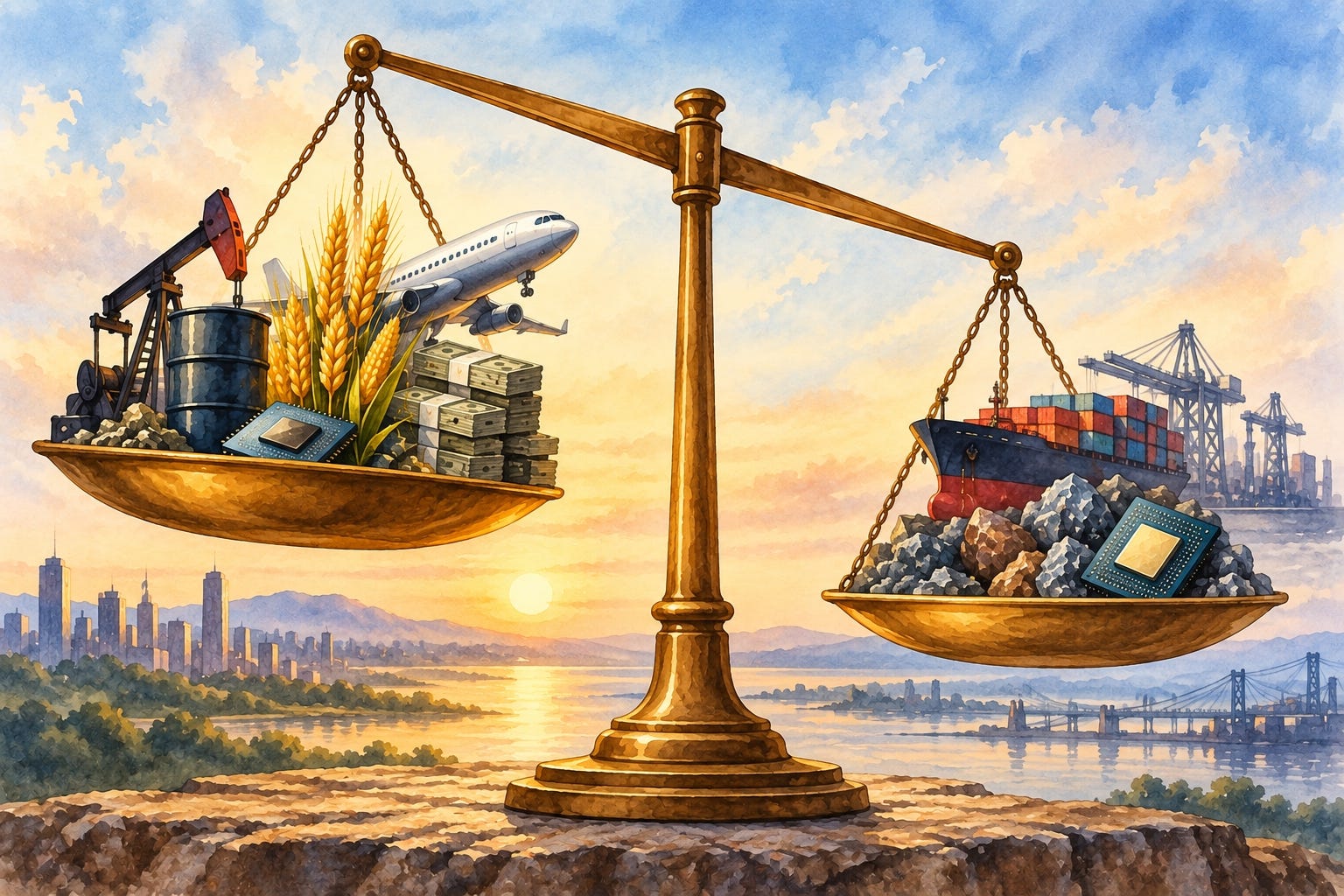
One of my philosophies is that success is better achieved from building on one’s strengths, not from overcoming non-fatal weaknesses.
If I spend effort making myself better at things I don’t genetically, physically or otherwise have innate capabilities to do, I may improve myself, but not by as much as if I were to spend the time, energy and money building upon what I am innately good at. Same with wealth creation. Same with companies. Maybe the same with countries.
As we move from the individual to the companies to countries, we get increasingly collectivist in our thinking, so beware. But with that caveat in mind, I present here a list of some relative strengths and weaknesses of the United States—as a giant collective—that stick out in my mind. I’m deliberately leaving cultural and social questions aside, although those are of course relevant to the future of the listed items below. But this list is about strategic, resource, financial, and industrial capabilities.
And there are many more strengths and weaknesses than I yet have on this list.
I intend to write no specific conclusions here. Unless I can’t help myself. You will come to your own conclusions. This is a conversation starter. Please add to this list in the comments please.
Notable Strengths of the USA
Energy
The US is the largest oil producer on earth since 2017. It amounts to 18% of global crude supply, more than Saudi Arabia and Russia combined. Also the world’s largest natural gas producer. Caveat—formal petroleum reserves are only about 9th in the world, a bit bigger than China’s. But the reserves keep growing. The US is particularly good at getting the oil out of the ground. The US is the world’s largest LNG exporter, reaching 35 countries. The U.S. will hold about 30% of the global LNG market by 2030. Cheap domestic natural gas is a direct feedstock subsidy for chemicals, fertilizer, and steel.
Commercial aircraft manufacturing
Boeing is the second largest producer of jet airliners, after Europe’s Airbus. Between them they build nearly the entire global fleet. (Boeing 45%, Airbus 50%). Clearly, no third competitor (COMAC in China, JetZero in the U.S.) is remotely close.
Agriculture
Incredibly productive agriculture. $171 billion in agricultural exports in 2025. Corn, soybeans, dairy, beef, and pork are the top categories; Mexico, Canada, and the EU are the largest buyers.
Capital markets and the dollar
U.S. dollar still makes up 57% of global FX reserves and almost 89% of foreign exchange transactions. $7.4 trillion of global reserves are held in dollar-denominated Treasuries and investment-grade bonds. Deepest, most liquid capital markets in the world. All this is what lets the U.S. government run deficits other countries couldn’t finance.
Technology and chip design
Nvidia and AMD dominate chip design and AI accelerator architecture even though actual fabrication happens overseas.
U.S. firms still own most of the intellectual property in the semiconductor value chain, just not the factories.
Defense and aerospace
Full-spectrum weapons and aerospace manufacturing base, still the most complex in the world, even though it’s slow and expensive.
Notable Weaknesses
Shipbuilding
The U.S. builds 3-5 large commercial vessels a year. China builds somewhere between 1,000 and 1,700, depending on how you count hull sizes. Chinese shipyard capacity is roughly 23 million tons per year versus under 100,000 tons in the U.S., a 230-to-1 gap. The U.S. has 4 active public shipyards; China has 35.
A single Chinese state shipbuilder, CSSC, built more commercial tonnage in 2024 alone than the entire U.S. shipbuilding industry has built since the end of World War II. U.S. share of global commercial shipbuilding by tonnage: 0.10%. That’s one-thousandth. China alone took 69% of new orders in 2025, South Korea 22%, Japan 6%.
Fleet count: the U.S. Navy has about 296 deployable ships; China’s navy now has 355 battle-force ships. It now takes about a decade for the US to build a Navy ship. They can be sunk faster.
Rare earth and critical mineral processing
China processes 85-90% of the world’s rare earths and produces about 94% of sintered permanent magnets. The U.S. mines 13% of global rare earth output but has almost no domestic refining capacity.
Semiconductor fabrication
Taiwan holds roughly 90% of global capacity for advanced logic chips (sub-10nm). TSMC alone controls 64%+ of the global pure-play foundry market. The U.S. designs the chips. It doesn’t make the advanced ones.
Mine permitting
Average time from discovery to production for a U.S. mine: 29 years. Second-slowest in the world, behind only Zambia (34 years). This figure covers cobalt, copper, gold, lithium, nickel, palladium, platinum, vanadium, and zinc. It does not cover coal, oil and gas, or iron ore, which have different permitting tracks. Permitting alone takes 7-10 years in the U.S. versus 2-3 years in Canada and Australia.
I found this interesting: U.S. gold mines average 24 years discovery-to-production versus a 21-year global average for gold. U.S. copper mines average 32 years versus a 24-year global average, making copper the slowest major commodity to permit and build, both in the U.S. and worldwide.
Skilled trades and manufacturing labor
Manufacturing will need 3.8 million new workers by 2033; 1.9 million of those jobs are projected to go unfilled. 2.8 million of the 3.8 million needed are replacing retiring workers, not even net growth.
Motor vehicle manufacturing
The U.S. is the world’s second-largest vehicle producer, but a distant second. China now builds more than 3x what the U.S. builds, and is still growing (+10% in 2025) while U.S. output fell 3% the same year. 2025 global output: China 34.5 million vehicles (37% of the world total), U.S. 10 million (11%), Japan 8.4 million, India 6.5 million, Germany 4.2 million. Total global production: 96.4 million vehicles. China exported nearly 5.9 million vehicles in 2024, overtaking Germany and Japan as the top vehicle exporter.
Ball bearings
Alongside abrasives (which I will discuss in a future letter), precision bearings are a textbook chokepoint item: every engine, turbine, machine tool, and vehicle needs them, and they’re hard to substitute on short notice. The U.S. consumed 185,000 tons of ball and roller bearings in 2024. Imports supplied 139,000 tons of that, which is about 75% of total consumption.
Savings rate and current account
U.S. current account deficit ran $1.12 trillion in 2025, about 3.6% of GDP. Net saving declined while net investment kept rising. The gap is filled by foreign capital buying up pieces of America.
Healthcare cost as a tax on labor
National health spending is 18.0% of GDP and rising. The American system of third-party insurance payment, hybridized deeply with government, is foolish at so many levels. As a physician, this hits close to home for me. Maybe for most people.
Permitting and regulatory drag, beyond mining
The mine data above is the clearest example, but the multi-year timeline applies to refineries, pipelines, liquefaction terminals, and new industrial plants across the board. Competing countries measure the same approvals in months, not decades.
Bottom Line
America is exceptionally good at extracting resources, growing things, designing things, financing things, and developing high-value intellectual property—but increasingly dependent on others for the industrial processes that turn those capabilities into physical goods at scale, and the transportation of goods around the globe. Regulatory and medical care present enormous drags on productivity. Government is always in the way.
There are many more strengths and weaknesses. If you post more of them in the comments, I’ll add them onto my master list. If you are motivated to comment about social/political strengths and weaknesses of the US, that’s fine too. I’ll track them as well.
Thank you.
John Hunt, MD
Editor, Doug Casey’s Crisis Investing
The US is a major timber grower with 60% of its forests privately owned by millions of diverse owners producing 89% of total national timber production. Public forests face bureaucratic management without incentives to produce and are easy targets for NGOs and lawfare against harvesting and management.
Sad part is the human capital. As a nation we become lazy, entitled, rude and belligerent. The orange wall kisser is a major problem for earth. Committing genocide is beyond insane it’s totally mad.