

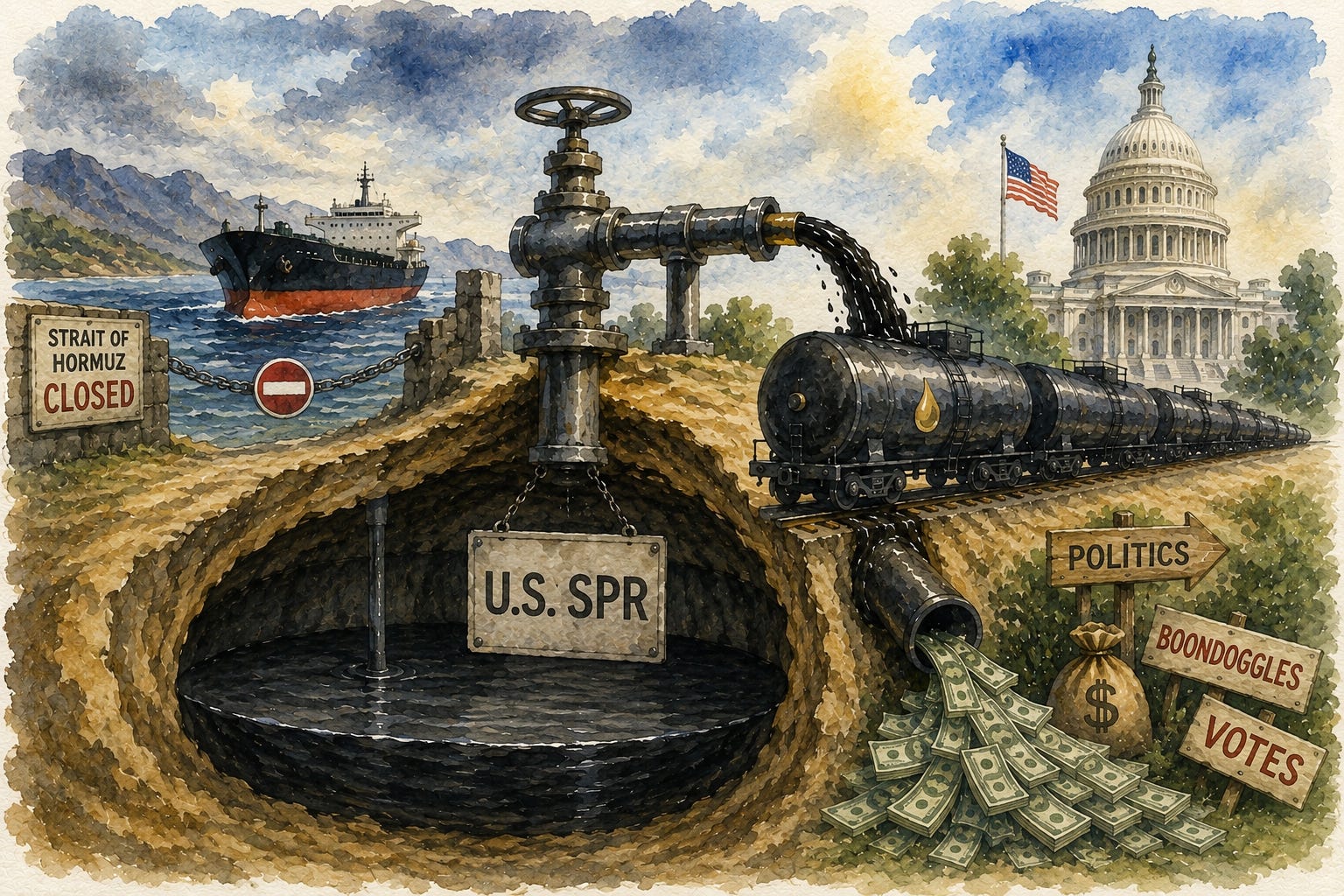
Look at the U.S. Strategic Petroleum Reserve.
298.7 million barrels. The lowest since January 1983. Down from 415 million in March. Down from a peak of 726.6 million in 2010. Down because Secretary of Energy Chris Wright announced 172 million barrels for release in March, after Iran shut the Strait of Hormuz and 32 IEA nations agreed to a coordinated 400-million-barrel dump.
That’s a Keynesian move. And a political move. It’s not a strategic move.
The SPR is a misnomer.
In the boom times, Keynesians theoretically want government to suck currency out of the economy, right? To moderate the boom they are supposed to increase taxes and decrease government spending. A byproduct of that is creating a government surplus, a reserve: loading up the capacitor.
In the bust times, Keynesians supposedly want government to put currency into the economy to smooth out the valley. They are supposed to lower taxes and increase government spending, consuming the reserves, draining the capacitor.
At the macro level, this Keynesian system can be superficially enticing. Smoothing the valleys and hills can make some sense. The problem is that it requires politicians and bureaucrats to know things they cannot know—and then to do things they have no political incentive to do. How much should be taken out during the boom? How much should be put back during the bust? When should the stimulus stop? Nobody knows. Meanwhile, politicians get rewarded for spending today and rarely punished for the bill that arrives tomorrow. They get to decide which crony friends benefit (nod nod, wink wink), buy votes with the spending, and create new programs and entitlements that never unwind.
The spending is supposed to be temporary. It rarely is.
Deficit spending in the bad years, government surpluses in the good years. That’s the Keynesian idea. But politicians decided deficit spending—every day, all the time—is easier. We can call this a mutated Keynesian playbook.
Back to the SPR
Now the government runs the same play with oil in the SPR that the government (and Fed) runs with the dollar.
The US SPR is held in salt caverns with a maximum capacity of 714 million barrels (a bit lower than at its peak because one storage site had to be decommissioned). The reserve hasn’t touched that number since 2010. The reserve keeps ratcheting lower.
The politicians and bureaucrats are pumping oil into the economy like they pump currency into the economy. It’s the mutated Keynesian playbook.
As it their way, they mutated it further. For years, the SPR was a congressional piggybank. They’d sell some crude here and there to pay for congressional boondoggles. Just like they print money to pay for congressional boondoggles.
Then Biden released 180 million barrels in association with the sanctions of Russian oil to keep pump prices lower before his midterm elections. That’s just the headline number — the SPR fell from 638 million barrels when he took office to 350 million by September 2023, a drop of nearly 290 million in a mixture of political shenanigans by Biden and political shenanigans by Congress. Trump critiqued the whole drawdown in no uncertain terms.
That drain got partly refilled over the next two years, back up to about 415 million barrels, paid for (in the end) with newly created dollars (inflation). The Biden admin kept the mutated Keynesian playbook going.
Now Trump has released 172 million barrels to combat fears of rising oil prices because of Hormuz. If that is “strategic” then the strategy is just to keep the population less pissed off about the price of fuel so we don’t pick up our pitchforks, and don’t oppose the war.
If and when that gets restocked, it will be paid for with new currency units (inflation). Same play, different political party.
And so the Strategic Petroleum Reserve—created to provide emergency supplies so we could defend the borders and maintain commerce when foreign entities misbehaved—has been used by politicians to blunt the negative effects of their own foreign policy decisions (Russian sanctions, wars, etc). And to pay for boondoggles.
Unlike the US dollar, petroleum can’t be created out of thin air. So you’d think there would be an end to this play. But it’s called the petrodollar for a reason. The dollar part of that is unlimited.
China
Now look at China. In the first quarter of 2026, before Hormuz closed, China was importing crude at 11.6 million barrels a day on average through 2025, with 5.4 million of that a day flowing through the strait itself, more than any other country on earth.
And Beijing wasn’t burning all of it. By the U.S. Energy Information Administration’s estimate, China was banking roughly 1.7 million barrels a day before the closure — buying more oil than it needed, at prices it liked, and stacking the difference in salt caverns and commercial tanks — the Chinese SPR. Estimates are that they were starting to max out their storage capacity.
Based on the global price of a barrel of crude, the Chinese government sets the prices of fuels that Chinese people have to pay at the pumps (it’s more complicated than that, but close enough for now). When the oil prices were low, Chinese purchases kept the global barrel prices a touch higher as they bottom-fed to fill their SPR. And the Chinese citizens paid for this at the pumps.
When the strait closed, China’s answer wasn’t to bid up the price against a shrinking supply in order to keep filling their stockpile. Instead, it cut seaborne imports by 5.4 million barrels a day from prewar levels — more than 40% of what it had been buying — and presumably stopped filling their SPR and began drawing down their SPR stockpile.
When oil prices rose from the war, China released its SPR instead of buying pricier replacement crude, but the pump prices rose because those prices are determined by global prices (according to the Chinese government pricing system). So the Chinese government effectively made money coming and going.
Very clever, these Chinese.
Buy low, don’t overpay in a panic, keep the books private, have an emergency fund, produce more than you consume and save profits. That’s wise economic thinking.
Heck, it’s as if they were speculating the way we (at Crisis Investing) like to do. Put it aside during abundance so you can sell it at a profit when the normal supplies fail and people get desperate. It’s pretty wise for the Chinese government (not so great for its people).
Meanwhile, the US and Europe ran their same mutated Keynesian program: spend hard in the crisis, never save in the calm.
There is an important distinction between China and the US reserves. The US government has its reserves in the SPR that it can immediately pump out and send to refineries. But the geographic area known as America has lots more oil in the ground that has never been pumped out. That is a form of reserve as well, just a bit harder to pump. The US also possesses the world’s reserve currency.
China does have oil in the ground — proved reserves around 28 billion barrels — but domestic production covers only about a third of what the country burns, leaving it dependent on foreign supply. And it doesn’t have the reserve currency. So China’s SPR is more critical to China than the US SPR is critical to the US.
It is reasonable to expect China to start refilling its SPR. And that will help keep a floor under crude prices until their storage capacity maxes out.
The US politicians will print up more currency units to refill their own SPR. But they won’t be producing more than they consume and saving the difference. They will be counterfeiting the currency to fill the caverns. It’s their mutated Keynesian playbook going for a bit longer.
Or just call it what it is. The Political Petroleum Reserve.
What are the odds that it will be nearly empty when the time comes that we actually need that supply strategically? I’d think pretty high.
What can you do about the SPR?
Nothing.
But you can build your own strategic reserve. Something that doesn’t spoil, fits in the palm of your hand, and can be traded for the other things in life you need.
John Hunt, MD
Editor, Doug Casey’s Crisis Investing
A nice big picture John. A pile of cash and a bigger pile of gold for the day the bottom falls out. It's coming.
Jim Marshall
Lowest SPR since 1983 and they still call it strategic. It's a campaign fund with a pipeline.