
The Petrodollar Is Coming Apart in Real Time. Trump Calls It a Win.
OPEC Is Unraveling—and That's a Problem for the Dollar

A couple of weeks ago, Khaled Balama — the governor of the United Arab Emirates’ central bank — met with U.S. Treasury Secretary Scott Bessent on the sidelines of the IMF Spring Meetings in Washington. Balama quietly raised the idea of a currency swap line — essentially a central-bank-to-central-bank emergency credit facility, the kind the Fed uses to keep dollar liquidity flowing during a crisis. The story generated a few headlines, then quickly faded from view.
But days later, something more interesting happened: the United Arab Emirates walked out of OPEC. After 59 years a member.
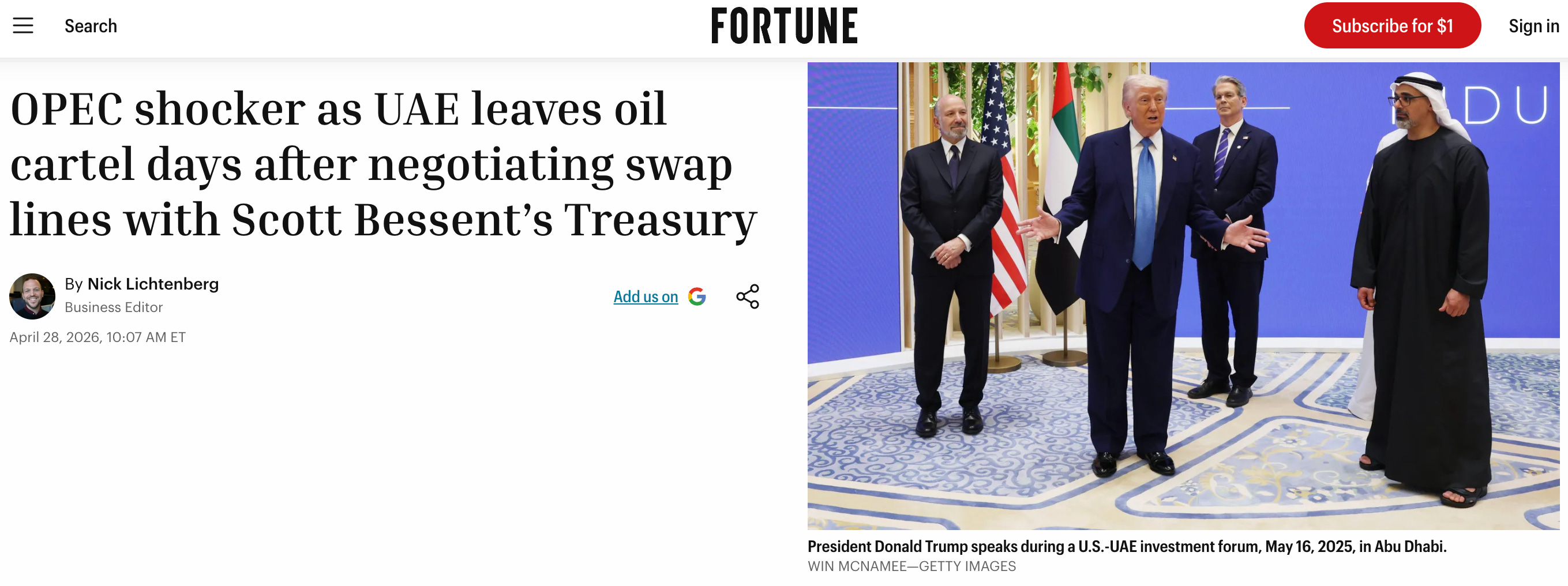
OPEC, as you probably know, is the cartel that has coordinated oil production and pricing among the world’s largest exporters since 1960. The UAE joined in 1967 — and for most of the petrodollar era, which is to say for half a century, has been one of OPEC’s most important members.
President Trump’s been running victory laps. He’s been calling OPEC “broken” and “collapsing” on Truth Social, telling Americans the cartel is finally cracking, oil prices are about to come down, and we win at the pump.
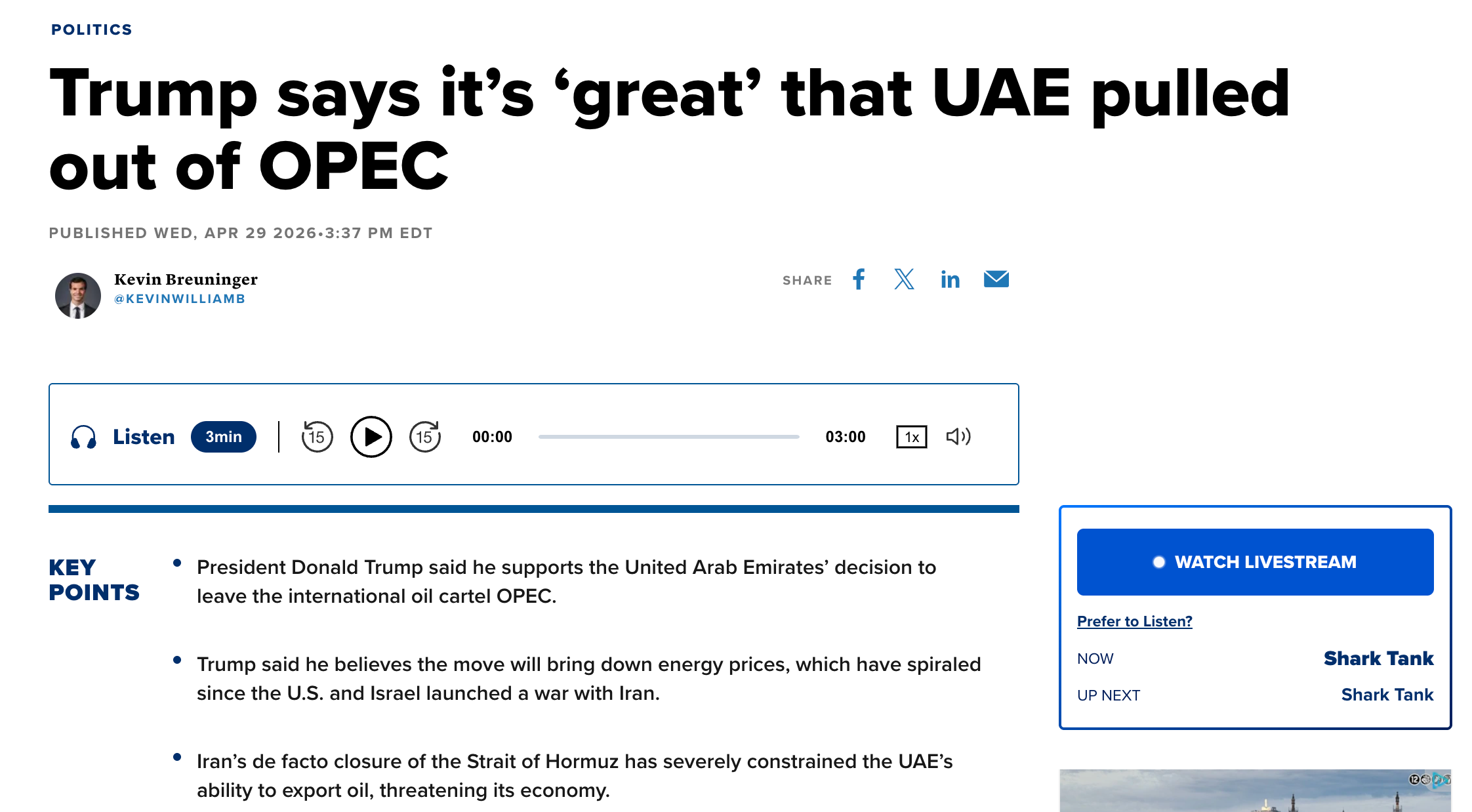
But if you understand what OPEC was actually for, the UAE’s exit isn’t a win. It's the petrodollar system — the arrangement that's kept the U.S. dollar standing for 51 years — coming apart in real time.
How We Got Here
To see why, let's back up.
In 1971, Nixon closed the gold window. The dollar went pure fiat — no gold, no redemption, just paper. And every oil-producing country was suddenly facing the same question: why sell a real, finite resource for a currency that can be printed in unlimited supply? Only a fool would. The Saudis weren’t fools.
So in 1974, Henry Kissinger flew to Saudi Arabia and cut a deal — in secret. Three terms. The Saudis would price their oil exclusively in U.S. dollars. They would recycle those dollar revenues into U.S. Treasuries. And America would provide military protection and guarantee the survival of the House of Saud.
Interestingly, the full terms of that deal were kept hidden for 42 years. They didn’t surface until a Bloomberg FOIA request in 2016 forced them into the open.
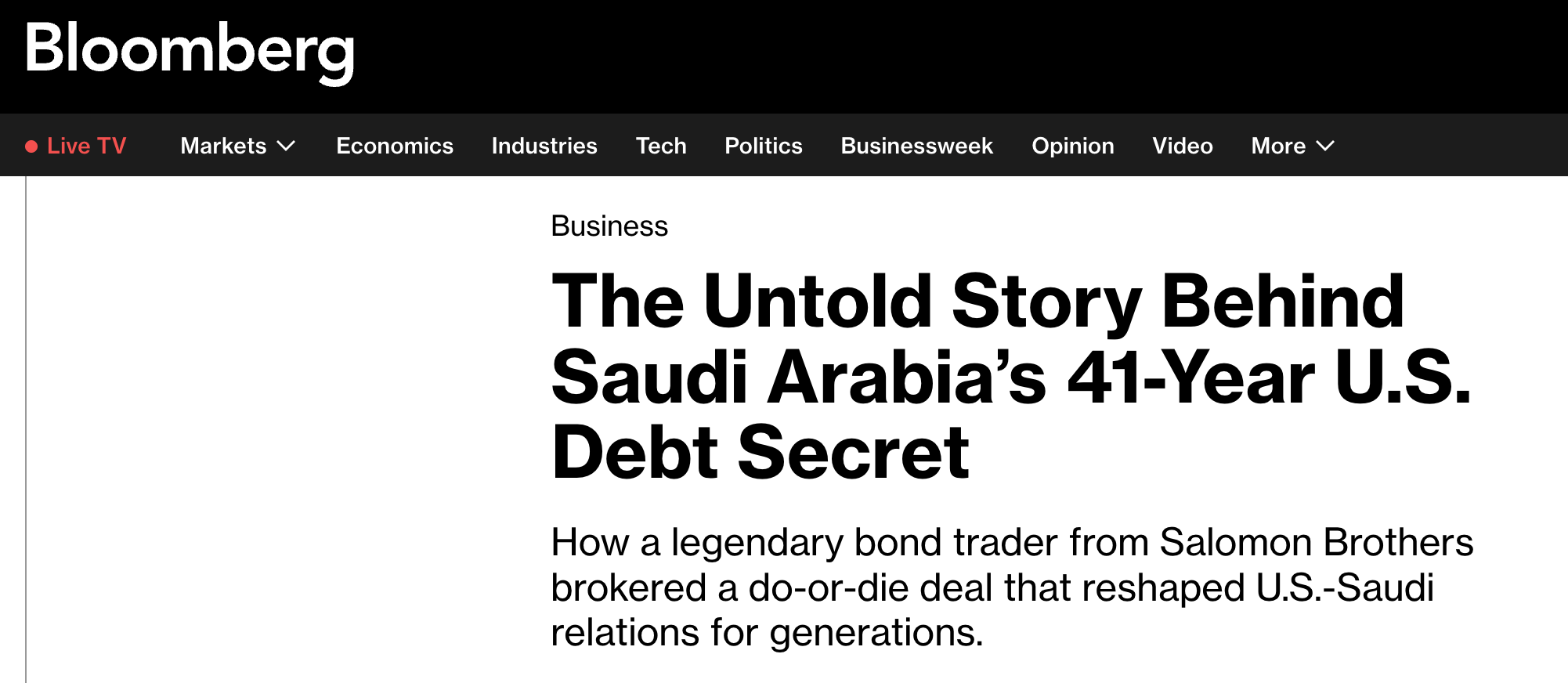
Either way, the deal between the U.S. and Saudi Arabia meant that if countries wanted to trade oil, they had to first get their hands on dollars.
It was pretty genius when you think about it.
Oil isn’t just any raw material. It was the biggest and most important commodity in the world back in the 1970s, and it remains so today. As you can see in the chart below, it completely overshadows all the other major commodity markets combined.

That’s because every country needs oil... in huge, never-ending amounts.
Understandably, that created permanent, planetary, structural demand for the dollar long after the gold backing was gone. The dollar was no longer backed by gold. It was backed by oil.
And OPEC’s job, from that day forward, was to keep that system intact — coordinate pricing, manage supply, hold the cartel together.
Why This Isn't a Win
Now, I’ve bolded the last part on purpose. In a gold-backed world, you don’t need a cartel — countries take dollars because dollars represent something real. In a fiat world — where that anchor is the most valuable commodity on earth — you need the producers to coordinate. For 51 years, OPEC did exactly that. Until now.
The UAE walking out matters for two reasons.
First, the UAE is important. It pumps roughly 3 million barrels of oil a day — third in OPEC after Saudi Arabia and Iraq. And it’s the first major OPEC member to walk out of the cartel since the petrodollar system was built. For more than half a century, it priced its oil in dollars and recycled those revenues into U.S. Treasuries. Not anymore.
Second, when a major member walks, the rest of the cartel has to decide whether to follow. The petrodollar system holds together because the producers move in lockstep — selling oil in dollars, recycling the proceeds into American paper. When one defects, the discipline weakens. And if Saudi Arabia follows — and Saudi pumps roughly three times what the UAE does — the system is over.
And the cracks are already visible elsewhere. Which brings us back to UAE’s swap-line request from a couple of weeks ago.
When Balama flew to Washington, he basically went to tell the Americans: if you don’t extend us dollar liquidity, we’ll start settling oil in yuan.
This wasn’t an empty threat either. We already know France, Japan, Malaysia, Thailand, and the Philippines have quietly negotiated passage through the strait directly with Iran, paying in yuan, routed through China’s CIPS payment system. These are longstanding U.S. allies — treaty partners, the countries the U.S. has spent decades hosting bases in and selling arms to. And they’re settling oil trades in Chinese currency because the Iranians won’t take dollars and the Americans can’t deliver open sea lanes.
And of course, settling oil in yuan is one step short of dumping U.S. dollar-denominated debt.
In fact, when pressed on the swap-line request at a Senate Appropriations hearing on April 22, Treasury Secretary Scott Bessent admitted as much. Swap lines, he said, are needed “to prevent the sale of the U.S. assets in a disorderly way.”
It was the first time in 51 years a Treasury Secretary admitted — in congressional testimony, on camera — that foreign countries' holdings of American paper could move our markets if they decided to liquidate. Keep in mind, the Gulf Cooperation Council collectively holds over $2 trillion in U.S. Treasuries, equities, and real estate.
As of writing, the UAE hasn’t actually gotten the swap line. The Fed has historically reserved permanent swap lines for a handful of major developed-economy allies — the Bank of England, the European Central Bank, the Bank of Japan, the Bank of Canada, the Swiss National Bank. Never a Gulf state.
Imagine the most powerful country on earth printing dollars to swap them for UAE dirham — a currency that’s literally pegged to the dollar, held by almost no one outside the UAE. Essentially a bailout, to keep an ally from defecting. But that’s what was on the table. That’s what Bessent was defending in front of Congress.
So they didn't get a yes. And you already know what happened a few days later: the UAE walked out of OPEC.
Now, leaving OPEC doesn’t legally unlock yuan pricing — the cartel has no explicit currency rule. But it removes the political and coordination pressure to keep prices in dollars. Outside the cartel, the UAE can negotiate side-deals — including in currencies other than dollars — without checking with the rest of OPEC.
Put it all together. The Trump administration has spent three months trying to reopen Hormuz and has very little to show for it. The other Gulf OPEC members — Iraq, Kuwait, every state whose economy is bleeding from the shutdown — are watching. None of them has a reason to wait for Washington to fix what Washington broke. The question probably isn’t if another OPEC member follows the UAE out. It’s when.
Regards,
Lau Vegys
P.S. We recently published the latest issue of Crisis Investing, with two new picks. If you’re a paid subscriber, make sure you haven’t missed it. And if you’re not yet on the paid side, the lead — featuring Doug Casey’s latest words of wisdom — is free to all.
This is not just a problem for the dollar. By logical extension it's a problem for every single fiat currency in the world. The dollars value is likely to plummet dragging the rest of the planet with it.
Got gold?
(Lots of gold..!!!)
The fact that the U.S. didn't manage to protect the UAE from the Iranian retaliation strikes probably didn't help either.