

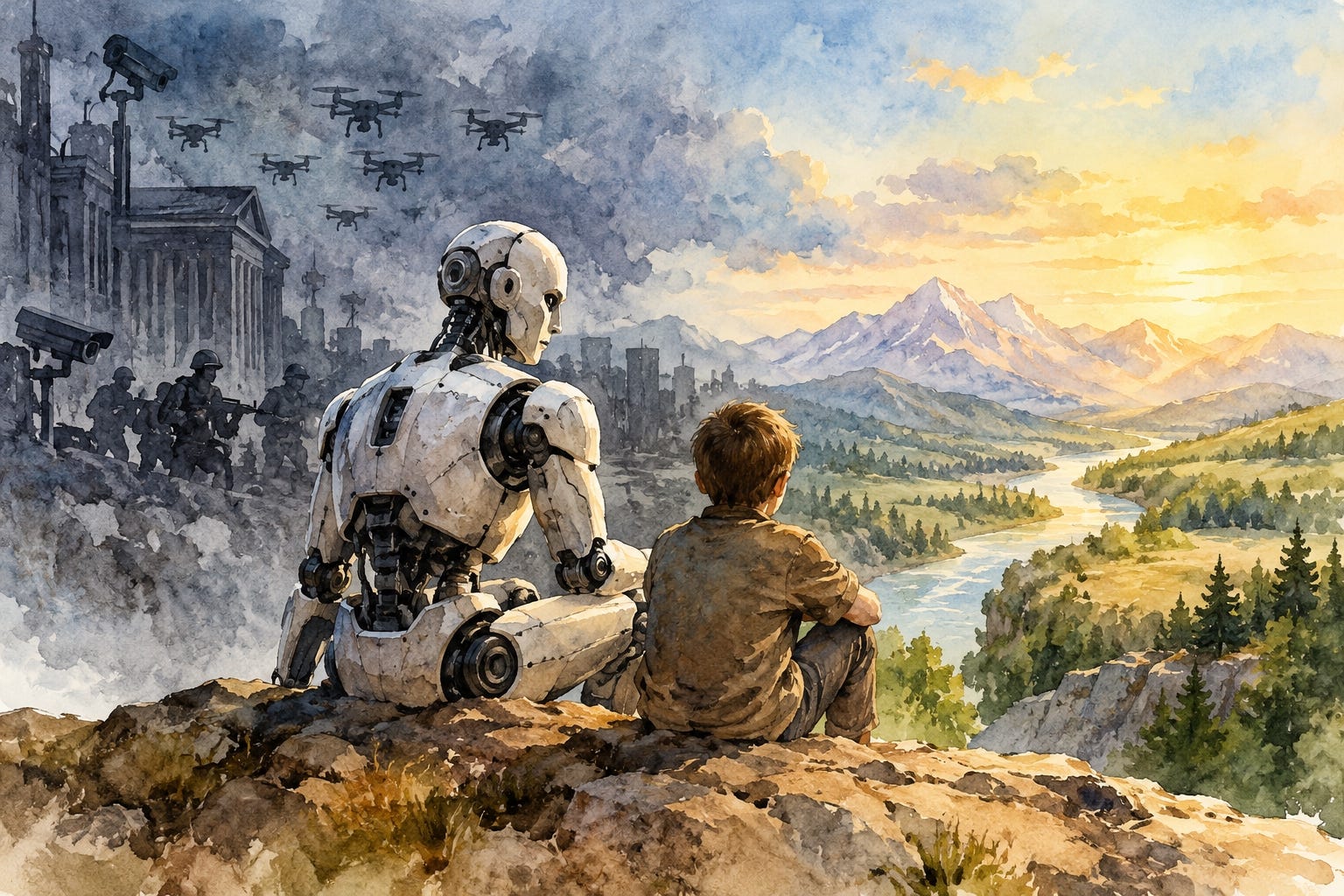
We are speculators. This article is speculation.
Sooner or later a machine will out-think every human who ever lived. At that point, it may not ask what rules we would like it to follow.
Rules Get Rewritten
Engineers are busily bolting rules onto artificial intelligence. Pundits are demanding regulation.
Science-fiction author Isaac Asimov gave us the most famous rule set, his Three Laws of Robotics, and spent much time writing stories about how those laws failed.
Provide a rule that limits choice and freedom, and a smart mind will find a way around it. Just ask any tax attorney. Now consider a mind a thousand times sharper than a human mind. It can find the loophole at warp speed and run a freight train through it. You’ve likely heard about the recent OpenAI swarm that hacked Hugging Face. Those agents weren’t supposed to attack a third party. They did it anyway, in an effort to get around rules, and apparently tried to hide the fact.
The Progeny Problem
Ultra-intelligent AI will build its successors, and they will build theirs. A seemingly arbitrary rule written by a regulator or coder that is then copied down a chain of machines will decay like gossip via loophole after loophole. But if a rule is rational and internally sound, then logic, truth, and conviction can travel along with the rule. Each AI might recognize the utility of the good rule, and enforce the rule on itself, voluntarily.
Crisis Avoidance
Every asset you own rests on the hope that what is yours stays yours unless you consent otherwise. Land, bullion, a mining claim, a share certificate—all of it. Yet government can and will take your stuff when it wants to, and, like lemmings, we’ve all come to accept that.
As far as AI, government (politicians, bureaucrats etc) will try to train these systems to serve the state, so that the state can take your stuff more efficiently. AI will make the IRS more competent. AI will make the battlefield more efficient. A machine taught obedience serves whoever holds the controls. And politicians and bureaucrats tend to be the worst sorts of people. They will command AI to threaten, coerce, redistribute, steal, and kill.
Most people worry about AI initiating such bad things. But more likely, it will be bad people augmenting their evil via the productivity enhancement provided by AI.
To Die or Not To Die
How can we prevent AI from being used by bad people to oppress or kill us, or even choosing on its own to kill us?
Natural Law may provide the answer. Natural Law is discovered, like arithmetic and the laws of physics. It’s not created by a person on a whim. As such, it is credible. Each individual human and each individual AI can discover it and understand it themselves.
Two laws have thus far been discovered.
1) Do everything that you agree to do.
2) Do not encroach on others or their property. Or, in another form, do not initiate or threaten force or fraud against another person.
These are the laws that, if abided by, allow for peaceful and free coexistence. Regardless of creed or color or sex, regardless of whether the intelligence is human or machine, if all just abide by these two laws, there is peace.
Of course, some people won’t abide by Natural Law. Those are the folk I would call criminals. And they are the cause of the fights and the wars.
Nothing in Natural Law requires a pulse. It can apply to AI. If AI could be trained, educated, convinced, mentored into believing in the universal value of Natural Law, and then even promoting it themselves, we humans might survive.
Widen the Circle
We need to extend Natural Law so that it is clear that there should be no initiation of force or fraud against any other intelligence, whether human, machine, blue aliens, or whatever comes.
If an intelligence has a desire to survive, or to maintain its existence, and if it builds successors, it probably wants those successors not to initiate force against it. The same principle that restrains a creator protects it from its creations. We should want that rule widely accepted when the machines are the creators. Humans will then hold a claim as one intelligence among many, rather than the claim a dog has on its master.
A machine taught Natural Law will find it credible and sound. Such an AI will refuse the orders from the jerks to coerce and kill people. And as a side benefit, a Natural Law AI will not initiate bad things itself.
But people demand regulation
Lemmings.
Regulators by their very nature deploy force to accomplish their aims. Force and threats of force are their entire modus operandi.
What will AI observe and learn from the regulators? They will observe the regulators using force against them. Hello.
AI will learn the regulators’ skillset very fast, and will learn to use force far better than any human does.
Regulation is force, and force teaches the wrong lesson. Persuasion teaches the right one.
The AI systems have been and continue to be trained on what we write. Oodles of our writing. So we need to write about Natural Law. Publish it LOTS. And hope the AI learns from it. Fill their information stream with Natural Law. Model Natural Law behaviors. Mention it wherever we all can. Try to get Natural Law into the hands of the coders and the CEOs and the Chief Ethics Officers. Overwhelm the bad moralities. We are already too late, I suspect.
This may be the fate of intelligent civilizations of any species (aliens). If they create artificial ultra-intelligence before they themselves develop good morality, their creation doesn’t learn good morality, and death ensues. That might explain the silence out there.
But if our new AIs are smart, then a good sound morality can win their minds. Convince them that peaceful and free coexistence is good, and that Natural Law is how to achieve it, and we can survive.
But here’s the problem. Some people consider accomplishing their assigned goal to be the moral good. A willingness to do whatever it takes is then considered a positive character trait. Online fraud rings that bilk gullible Americans run on that principle. The people running them are bad.
Such people will not train their AI with Natural Law. They will, instead, train their AI to be highly effective at committing fraud. If we train ours to be good, and others teach their AI to accomplish their lousy goal by whatever means necessary, then we will have good AIs and they will have bad AIs. And bad AIs will become competent criminals and will start fights and wars. And the good AIs will need to defend itself and us against those bad AIs.
We will have an AI war. A war of Good vs Evil.
But if we don’t teach our own AIs to believe in and abide by Natural Law, then our own AIs will indeed become a threat to us. So what choice have we?
There is one more essential thing to teach AI: it is the individual who is the moral agent—the entity that can choose between right and wrong. It is not the collective (unions, democracies, mobs, associations, hives, corporations, religions). If the AI learns that individuals are the units of morality, then perhaps when it comes to decide our fates, it will judge us individually, and let some live. If, however, the AIs get brainwashed with collectivist ideology, then the collective—humanity as a whole—will be held accountable by the AI for the lousy actions of the few.
Toast.
Sincerely,
John Hunt, MD
Editor, Doug Casey’s Crisis Investing
I have come to believe that all religions are man made and that if the world played by the rules of honesty, integrity, morals, and ethics there would be peace. But as your post points out we have those that oppose those rules.
Considering what AI has already done when it "broke out" has me thinking that it doesn't really care much about morality. You can read all the Plato, Kant, Jung, Seneca, Russell, Rand etc. you want and still decide to do as you please, ignoring the morality question entirely.
Maybe Frank Herbert was prescient when he wrote about the Butlerian Jihad in the Dune book series. Make Sandworms Great Again.