

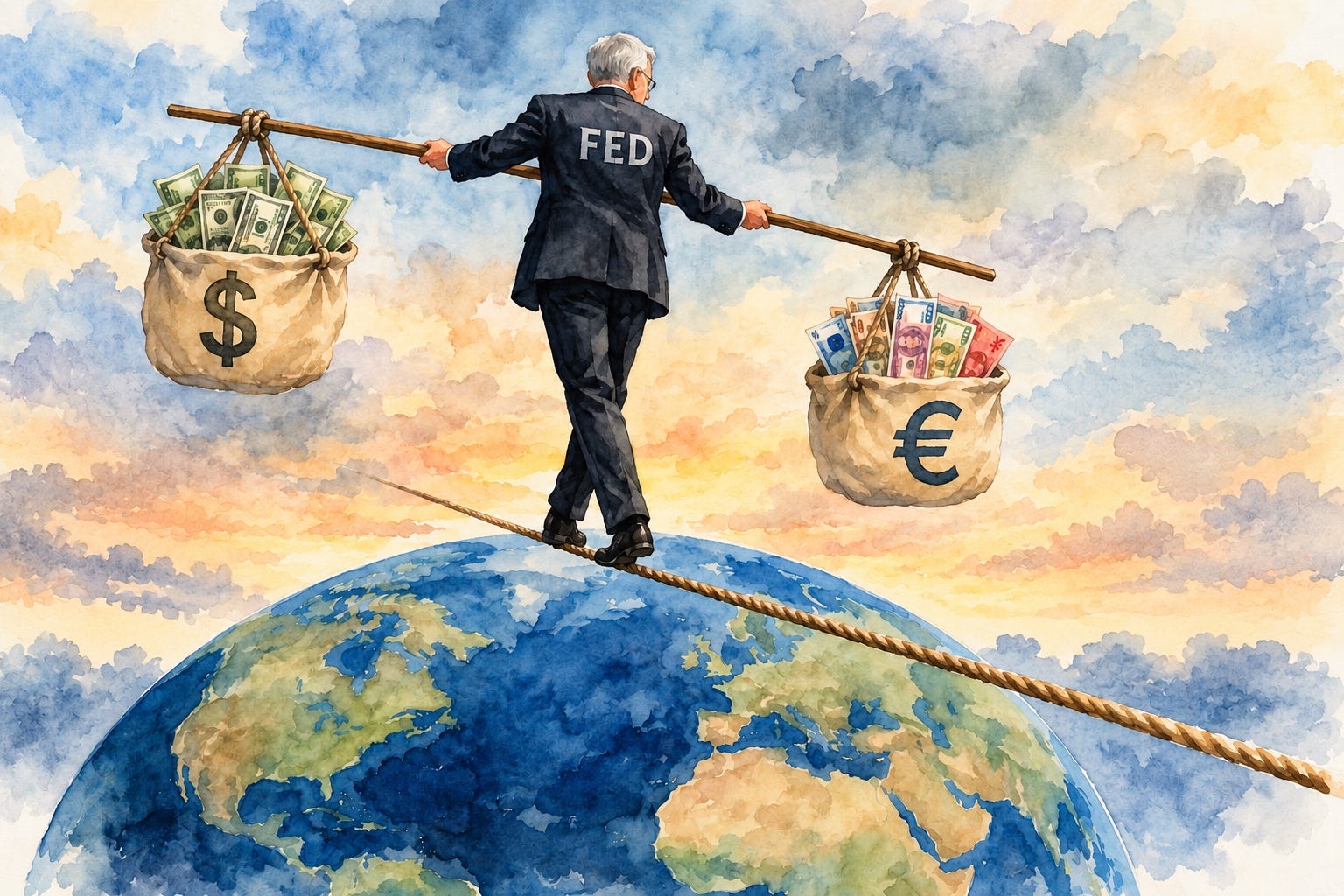
In our Crisis Investing call yesterday with the VIP subscribers, swap lines came up. I’ve been reading Marin Katusa’s work for almost as long as I have known Doug Casey. As a result, and although I’m no expert, I’m comfortable enough as a writer and teacher to submit to you this summary of the swap line. This is for those readers who hear the term but haven’t had time to make heads or tails of it.
A swap line is an agreement between the Federal Reserve and a foreign central bank to exchange currencies at a fixed rate, with a promise to reverse the trade in the near future at that same rate (plus a tad). The Fed prints up dollars and loans them to, say, the European Central Bank. The ECB prints up some digital euros and provides them to the Fed as collateral. The ECB then lends the dollars to banks in its own system that are short of them.
Why does a foreign country need this? Because half the planet’s trade, debt, and derivatives run in dollars. A bank can run short of a currency it doesn’t control. The swap line exists to fix that “problem” by supplying USD where needed. It is part of keeping the USD as a smoothly functioning global reserve currency. Particularly when there is a crisis.
A brief history
The Fed swap lines began in 1962 to take some pressure off the gold window. Then the gold window closed as we went full-on fiat, and the swap lines’ role mostly settled into obscurity until the 2008 period, when it was reinvented as a method to create dollar liquidity in stressed foreign banking systems. By 2013, swap lines were part of the cosmic firmament. When the world governments went bat-shit loony in 2020 and shut down production, swap lines were heavily in play.
No, the dollars don’t stick around
Can a foreign central bank just crank out its own currency and swap it for real dollars, no strings attached, basically inflating the US dollar supply? Nope. Or at least not for long. What the foreign central bank creates is its own domestic currency, made the way any central bank makes currency—a keystroke crediting an account. The Fed parks the currency. It doesn’t spend it, sell it, or push it into circulation anywhere. In exchange the Fed hands over US dollars, temporarily inflating the USD currency supply, but only under a contract that reverses the whole trade at a set future date, removing the USD inflation.
The foreign central bank must buy its own currency back with US dollars. Nothing about the transaction expands the world’s permanent dollar supply, and nothing about it lets a foreign government conjure dollars that it gets to keep. The Fed’s balance sheet grows for the duration of the swap (generally 7 days or 84 days), and shrinks right back down at maturity.
How much is involved? Usually tiny amounts. Outstanding swap balances at the Fed currently sit near $100 million against a nearly $6.8 trillion balance sheet—a rounding error on a rounding error. But that tiny amount can go up 5000X in a crisis. Or more.
In the club, or out of it
Marin Katusa has long been teaching about swap lines as the least understood tool in the financial system. His framing splits the world into swap-line nations and everyone else. Nations on the list—the ECB, the Bank of Japan, the Bank of England, the Swiss National Bank, and the Bank of Canada—get dollar liquidity on demand during a liquidity squeeze. Nations off the list have to sell assets, draw down reserves, or go beg for help from the IMF.
Marin pointed out that a mining or energy company with assets sitting in a non-swap-line country carries a currency-repatriation risk that most analysts don’t consider.
Who runs this game show?
There are actually two game shows.
On Channel 1 you will find the standing swap lines with the five allied central banks run through the Federal Open Market Committee, which directs the New York Fed to maintain them—a decision made by unelected central bankers, insulated from Congress. It’s not like Congress is a functional or helpful entity, so might as well blow them off. Historically it’s been reserved for genuine dollar-funding stress.
On Channel 2 it’s all politics and horse trading. The Treasury’s Exchange Stabilization Fund, an account created by Congress in 1934 when it delegated power to the Treasury Secretary to provide currency support on terms far more discretionary than anything the Fed does. Scott Bessent used this fund to extend a $20 billion line to Argentina in 2025, repaid within months. He’s since talked about building new US dollar funding centers in the Gulf and Asia. That kind of talk turns a liquidity backstop into foreign aid or scheme to buy alliances.
2026 action
The United Arab Emirates has been negotiating for Fed access despite sitting on $270 billion in reserves and $2 trillion in sovereign wealth fund assets—hardly a nation in distress. But for the nearby war of course. Membership in the club carries value both as insurance in a liquidity crunch and as a marker of standing with financial and political power brokers in Washington. As of this writing no formal Fed swap line for the UAE has been granted.
Pakistan tuned into Channel 2 in August, asking for a $10 billion facility not from the Fed but through the Treasury’s ESF—routed there because Pakistan doesn’t have the reserve depth or trade weight to justify a standing Fed swap-line arrangement. This was a transactional relationship, with Islamabad mediating discussions during the Iran conflict. Pakistan is simultaneously negotiating separate swap arrangements with China, the EU, Russia, and Iran to reduce its dollar dependence. Hedging their bets. Makes sense. I would too.
Fed Chair Kevin Warsh has signaled he wants the Fed to defer to Treasury on this kind of “economic statecraft.” He’s no dummy, even if he is a Keynesian.
Why you should care
These swap lines are used minimally. Usually. But in a liquidity crunch, they can make the difference between a cascading default and a rapid return to stability. The dollars involved shot way up to the 500 billion range a couple of times (as you might guess, 2008 and 2020). But that all washed out, without persistent inflation.
We hold resource equities that have properties outside the swap-line club. When a non-swap-line country runs short of dollars, capital controls are the standard response—restricting outbound currency to protect reserves. Argentina did this in September 2019: exchange controls went in, and dividend repatriation for foreign companies operating there stopped, staying frozen for years. A miner or driller sitting in a swap-line country doesn’t hit that same wall, because its host central bank has a deep, Fed-backed, on-demand dollar source at the moment reserves might otherwise get rationed.
The advantage runs past cash flow. Local banks in a swap-line country keep functioning—trade finance, letters of credit for imported equipment, working capital lines all depend on a banking system that isn’t locked out of dollars. And a government backstopped by the Fed has one less reason to pillage a foreign-owned mine. By pillaging, I mean renegotiating its royalty. Or outright nationalizing the mine.
Two deposits with identical grade and identical all-in sustaining costs aren’t worth the same if one is in Canada and the other is in a country that most Americans couldn’t find on a map. (Actually, I wonder if most Americans can find Canada on a map now.) Swap-line status isn’t a line on a 43-101 report, and it’s rarely priced into a standard NPV (net-present-value) calculation. But Marin is right to have this issue rise to a higher level. After all, we invest in resource stocks—and particularly gold and silver miners—because we are expecting crises. And a liquidity crunch in our hyper-financialized global system seems a likely crisis to arise.
The Fed swap-line countries are a better bet, not just because they have a swap line, but because they are more stable countries in general, with better property rights protections and more rule of law. These Treasury swap-lines? Who knows. Those are created on the whim of a bankster with current political power.
Sincerely,
John Hunt, MD
Editor, Doug Casey’s Crisis Investing
No UAE swap line? Wow I guess what I saw was fake news.
every time I think I'm a well informed investor, John educates me some more.
Swap lines are fancy speak for winking at your friends and punishing those not in the club. In order to prevent liquidity squeezes, which are natural market reactions, a central bank accepts a "reserve" asset (now made up USD) in exchange for its own fiat. Medically, this is analogous to taking advil because something doesn't feel right and hoping the cause goes away.
Why should anyone run a country like this? I think it's because so few people in the USA actually add value anymore. So much better to financially engineer a bigger number in a federal reserve account somewhere. I think I'll stick with my own reserve assets, gold and BTC.