
Japan’s Yen Problem, and Washington’s Tightrope
A currency intervention can't fix Japan's monetary and fiscal policies

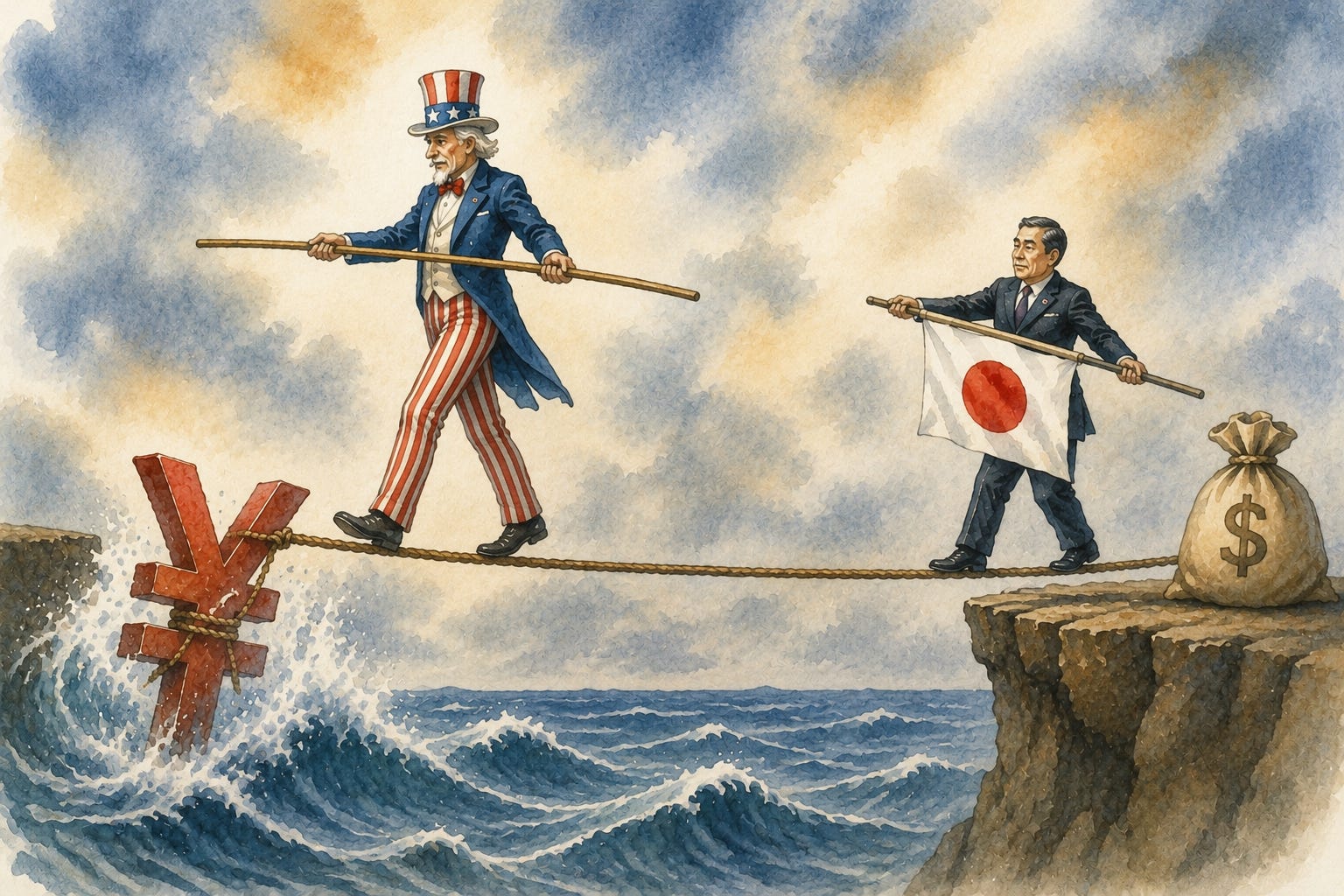
The yen hit its weakest level against the dollar in roughly four decades this summer, and Washington and Tokyo did what central bankers do when the tightrope starts getting shorter: they took another step out onto it.
The Diagnosis
The Bank of Japan’s policy rate sits at 1.0%. The Federal Reserve’s sits at 3.5–3.75%.
Money follows yield. So people and institutions borrow yen at nearly nothing, convert it to dollars, and then buy US Treasuries paying interest. This is called the carry trade, and it is a playbook that has been run for years, an arbitrage of sorts that taps the difference between how the two central banks choose to manipulate their currencies. It produces no new goods or services. Estimates put its size near US$500 billion. That’s half a trillion dollars of positions whose economics depend on the yen remaining cheap.
The Bank of Japan has been monetizing the Japanese government’s deficits and now it owns roughly half of all outstanding Japanese government bonds, much of it long-dated. Bond prices move opposite yields, so BOJ paper takes a hammering the moment it raises rates. Mark those bonds to market and the BOJ’s balance sheet takes a serious hit, potentially reducing or eliminating the profits it remits to the Ministry of Finance and inviting questions about its financial credibility.
Prime Minister Sanae Takaichi wants to spend more on defense, technology, and consumption, which means the BOJ will feel pressure to buy more Japanese government debt. Rothbard called this what it is: a government financing itself by debasing the money its own citizens use to buy dinner. And it’s tough on the Japanese people.
Why Washington Cares
Washington’s own debt boondoggle. The BOJ itself is a top holder of US Treasuries. A yen in freefall pressures Japanese institutions to repatriate capital and sell dollar assets to cover losses at home. Sell enough US Treasuries at once and Washington’s system of borrowing money to pay interest on its debt starts exposing a lot of its cracks.
Contagion. Japan competes head-to-head with Korea, Taiwan, and China in autos, semiconductors, and electronics, so a cheap yen lets Japanese exports undercut theirs on price and pressures those central banks to devalue in response. The carry trade doesn’t run yen-to-dollar exclusively —cheap yen can fund positions across a basket of higher-yielding currencies. So currency desks treat the yen as a regional risk gauge, and start selling Asian currencies when the gauge moves toward the red.
In a world economy built on fiat currencies, debt, and long chains of counterparties, a credit collapse can be triggered by an event that even the most brilliant central bankers cannot predict. As narcissistic as central bankers tend to be, I suspect that they know this, so they try to intervene early so that the system they built is less likely to blindside them.
Trade math. Washington has argued the yen sits below fair value, which makes Japanese exports cheaper than they’d otherwise be and American goods pricier by comparison. “Undervalued” is an estimate, built one of a few ways, each shaky enough that I won’t bother going through them — the short version is that US government institutions grade currencies against a benchmark those same institutions constructed. There’s no gold window to check the answer against. Fair value is whatever the agency releasing the report or calling the news conference says it is this quarter. Calling the yen “undervalued” costs Washington nothing while handing it a trade grievance and a justification for playing currency games.
What Actually Happened
On July 31, Japan and the US ran a coordinated yen-buying operation — the first joint intervention between the two to shore up the yen since 1998. The Bank of Japan sold around US$75 billion to buy yen. Washington’s contribution was smaller and stranger (central bankers would call it clever): rather than sell dollars outright, the New York Fed sold euros from reserves and used the proceeds to buy yen, reportedly around $10 billion worth — a workaround that avoids the appearance of weakening the dollar directly.
USD/JPY fell from 163.87 to about 157 inside two days. Call it two more feet of rope, paid out to buy a little time.
What did it cost Washington (or the Treasury, or the Fed)? In terms of currency, pretty much nothing. In fact, Washington could make some bank on the deal, because they bought the yen lower than it ended up rising to. But there’s another type of cost to intervention: moral hazard. A step that buys a week of calm also teaches the market to take more risks, expecting government help as if it is part of the cosmic firmament.
Does It Treat the Cause?
No. Intervention buys time. It doesn’t touch the interest rate gap, doesn’t touch the Japanese government’s spending appetite or the BOJ’s bond-buying, and doesn’t open Hormuz.
A single BOJ rate hike would do more for the yen than another coordinated purchase, because it closes the actual gap instead of papering over it. Tokyo doesn’t want to, because higher rates raise the government’s own borrowing costs on a debt pile it’s grown addicted to servicing cheaply.
Is It a Problem?
For Japanese households, yes — real wages down, imported inflation up, and no fix in sight until Tokyo accepts higher borrowing costs and addresses its fiscal problems. For American investors, the exposure runs through carry-trade unwind risk: when that $500 billion trade reverses, it has shown it reverses hard, and equity markets are priced for everyone staying calm.
The Fed and Treasury decided propping up the yen for a moment mattered enough to trade reserve euros for it. Japan spent its dollars. Net effect: a minimally weaker dollar and euro; a slightly stronger yen, for a while. Was that because Trump said he’d help a friend? Or is it one of dozens of interventions financial bureaucrats believe they need to make, year after year, to keep the global economy on the tightrope they built, for one more step across the ravine?
Given that we live in a Keynesian world, I suppose I am glad they do these things.
But in my view, the problem isn’t how to balance well enough to take the next step across the ravine. It’s that the rope isn’t long enough to reach the other side.
Someday, lots more people are going to see through the mist and fog and wonder how they will get across. And many will then buy gold. Because a pile of gold provides a perch to sit upon when those walking the tightrope realize that the next step is straight down into the brink.
John Hunt, MD
Editor, Doug Casey’s Crisis Investing