
I'm Told Oil Companies Are Making Too Much Money
Must be, because Trump and Bernie say so.

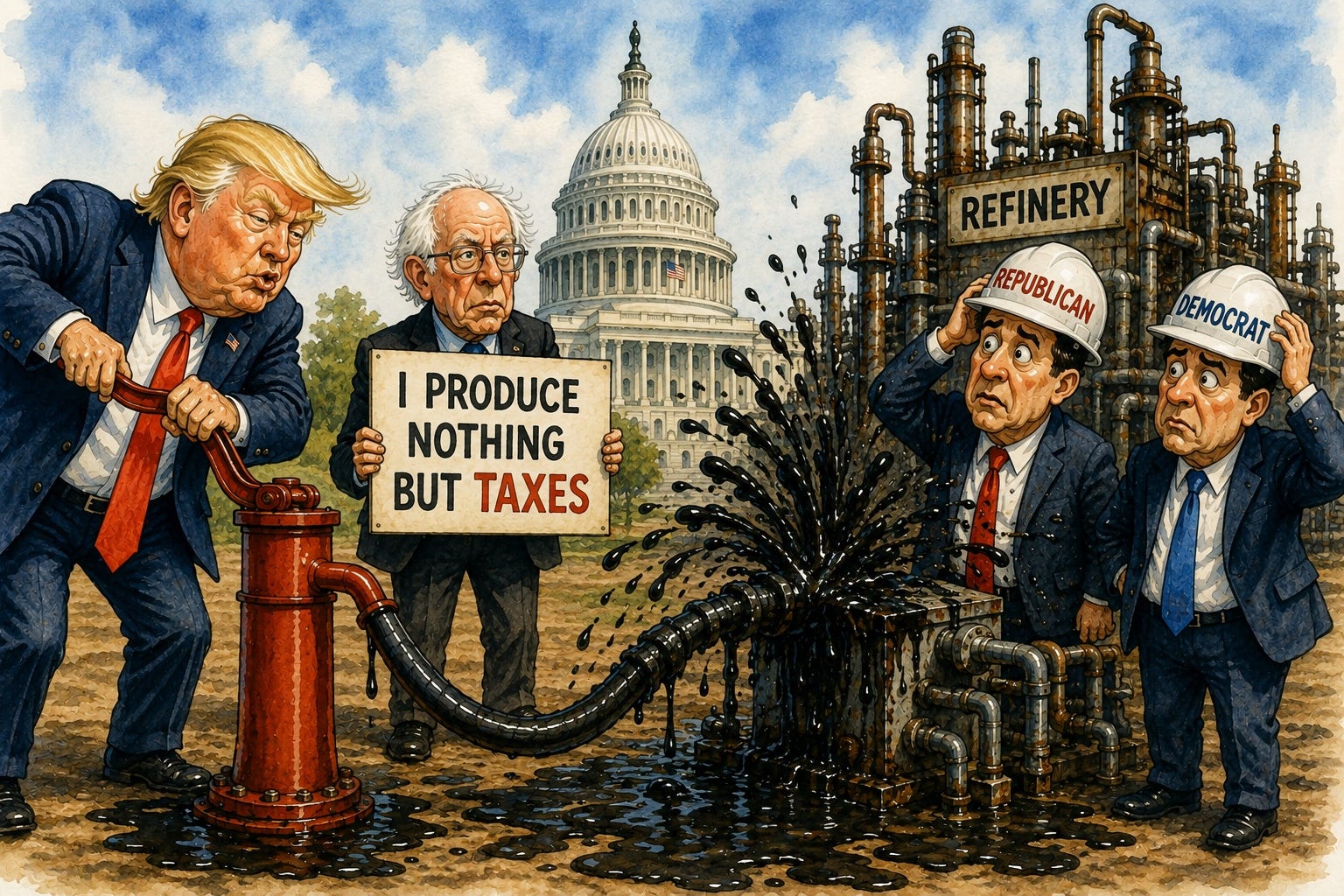
Trump looked at Exxon’s $14.5 billion quarter and Chevron’s $12.1 billion quarter and said oil companies are making too much profit. My skepticism of his comment runs deep.
Pump prices for gasoline and diesel are (as usual) based on the demand for those refined products compared to the supplies of those products coming out of the refineries. (Throw in transportation costs and government fees and taxes of course.) I will reiterate that it is supply of, and demand for, the refined products that matter. The crude price is relevant but not the big issue.
How A Barrel Actually Makes Money
Oil companies didn’t suddenly become greedier this quarter. What happened was that politicians temporarily changed the economics of the oil business.
An oil company earns two margins that move independently of each other.
The first is the upstream margin — the gap between what it costs to pull a barrel of crude out of the ground and what that barrel sells for.
The second is what we’ve all heard about so much lately: the crack spread. Sounds like a plumber’s butt. I won’t go into all the processes a refiner undertakes, but I’ll take a moment to define that bit of industry lingo in simple terms.
“Cracking” is one of the key downstream refinery processes, breaking long crude molecules into the shorter ones that help make the gasoline and diesel we put in our tanks. The crack spread is the refining margin—the difference between what the refinery pays for crude and what it receives for the fuels it sells. You’ll often hear about the “3-2-1 crack spread.” It’s a standard industry benchmark that assumes three barrels of crude are refined into products equivalent to two barrels of gasoline and one barrel of diesel.
Those two profit margins — upstream crude from wells, and downstream refining — can move in opposite directions, or the same direction for different reasons.
This quarter, the margins both moved up hard for different reasons. Crude ran from $68 to $104 a barrel because of the war. That provided increased upstream margin. Separately, margins of the still-operating refineries expanded because millions of barrels per day of Persian Gulf refining capacity sat offline while global gasoline demand didn’t fall. Supply of refined products declined. Prices rose.
Consistent with this, the bigger earning wins in Q2 were in the refining.
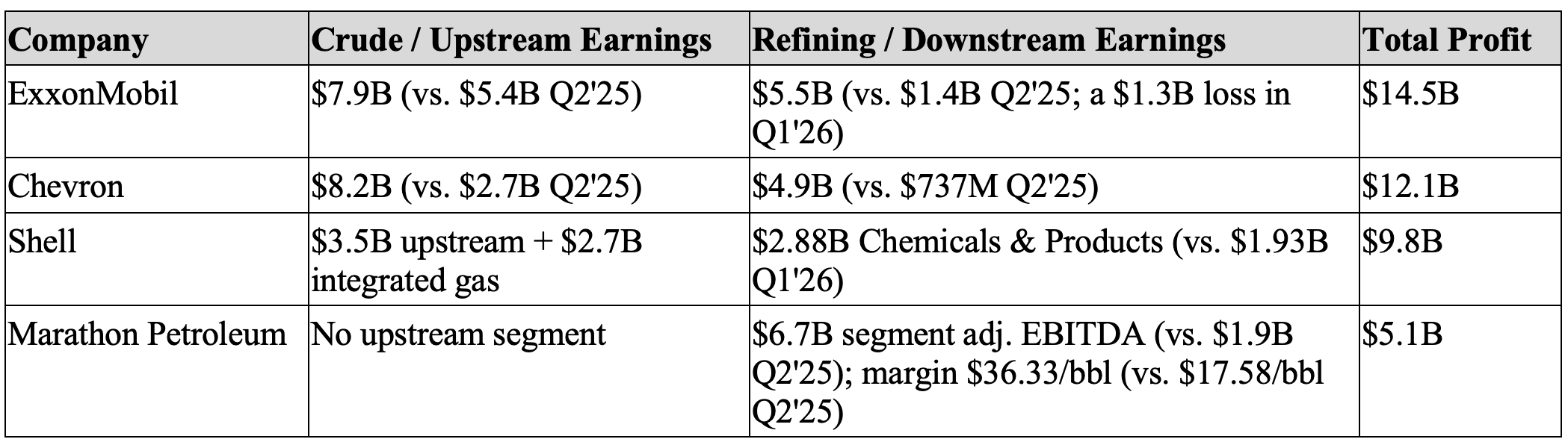
Marathon Petroleum reported just this morning. With no upstream (crude) business at all, its second-quarter net income more than quadrupled to $5.1 billion, from $1.2 billion a year ago — every dollar of that a crack-spread dollar.
Government Actions
Politicians started a war. Politicians in Tehran and politicians in Washington and Israel made choices that shut the Strait of Hormuz, moved the price of crude, and — most importantly — shut down a whole bunch of Persian Gulf refining capacity. Why they chose this year to do this, I simply don’t know. Perhaps it was WMDs: that old trope. Truth is the first casualty of war.
Politicians created SPR loans. The US Department of Energy has been lending crude (not selling it) to nine companies who owe it back later with a premium (roughly 20-28% more barrels than they borrowed — a sort of crude interest rate, you could say). Those SPR loans slightly helped keep global crude prices lower than they otherwise would be, given the war. And that kept the input cost to the downstream slightly lower: the refiners had to pay a bit less for the crude.
But because of the war’s effect to turn off Persian Gulf refineries, there has been insufficient refining capacity to crack that crude. The available refineries are working at max. Crude loaned from global SPRs didn’t build out refinery capacity. It didn’t produce any extra gasoline or diesel. So it didn’t fix the supply/demand dynamics for gas and diesel caused by the war, nor the high prices that result from those dynamics. The prices shot up as supply declined, and all the SPR loans did was to slightly decrease the production cost.
The politicians’ actions are the proximate cause of this quarter’s high reported profits — not the greed of suits in a boardroom at Exxon or Chevron.
Politicians propose a windfall profits tax. It wasn’t ExxonMobil or Chevron that started the war. And they didn’t release the SPRs. But there’s a bill in the Senate — introduced and sponsored by the regular gang of economically illiterate buffoons — that would steal 50% of the gap between this year’s crude price and last year’s. Exxon and Chevron and the others already owe the standard 21% federal corporate income tax, same as any company, plus state income tax, severance tax, and royalties on the crude itself before it ever reaches the income statement.
Nobody introduced a bill to send Exxon a check in 2025, when its second quarter was its worst in four years. And nobody should be taxing the temporary “windfall” profits of a cyclical business.
Trump seems to be aligned with Bernie Sanders in proclaiming that these companies’ profits are too high. By what standard? What profit margin is “too much,” and why do they get to decide?
The politicians don’t drill oil. They don’t refine oil. Politicians produce nothing. The tax and spend crowd use their power to steal money from producers. They are the last people who have any clue about what an acceptable profit should be.
The Dems are using these earnings reports to claim that Trump is filling the coffers of his Big Oil donors. And indeed the war and the SPR dump did that. Will Trump be able to walk back his statement about profits being too high? If he does, he risks giving the Dems more ammo.
The bills emerging from the economic ignorance of Senator Whitehouse and Sanders will likely be sidelined in Congress, as they usually and rightfully are. But Trump has a lot more oomph.
Oil companies didn’t create the conditions for these windfall profits. Government did. Let’s tax government.
John Hunt, MD
Editor, Doug Casey’s Crisis Investing
Excellent, Doc!
Keep it up.
DFH