

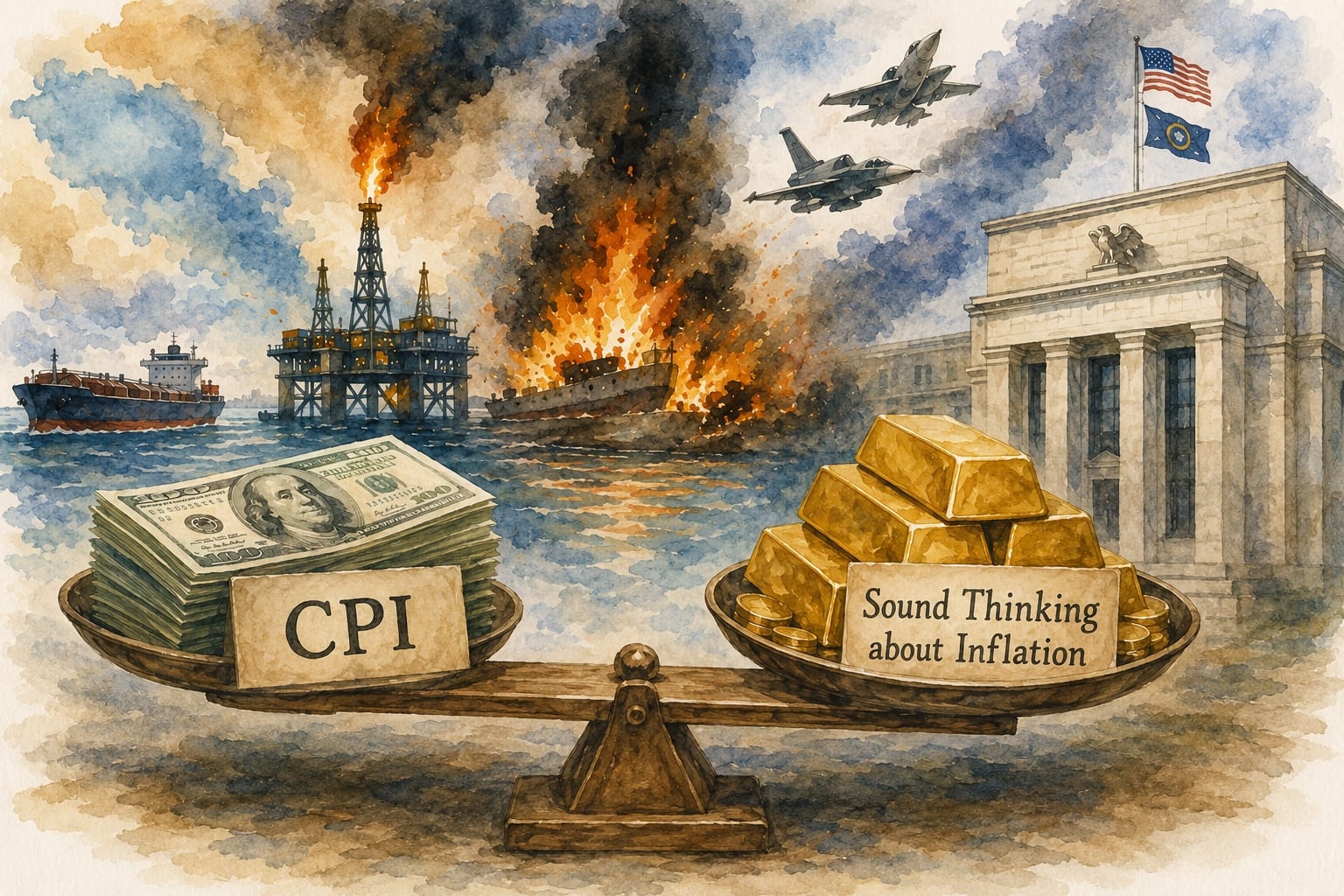
Unpredictable leaders of warring countries create volatility and generalized fear. Bombs are falling near and on the Strait of Hormuz. Oil jumped 16% in five trading sessions.
And yet gold, the asset people want to have when the world is on fire—the asset that people squirrel away in their pockets as they flee the invading hordes—has fallen in dollar terms. 2.6% over that same week. And it broke below $4,000 an ounce for a moment.
Selling gold is now being called “risk off.”
Really?
Is this akin to when data show the economy is doing poorly, the stock market rises?
Pretty much.
We live in a topsy-turvy world.
The Keynesian reflex
We have to accept that Keynesians dominate the media, the central banks, academia, the government, and most economist positions at investment houses. That they are confused and wrong in no way diminishes the reality that they are controlling the whole show.
The Keynesians have obscured the dilution of the dollar for the last five decades by defining inflation based on the CPI (and other price level indices). We know that the CPI has been kept low (in the face of huge money printing) by the increased supply of goods and services via increased productivity, and via cheap products made out of Chinesium. The Keynesians see that too. But Keynesians believe that prices being kept low means “inflation” is under control and that they can get away with printing more dollars. Whereas we know that the effects of inflation (money printing) are just being temporarily obscured by low prices of cheap crap.
With the inexpensive imports from China and our improved productivity keeping the CPI seemingly under control, gold prices in dollar terms rose much less than they otherwise would have, because people believed the dollar wasn’t diluting much.
But the truth is hard to suppress forever. And gold shot up (in dollar terms) to almost $5600. (It wouldn’t be surprising that such sudden price momentum might overshoot. And maybe that is what happened last year. And some correction this year is not unreasonable.)
But now with concerns that oil shocks will push CPI higher, gold has experienced downward pressure in dollar terms because of expectations of Fed action.
Let’s parse this.
The Fed is Keynesian, and thoroughly so. Regardless of the cause—monetary inflation, a war, a tariff, a bad harvest—any price increase that shows up in the CPI or PPI can trigger a hike. The Fed is like a lousy doctor. It doesn’t diagnose the problem. It just sees a number outside of the desired range and tries to treat the number.
To the Keynesian brain, the war disrupts oil, oil disruption raises energy prices, Keynesians read rising energy prices as “inflation” — which raises Pavlovian expectations of a Fed rate hike, which (if it were to occur) would raise real dollar yields. Gold pays no yield, so higher dollar yields make holding gold have a higher opportunity cost. The response of a dog to a bell ringing is to salivate. The response of a Keynesian brain to oil disruption is to sell gold for dollars before the Fed hikes the interest rates.
If prices are rising because of true monetary inflation (expansion of money/credit—which is how Austrian economists define inflation), that’s exactly when you want to get rid of the bad money and hold onto the good money (in other words, dump dollars and buy gold).
But if prices (CPI) are rising because of supply disruptions (not from inflation), then gold might fall as some people need the cash to buy the more expensive goods. Or as they indeed figure that the Fed will raise interest rates.
Do we have more true inflation? Or do we just have a higher CPI? I expect both.
War leads to money printing/inflation. Supply disruptions lead to higher CPI.
Dollar inflation should lead to gold prices rising in dollar terms. Supply disruptions might lead to gold price declines because of the Fed interest rate response to a rising CPI.
Which wins?
The market recently seems to have decided that higher rates are worse for gold than the inflation itself.
Is it? Let’s do the math.
Money and credit are growing at 5.6% and 5.2% a year, respectively — call it 5.4% blended. That’s real inflation. It’s 5.4% dollar debasement, the real thing, not the CPI-type numbers the media and Fed present. Against this debasement, a good money market fund pays you roughly 3.5% to hold cash. At the end of a year in the money markets, you have 3.5% more dollars, but every one of those dollars is worth 5.4% less. That’s a net loss of 1.9%.
Sure, gold pays no interest. But gold isn’t diluted at 5.4% a year like the dollar is. New mine supply adds roughly 1.9% to the above-ground stock annually.
Two currencies. The dollar and gold. One currency involves gold mining and storing, and one involves dollar printing and interest. Each nets a 1.9% dilution in your individual account that holds that currency. At current baseline, the net real cost of holding gold in your safe vs. the cost of holding dollars in a money market account are the same.
The rate of gold production doesn’t increase year to year. But the dollar printing often does.
If the war leads to inflation (printing more dollars), which it will, then gold wins in the long term.
If a rise in CPI (not inflation) caused by supply/demand disturbance leads to the Fed raising rates, then the dollar money market wins in the short term. But only until the printing press—the real inflation—percolates through markets.
So, in a Keynesian world, in which Fed rates might increase before the printing press needed to fund the war is felt, it is not irrational in the short term to sell gold. And given that Keynesians dominate, gold prices have stayed low.
Our gold thesis remains sound
Bank of America trimmed its 2026 average gold price forecast on hawkish Fed positioning in early July — but kept its long-term $6,000 target intact. Central bank buying of gold hasn’t gone anywhere. Federal government expenses aren’t going to go down. Dollar debasement isn’t going to stop. The dollar will go down in value. So in the long term, the true dollar inflation will become fully evident.
An ounce of gold is ever and always worth an ounce of gold.
It is the Keynesians and their fiat dollar that are the hot messes.
Sincerely,
John Hunt, MD
Editor, Doug Casey’s Crisis Investing
Yes, These Delusional Keynesians somehow believe Inflation equates to Economic Growth which clearly does not, as demonstrated by Benjamin Shalom Bernanke and Janet Yellen who "Targeted 2% Inflation" as a goal. These Are Frankfurt School educated fake Economists aka Fabian Socialists (Communists). They wouldn't understand real Economics or Business Dynamics if it bit em in the ass. They wouldn't be able to operate a Lemonade stand in front of their homes. I hope they don't have children. Janet Yellen was one of the dimmest bulbs I had ever witnessed testifying before Congress. Inbreeding is a horrible thing.
Financial markets are presently experiencing an extreme mania, perhaps the worst in history, so one would expect precious metals to be out of favor. Recent price gains are likely largely attributable to central bank buying driven by attempted weaponization of the US dollar. Ultimate timing is only knowable in hindsight but anticipating skyrocketing precious metal prices in the years ahead is close to intellectual child's play at present, for those who aren't caught up in this mindless financial mania. However be warned, powerful deflationary forces characterize the early stage of financial collapse which might take precious metal prices lower in the interim.
As long as fiat money and credit expand via central bank action and within the financial system due to fractional reserves at financial intermediaries, thus distorting rates of interest, there will be financial manias and collapses. The notion that central banks are going to engineer a "soft landing" at this point is simple fantasy.
Worth noting, most economists are sold on the academic nonsense called Keynesianism so they will completely fail to anticipate inevitable outcomes yet again.