
How To Be on the Winning Side of a Bad Game
Letter 3 of 3. Positioning Yourself for Credit Deflation and Monetary Inflation

We’ve spent two letters establishing that monetary inflation and credit deflation can run at the same time, in different aggregates, hitting different balance sheets. Both processes have winners.
WHO WINS FROM MONETARY INFLATION
Start with debtors carrying long, fixed-rate debt on real assets. Inflation erodes the real value of what they owe while the nominal value of the collateral, and often the income servicing it, rises alongside the currency debasement. The homeowner who locked a 30-year mortgage at 3% in 2021 is repaying that loan in dollars worth less every year. Good for him. Inflation is paying down his mortgage.
That’s the mechanical transfer inflation performs, from the currency’s holders to the currency’s borrowers, as long as the borrower survives long enough to collect it.
The US government is the largest debtor in the history of the world, which makes it the largest winner of its own inflationary policy. Every unit of new currency created shrinks the real burden of the existing debt. This is not a side effect. For a government that will never balance a budget again in your lifetime or mine, it is the point.
Owners of hard, scarce, unencumbered assets win a bit too — gold, productive land, resource-in-ground. When the foreign capacitors of dollars discharge into the market, those dollars likely will come after these hard scarce assets.
Unencumbered is the operative word. It’s important that the asset isn’t itself carrying debt that can be called before the inflation shows up in its price. A gold bar in a vault has no counterparty who can force a sale. But a silver mine financed at 40% loan-to-value does.
And then there’s the group that gets the new currency first. Richard Cantillon worked this out three centuries ago — new currency doesn’t arrive to everyone simultaneously and proportionally. It arrives first to whoever is closest to the spigot: banks, primary dealers, large asset managers, the federal contractors who get paid before the general price level has caught up. By the time the new currency units reach a retail paycheck, most of the repricing has already happened. People close to the monetary spigot get to drink the most.
WHO WINS FROM CREDIT DEFLATION
Disciplined savers gave up yield during the good years and, if they act to buy up distressed assets, can get paid for it during the bad ones. Cash holders and buyers with dry powder are in a position to win, because credit deflation is a forced-selling event, and forced sellers can’t negotiate. Stocks, unproductive real estate, private credit paper, entire businesses — all of it gets marked down as leveraged owners scramble to meet calls they can’t otherwise satisfy. (Note, even those who hold their assets without debt will see the prices of those assets decline in dollar terms). Whoever shows up with actual liquidity in that window buys assets for cheap from people who have to sell.
The Federal government, unlike you and I, can print their way to paying their bills. And the pain only lands on us, not them. The government can use a credit deflation to justify a new inflation-funded spending spree, maybe even moving (alongside the Fed) into buying private assets outright for cheap—you know, to boost up stock prices or buy distressed property. They’ll come up with a reason. Japan did it. Statists gain more power during most any crisis, including rapid credit deflations.
I don’t like the fiat dollar. Of course I don’t. But in the acute phase specifically, dollars are the winning asset, ahead of gold, ahead of equities, ahead of anything else. Not because dollars are a store of value long-term. But because for the several weeks or months a credit crunch actually runs, dollars are the one thing every forced seller needs. Dollar holders can win.
WHO LOSES IN BOTH
The over-leveraged asset holder with variable-rate or callable debt loses on both processes at once. Credit deflation forces the sale before the monetary inflation jacks up the asset’s price. They don’t get to collect the inflation windfall the fixed-rate debtor collects, because they don’t survive to the reflation. The house, the stock, the business — sold at the bottom, to someone with cash.
The mirror-image mistake is holding cash too long. Cash wins during the credit-contraction window and loses after the Fed’s response arrives, because that response is, by definition, currency debasement. The saver who misses out on gains during booms in order to prepare for the bust, but then doesn’t deploy during the bust? He blows the opportunity he planned for.
HOW TO POSITION FOR BOTH AT ONCE
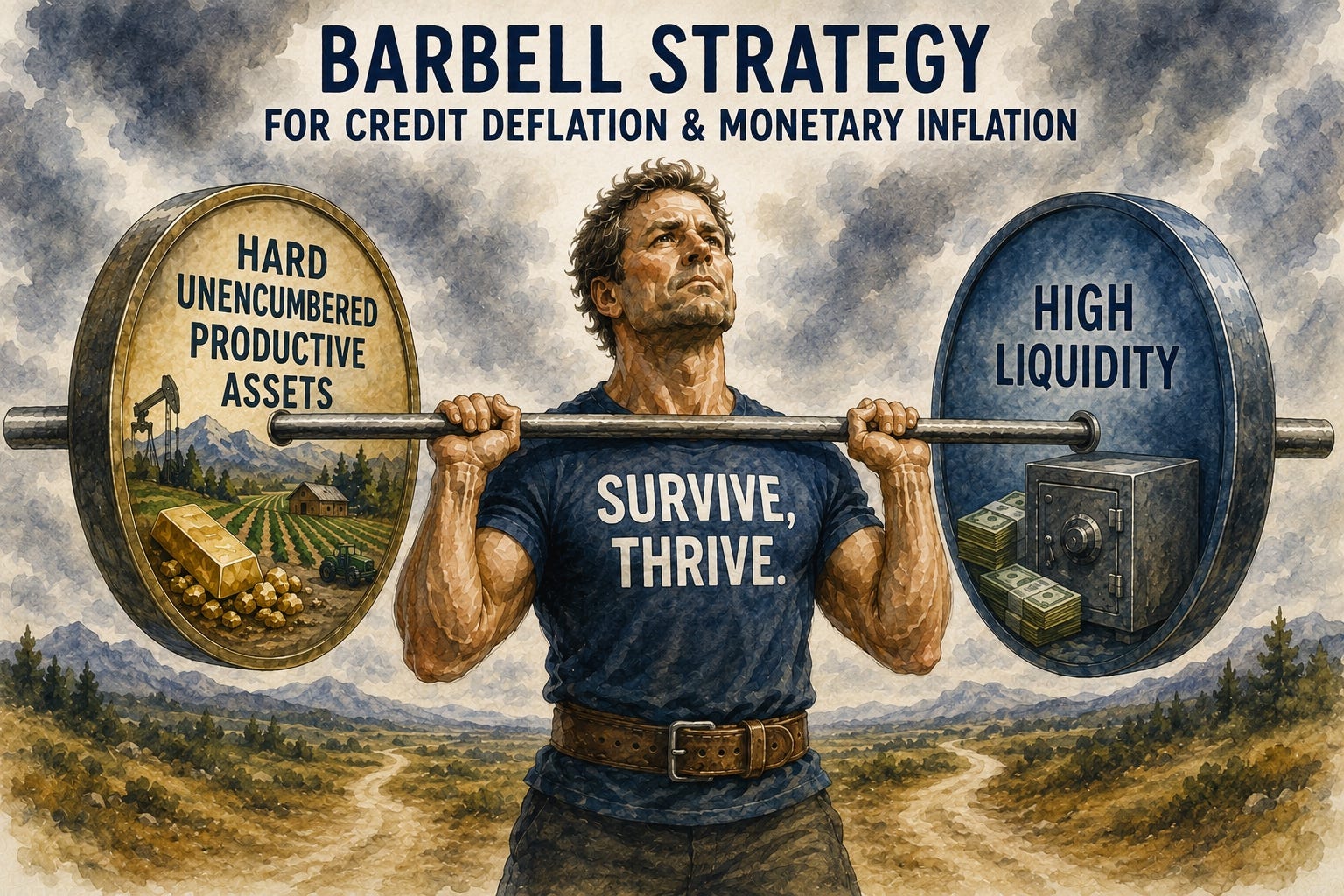
Barbell it.
On one end: hard, unencumbered real assets that capture price increases caused by monetary inflation without carrying debt that can get you force-sold — gold held outright, silver; selectively chosen resource equities with little debt; productive land free and clear; productive (cash-producing) businesses with no debt that provide goods and services that are needed in the tough times as well as good times.
On the other end of the bar: real liquidity, short-duration and boring, ready to buy the assets a credit crunch throws onto the market in a fire sale. Cash. Money Market. Short term treasuries (if you can morally tolerate loaning your wealth to the federal government).
How to get there.
We may not ever get optimally positioned. Timing may be lousy for us. We don’t want to miss out on some opportunities in AI, etc. etc. And that’s okay. We don’t need to be perfectly positioned for something we don’t know for sure will happen.
This credit unwind and monetary inflation that I expect is, of course, not the only potential future. My prediction could be wrong. It could be that the robotic revolution happens in time to create productivity augmentation that provides the wealth needed to clear the huge debts, while helping us maintain quality of life. That’s what I am rooting for.
But while we await the productivity miracles, we can move towards the barbell position.
If you carry debt, make it long-duration, fixed-rate, and serviceable from income rather than dependent on refinancing or asset appreciation to survive. That position benefits from inflation without exposing you to a margin call. 30-year mortgages at low interest rates are superb. But you have to be able to service it—even in the bad times. So your emergency fund needs always to be adequately stocked with liquid assets.
If you have assets that are higher in dollar value than makes any sense, consider selling them while you can. Examples include AI stocks that trade for 100x projected revenues, or other such inane numbers like that. If by doing so, you miss a future top of an over bubbled market, so be it. Selling highish is not as good as selling at the top, but much better than holding on while the AI/chip stocks fall to earth.
The cash you generate by selling assets that are overvalued by any normal thinking can serve dual purposes: first, it can fill your emergency fund, and second it can go into your dry powder to use at the bottom of the bust. That provides security and opportunity. It’s one end of the barbell.
Then concentrate your other assets toward the other side of the barbell. Bit by bit. The stuff that can come through the other side of a collapse intact.
Watch the sequence, because it’s not simultaneous in practice even when it’s simultaneous in mechanism. Credit deflation tends to hit first and quickly — it sure would be nice to be liquid and unleveraged going in. Monetary inflation follows as the policy response — be ready to convert that liquidity into hard assets as it arrives, not eighteen months later once everyone else already has.
Watch for capacitor stress too, not just domestic credit stress. Foreign central banks trimming Treasury holdings, Eurodollar funding spreads widening, large reserve holders buying gold instead of rolling into more Treasuries — these are the tells that a capacitor is releasing its charge before the CPI ever shows it.
Yeah, I know. It’s hard to do. It’s hard to time. It will be hard to take the leap to start buying when the markets seem still in free fall. And when the day to buy at the bottom actually arrives, we will only know in retrospect.
But close enough is pretty good.
I expect most of you believe that the economy is in a concerning position from decades of mismanagement by politicians, gaslighting by academia and media, and the incessant destruction caused by fiat currency. But you may or may not believe that the combination of credit deflation and responsive Fed monetary inflation is the likely path. Maybe there will be a timely robot-productivity explosion or a Milei-style leader with benign dictatorial powers. But if you think my logic is sound, then it seems wise to start moving at least a bit toward the barbell positioning.
Prepare for the storm. Invest in the sunrise. That’s what the barbell allows. It prepares us for the world I think we’re likely to face while holding the door open to a world I hope we’ll get—a world where robotics and AI unleash the greatest productivity boom and wealth creation in history. I’m looking forward to exploring that in a future issue.
Sincerely,
John Hunt, MD
Editor, Doug Casey’s Crisis Investing
P.S. A reader made a good point that deserves addressing here. In Austrian School thinking, the term money should be reserved for whatever wins in a free market as the preferred medium of exchange. Because fiat currency and bank credit exist within a government-managed monetary system rather than a free market, the more accurate terms are currency or currency units rather than money. I'll still use the term monetary when referring to central-bank policy, because that terminology has—rightly or wrongly—become the accepted convention. But when referring to dollars themselves, I'll use currency rather than money.
Dr. Hunt,
I agree with your barbell strategy and that having liquidity in the form of cash, money market [instruments] and short term treasuries would be good.
But what if the bank or intermediary fails? Then I'm just another unsecured creditor.
What would be a better way to hold liquid assets?
For example, would it be advisable to
- hold cash in the form of physical gold that's stored in a vault, which is outside the banking system; and
- register money market instruments and short term treasuries in my own name, rather than having them held in my brokerage account?
Or is there a better solution?
Thank you for your insights.
Hello Dr. Hunt, you announced once a 360 degree portfolio review, is this coming shortly? I am very curious on this. Thank you for your great work so far, very appreciated.