
Forget the Coal Eulogies. Here's What's Actually Happening.
43 Federal Emergency Orders to Keep Plants Alive, U.S. Coal Up 13%, China Commissioning at a Decade High, Plus a Primer on the Industry Most Investors Don't Understand

If you’ve been paying attention to commodities lately, you’ll have noticed something.
Coal — the industry the Western world wrote off a decade ago and declared dead at every climate summit — is quietly having a moment.
Take what just happened with a single power plant in Michigan. J.H. Campbell in West Olive is a 1,420-megawatt coal-fired generating station owned by Consumers Energy. The utility had been planning to retire it for years. The retirement date was set for May 31, 2025.
It never closed.
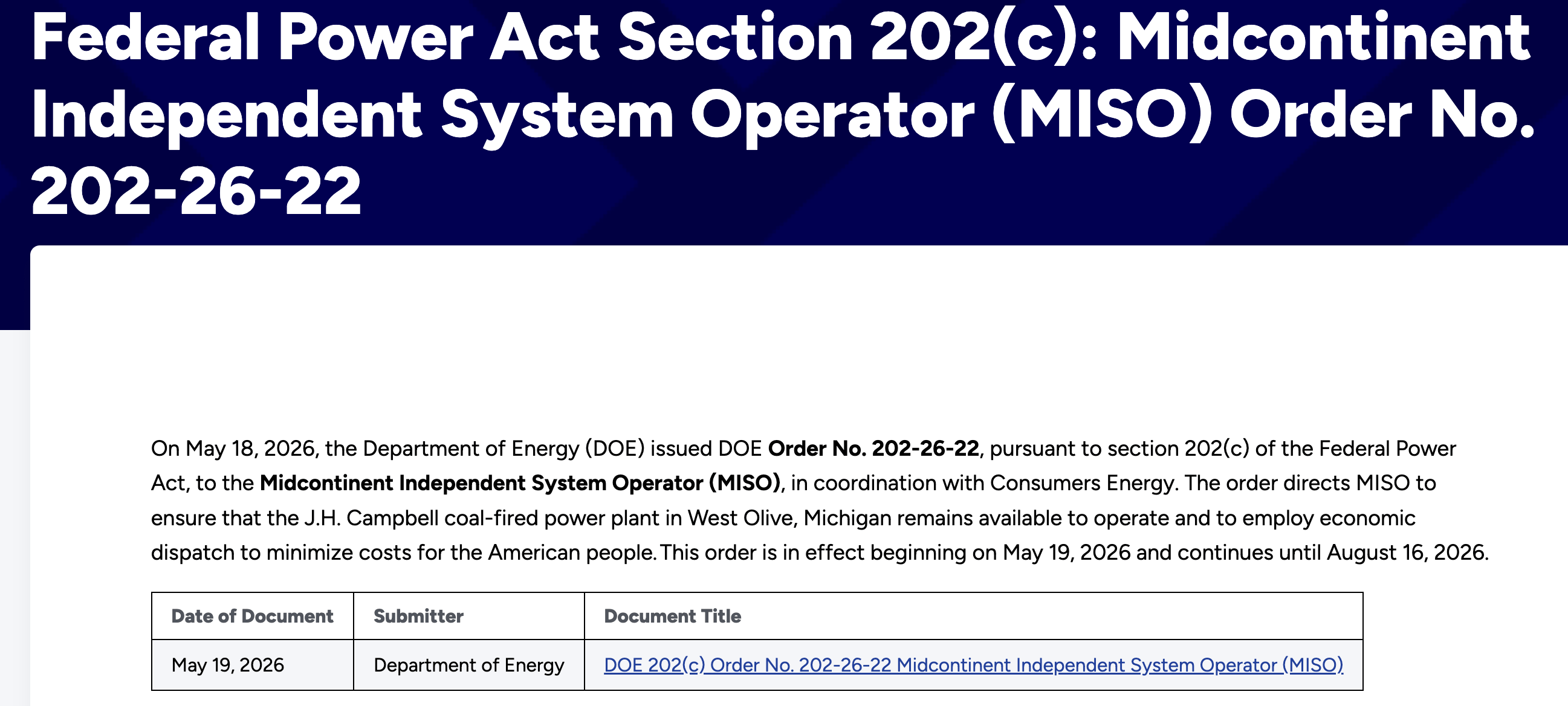
Eight days before that date, the U.S. Department of Energy (DOE) stepped in and issued an emergency order under Section 202(c) of the Federal Power Act requiring the plant to keep running. That was a year ago. Last week, the DOE issued another such order, the latest in a series, extending Campbell’s operations through mid-August 2026.
And Campbell isn’t unusual.
Since May 2025, the DOE has issued 43 such emergency orders to keep coal-fired (and oil-fired) plants running past their scheduled retirement dates. That’s more than double the total number of times the agency used this authority in the entire 25-year period from 2000 through mid-2025.
Why? Because renewables don’t run baseload. Nuclear takes a decade to build. And the grid is losing firm, dispatchable generation faster than it can replace it. The U.S. has reached the point where the government is forcing retiring plants to stay open because the system literally cannot keep the lights on without them. And coal-fired generation in the U.S. jumped 13% in 2025 alone. That’s the biggest annual increase since the post-COVID rebound.
And it's not just a U.S. story.
China commissioned 78 gigawatts of new coal capacity in 2025, the most in ten years. India is on track for its largest annual coal-capacity build in a decade. And coal stocks as a group have been quietly rallying through most of 2026 — exactly the opposite of what the consensus narrative said should happen.
Given all that, and considering most people (including a lot of investors) know very little about how the coal industry actually works, I thought a proper coal industry primer might be in order.
So here it is.
Coal 101
There are two basic kinds of coal, and they do completely different jobs.
Thermal coal (also called steam coal) is what utilities burn to make electricity. About 75% of the coal mined in the world is thermal. It’s the workhorse fuel of the global power grid: cheap, abundant, easy to transport, and capable of running 24/7 regardless of weather, time of day, or geopolitics. When people talk about coal “keeping the lights on,” they mean thermal coal. It’s why China and India keep building new plants. It’s why Japan, despite its high-tech reputation, still gets roughly a quarter of its electricity from coal. And it’s also why, when LNG tankers stop moving and oil hits triple digits, governments quietly extend the lives of plants they had announced for retirement just months earlier.
Metallurgical coal (also called coking coal or “met coal”) is something different. It’s used not to generate power but to make steel. Specifically, it’s heated in oxygen-free ovens to produce coke, which is then combined with iron ore and limestone in a blast furnace to produce pig iron. Roughly 70% of the world’s steel is made this way. There is no economically viable alternative at scale today. Hydrogen-based steelmaking is real but a rounding error in global production, and it will be for decades. If you want to build cars, ships, bridges, skyscrapers, or AI data centers, you need steel. And to make steel at industrial scale, you need met coal.
The two markets behave differently. Thermal prices track power demand and competing fuels (mainly natural gas), while met prices track industrial activity and Chinese steel output. But they tend to move together in the same direction during broad coal rallies. When the narrative shifts from “coal is dying” to “coal is essential,” both prices respond. Capital that was sitting on the sidelines doesn’t pause to ask which type. It just comes back.
Note: The premium benchmark for met coal is the Platts Premium Low Vol HCC FOB Australia (PLV HCC) assessment. As of the end of Q1 2026, it sat at US$236.80 per metric ton — up roughly US$19/ton over the quarter. Thermal coal benchmarks vary by region but Newcastle (the Asian thermal benchmark) has been trading in the US$130-140/ton range. Both well above the levels that prevailed during the 2020-2021 ESG-driven sell-off.
Coal Economics 201
Now, costs.
Coal is one of those commodities where the spread between low-cost and high-cost producers is enormous, and it explains most of the variation in producer profitability. Mining costs depend heavily on geology (open-pit mines are dramatically cheaper than underground operations) and on logistics, especially the cost of getting the coal from the pit to a deepwater port. A mine sitting on top of a railway line that runs straight to the coast is a very different business than a mine that requires hundreds of kilometers of trucking before the coal even reaches a railhead.
In broad strokes:
Australia has some of the lowest-cost met coal in the world: large open-pit mines, established rail and port infrastructure built specifically to move coal to Asia. All-in sustaining costs (AISC) for the major Australian met coal producers run in the US$100-130/ton range, which means at US$236 met coal prices, every ton mined throws off about US$105-135 in margin.
United States has higher costs. Most U.S. coal is underground, mines are smaller on average, and the rail infrastructure was designed for a domestic market that’s been shrinking for decades. Eastern U.S. thermal AISC is in the US$50-70/ton range, but met coal from Appalachia tends to come in around US$125-150/ton. Much of that gets swallowed by transport to East Coast ports.
Canada has perhaps the most strategically valuable coal in the world right now, even though most people couldn’t tell you it has a coal industry at all. British Columbia produces hard coking coal of premium specification, mines it relatively cheaply (open-pit operations in the Peace River Coalfield), and ships it from Pacific ports. Prince Rupert is the closest North American port to Asia. Roughly 80% of Canadian coal exports go to Asia; Japan alone takes 34%, South Korea 23%, China 21%.
South Africa is a mid-cost producer with very high logistics risk. The Richards Bay export terminal has been chronically constrained by Transnet’s railway dysfunction, which has effectively capped how much South African coal can reach the seaborne market regardless of price.
Indonesia dominates the Asian thermal coal trade. It’s the world’s largest exporter of seaborne thermal coal. But most of what it produces is lower-grade and serves regional Asian utilities rather than the premium global market.
This regional cost structure matters because it tells you who benefits most when the price moves. Low-cost producers see margins expand far more than high-cost producers in absolute dollar terms — operating leverage to the price is asymmetric. And jurisdictions with infrastructure that doesn’t run through chokepoints get re-rated upward when investors actually start pricing in supply security.
One last piece of context… the U.S. natural gas anomaly.
For most of the last 15 years, U.S. thermal coal has been competing not against other countries’ coal but against domestic shale gas. Henry Hub gas has traded in the US$2-4/MMBtu range while European TTF and Asian JKM benchmarks have routinely sat at three to ten times those levels. That structural cheap-gas anomaly is why coal-fired generation in the U.S. has been losing market share to gas almost continuously since 2008. Not because coal got more expensive, but because gas got absurdly cheap relative to the rest of the world.
Outside the U.S., the math is different. In Europe and Asia, gas is expensive, coal is competitive, and the “coal is dying” narrative was always more about politics than economics. Hormuz has just made that gap impossible to ignore. When gas-importing economies suddenly find their tankers stuck in port and their LNG contracts in force majeure, the alternative is coal. And the producers and resources that can supply energy-starved markets without running through anyone’s chokepoint are about to get a lot more attention.
That’s the lay of the land. If you’ve made it this far, you now understand the industry better than 95% of the people who’ve ever bought a coal stock.
Regards,
Lau Vegys
P.S. In our latest issue of Crisis Investing, we put forward two new picks built specifically for this coal thesis. If you’re a paid subscriber, make sure you haven’t missed it. And if you’re not yet on the paid side, the lead — featuring Doug Casey on why coal never really died — is free to all.
One point I don’t follow. You state that low cost producers see margins expand more in response to price moves. This seems counter intuitive to me. Why isn’t it the other way around?
Extremely informative. Thank you.