

We all know that the Fed can and does monetize government debt to expand the monetary base. Austrian School thinkers consider this inflation.
And most of us know that the so-called private banking sector—specifically those entities that accept demand deposits (colloquially, checking account deposits), while promising to pay those deposits back on demand, are loaning most of those deposits to someone else—and doing so repeatedly. In the past, that was known as fractional reserve banking—that fraction serving as the denominator in the so-called money-multiplier. But since 2020, it should be known as “no reserve banking,” because the reserve ratio has been zero since then. The textbook money multiplier became, for all practical purposes, infinite—and therefore irrelevant as a constraint on credit creation. Basel III became the new constraint ... sort of.
The private banks thus inject new money out into the system, but in the form of credit. The new money is out circulating, doing its thing. To an Austrian, that is inflating. Someday, that loan has to be paid back (which will remove that money from the system). Repayment of one of these bank loans reduces the money supply and is therefore, in Austrian terms, deflationary.
Government debt monetization by the Federal Reserve is a pure monetary-base event.
Private banking in a fiat system creates credit.
Both create money (inflation). They are mechanically distinct processes run by different actors on different balance sheets.
Now you have the key concepts to start parsing whether we are going to experience inflation or deflation as central to the next big financial crisis.
My expectation: it’ll be both.
The monetary side.
With the federal government spending always out of control and Medicare and Social Security upside down, it is unlikely that the Fed can or will reduce their balance sheet much. (Reducing the Fed’s balance sheet is reversing quantitative easing, aka burning money, aka reducing the money supply.)
The Fed will make a pretense and maybe they’ll have a few months here and there in which their balance sheet gets reduced (reducing the monetary base), but it cannot persistently decline without an American version of Milei’s chainsaw on steroids, hacking away the thick mass of constantly growing limbs off the three branches of government. Politicians in the US who have such tendencies are rare, and, sadly, they won’t win.
The baseline—in times of relative stability—will be continued monetary inflation.
And in times of stress? There is no rainy day fund for the next black swan, the next war, the next pandemic, natural disaster or financial shock. So when one occurs, the Federal government will conspire with the Federal Reserve to inflate the money supply, fast and furious.
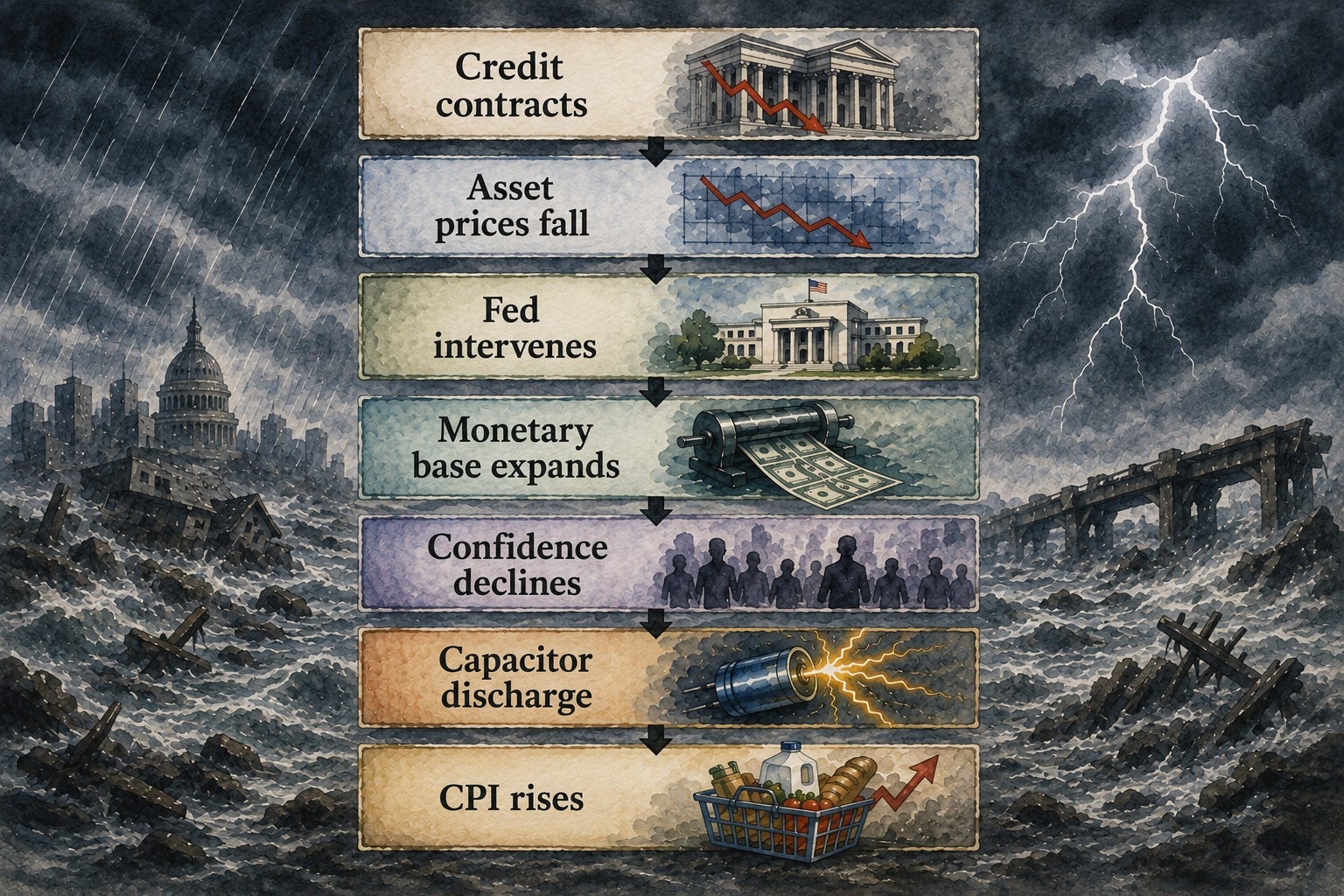
The capacitor discharge.
A big part of the story isn’t under the Fed’s control, and although part of the monetary inflation, it deserves to be named as its own risk.
The dollars sitting in the capacitors— foreign reserves, offshore Eurodollar balances, inflated asset prices — don’t require the Fed to create a single additional dollar in order to show up in the CPI. They just require a trigger that makes their holders decide to dump them. A foreign central bank diversifying reserves out of Treasuries. An asset-price unwind that converts stock and real estate into cash looking for somewhere else to go. A loss of confidence in the offshore dollar system that sends balances chasing after dollar-denominated goods. A loss of confidence in the US dollar generally, or concern about the dollar being weaponized by US politicians.
This is a scenario the Fed cannot pre-empt, because it doesn’t control the decision to hold money. It only controls the decision to create money. The dollars may have been created long ago. Whether the world keeps them parked in capacitors or spends them on goods is a function of global confidence, not FOMC policy. And when trust slips in one place, a short can cascade through the whole circuit. A CPI that’s stayed tame for years because trillions were sitting quietly in assets and reserves can move hard in a single quarter once the reason to keep holding disappears.
The credit side.
We’ve looked at the monetary side. Now let’s switch to the credit side, where the crisis is most likely to begin.
It’s a giant swamp of complexities and derivatives and guarantees. The banking system is entirely fiat-based and no longer constrained by reserve requirements (although it has some of the Basel III capital requirements that provide a bit of containment against infinite zero-reserve lending).
Government-sponsored-entities (Fannie Mae etc.) encourage banks to loan money to people who aren’t worthy of credit, and do so by making promises they can only keep during times of stability. The repo market and re-hypothecation create a chain of multiple claims against the same asset. Collateralized debt obligations did not go away. The off-shore Eurodollar market—foreign banks making zero-reserve loans of dollars—is a system of paper promises that works until it doesn’t. All of these expand the part of the money supply (inflation) that is in the form of credit.
The system of expanded credit is built on the trust that each of a long series of counterparties in these structures will honor its obligation to the next party in line. Liquidity crunches occur when one party in the chain fails to do so, sending the impact through the chain. Credit deflation occurs when the failed liquidity leads to banks and financial entities throwing their hands up in the air, locking their doors and not answering their phones, a process that turns their promises into confetti. Then the next parties in the chain can’t keep their promises and in turn hide from their creditors. Etc. Etc.
Out of fear and necessity, creditors all start demanding repayment. Loan repayments reduce the credit component of the money supply.
When the borrower can’t pay from their income, they turn to selling their assets to raise the funds. Stocks, bonds, yachts, houses. The selling pressure pushes the asset prices down, resetting after years of asset price inflation caused by expanding money and credit.
As asset prices decline, the available collateral used to back debt is decreased. Where loans can be called back based on inadequate collateral, the loans get called. It also makes it hard to refinance old debt into new debt. Credit shrinks.
When the debtor or obligated party fails to satisfy the demand to pay, the loan gets written off. Although those write-offs don’t erase money already out there, they reduce the bank’s capacity and willingness to serve up more credit.
Slowly and then suddenly, the trust is lost. Before you know it, very few are considered credit worthy, because there is no trust. When no one is credit worthy, credit is reduced, not extended.
All this is credit deflation.
The last one who can help people pay off their debts is the Federal Reserve, because it owns the printing press. The lender of last resort. Or payer of last resort. And so we circle back to monetary inflation.
Panning out.
At some point, some malincentivized executive or trader will do something so wrong that it will cause a significant liquidity event in an entity in the supply chain of credit creation.
Into the illiquidity cascade that follows, the Fed will inject liquidity as it has done in the past. It will rapidly move past its overnight lending facilities, repo operations and discount window, and onto increasing monetary base via quantitative easing, inflating the money supply.
The Fed will demonize the credit deflation and come in as the hero, attempting to use new monetary base inflation to neutralize the credit deflation.
That’s like the Fed giving heroin to treat pain caused by a parasite. The problem, of course, is the fiat monetary system that allowed for the creation of the credit inflation in the first place. It’s foundationally corrupt.
Credit deflation gives the Fed a reason to create new money — that’s a policy response on their timetable. But remember that a capacitor discharge doesn’t need the Fed to do anything at all. The inflation is already created, already sitting on the world’s balance sheet, all charged up and ready to blow. And the Fed can’t stop it. And the Fed can’t target that capacitor discharge to where it thinks the liquidity is needed.
What we have is a system in which a single point of liquidity failure can get magnified into a broader liquidity crunch, triggering asset sales (and asset price reductions), lowering collateral values concurrent with a spiraling decrease in trust that people or entities will pay their debt or meet their obligations. This loss of trust may well expand to loss of trust in the monetary system, which can in turn lead to a flood of offshore pre-existing money pressing on the CPI at the same time that the Fed wants to inject trillions of liquidity to moderate the credit deflation.
Credit deflation. Monetary inflation.
Assets declining. CPI rising.
Less wealth. Higher expenses of daily living.
Lower quality of life.
Crap.
That’s the wind-down of the multi-year wind-up of a fiat money system serving as the reserve currency of the world.
In the next letter (letter 3 of this series), we’ll discuss some ways to position yourself to not get so totally screwed, and maybe even win a bit.
Sincerely,
John Hunt, MD
Editor, Doug Casey’s Crisis Investing
Informative. John - it will help me if you will stop using the term MONEY when the term currency is more accurate. Thank you for your attention in this matter. 😎
John Hunt does a fantastic job. His writing is easy to read, and the information is timely and relevant to what's happening in my world. I really like the improvement in Crisis Investing has seen with John Hunt on board. Keep up the great work!