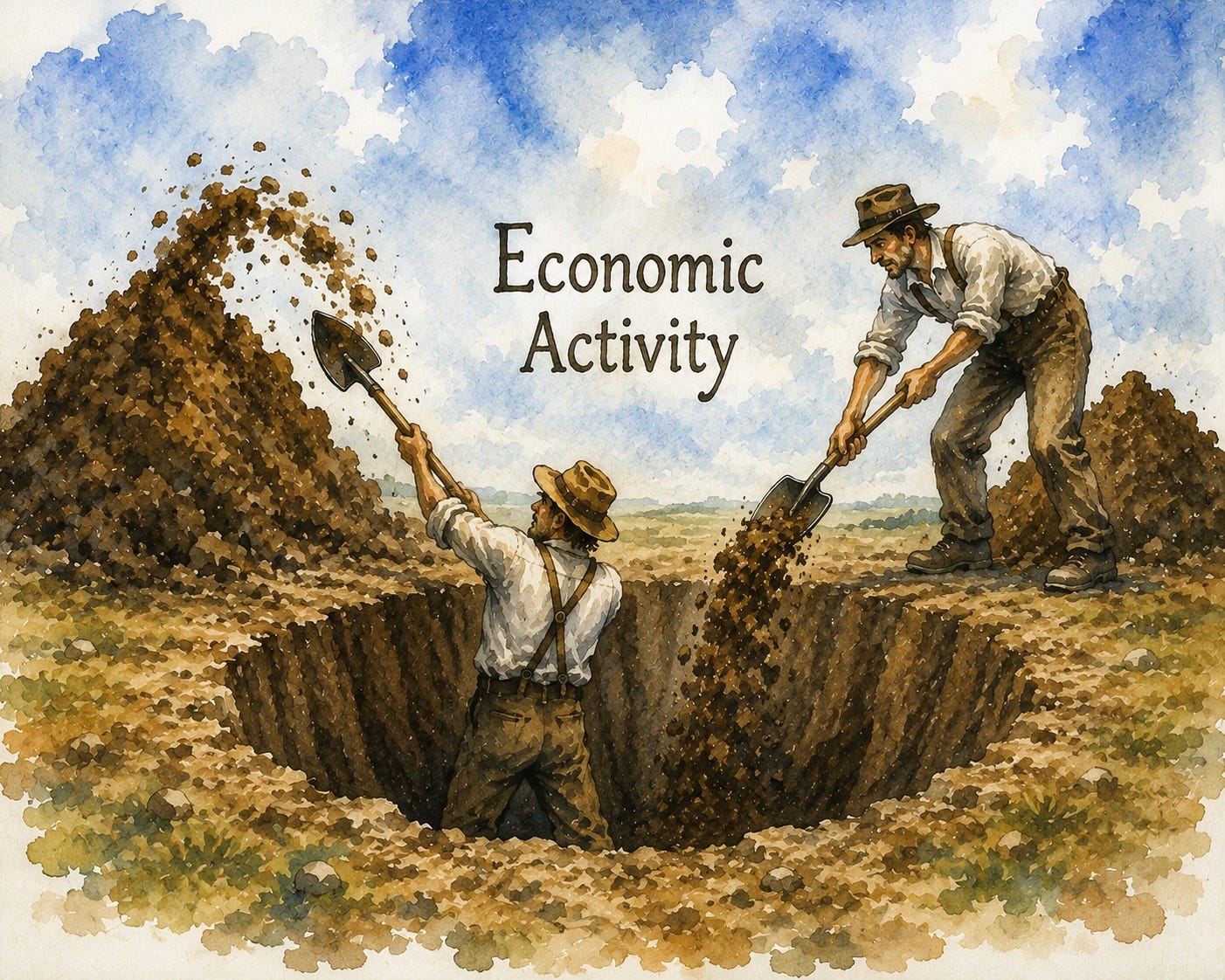
Bipartisan Plan to Grow the GDP: Spend More and Blow Stuff Up
GDP counts economic activity. It doesn’t tell you whether we got richer.

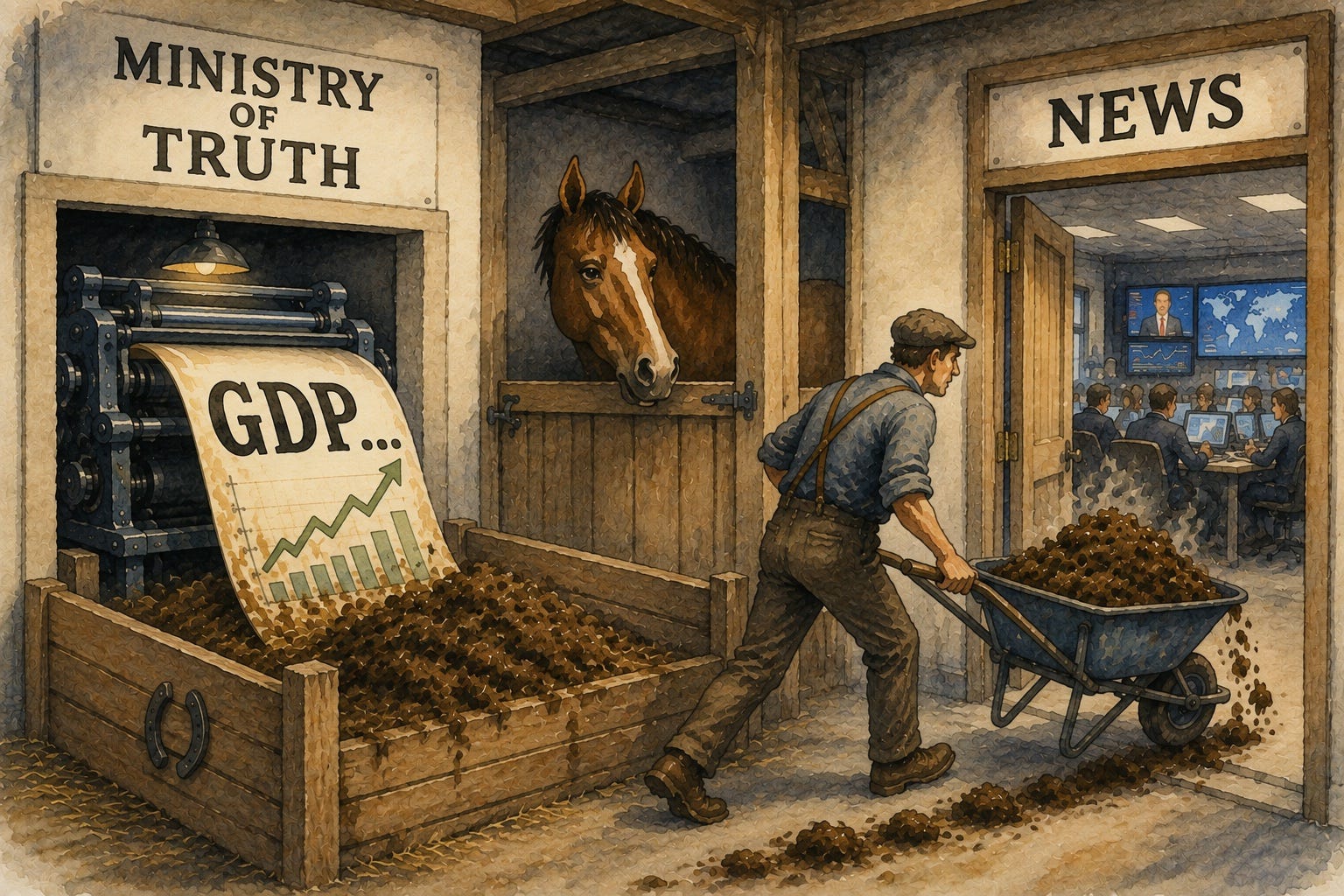
Every quarter, a government agency announces a single number. Gross Domestic Product. GDP. If it goes up? The White House takes a bow. Down twice in a row and pundits call it a recession.
Trillions in portfolio decisions ride on this figure. Few people know what it actually measures. Very few ask whether it should be measured at all.
Spend More
GDP totals the spending on all final goods and services produced within a country’s borders in a year. Simple enough on paper. The formula you learned in Econ 101 is C + I + G + (X – M). That is: consumption + investment + government spending + net exports. The formula is Keynesian aggregate thinking, through and through.
Government spending (G) gets counted as production, dollar for dollar, regardless of what the money buys. A regulator’s salary counts the same as a surgeon’s. The pay for a bureaucrat working one hour per day at home while sitting on her butt watching The Price is Right is counted the same as a plumber working his plumbers’ butt off all day doing real work. The Pentagon buying a missile that blows up a tent counts the same as a tractor that helps produce food.
GDP cannot distinguish value creation from value destruction. It counts the economic activity represented by the spending, whether that activity creates or destroys wealth.
This is Bastiat’s broken window. Intentionally smash the glass, hire the glazier to replace the glass, and whee, GDP rises. The glazier got a job, but the shopkeeper has spent more money than the glazier earned, there is one less piece of functional glass in the world (global net worth is lower), and yet the statistic says growth occurred. What GDP fails to capture is the opportunity cost and destruction of the shopkeeper’s existing capital.
Blow Something Up
Keynesian orthodoxy holds that a dollar of government spending multiplies through the economy, generating more than a dollar in output. The Austrian answer is that every dollar government spends was first extracted from the private economy through taxation, borrowing, or currency creation (inflation). Government spending redirects the spending decisions regarding that one dollar from private citizens in the markets, to politicians and bureaucrats spending other people’s money.
That redirection comes with costs the GDP statistic never records: the factory that wasn’t built because capital went to Treasury bonds instead; the business that wasn’t started because the entrepreneur tried to read the tax and regulatory codes and then said to hell with this, and quit; the destruction and generational hatred that result when politicians start wars.
GDP is a measurement of flow. It is a measure of water going through the dam. GDP tells you the value of what was produced (what flowed) this year. It says nothing about whether the capital structure (the water level behind the dam) that produced the flow grew or shrank (rose or fell). A country can post positive GDP growth for a decade while its factories rust, its infrastructure crumbles, and its savings erodes, so long as consumption and government outlays keep climbing. Rome’s grain dole looked like prosperity too, right up until it wasn’t.
GDP can be kept high simply by wasting capital, by government spending and inflation, by war … or by breaking and replacing glass. A higher GDP based on those reasons is a GDP I wish wasn’t rising.
The Bureaucrats Cook the Books
The GDP deflator — the tool used to strip out inflation and report “real” growth — is a set of assumptions and bureaucrats’ choices. Hedonic adjustments assume your new phone or car is better than last year’s model and quietly reduce the inflation figure to account for the improvement, which mathematically inflates the growth figure. Change the weighting of housing, healthcare, or owner’s equivalent rent, and you change GDP without a single additional good or service being produced.
Bureaucrats are in charge of all of that. In case you haven’t figured me out yet, I think bureaucrats are a waste of food.
Government output gets valued not at a market price, but based on how much government pays. After all, there is no market price for a permitting office, nor for an equity & diversity consultant embedded in a federal agency. Whatever the government pays is, by GDP definitions, exactly what the government “produced.” No profit-and-loss test, no consumer sovereignty, no bankruptcy to correct the error, no consumer preferences, no increase in net worth.
Revisions compound the problem. The initial GDP report, the one that moves markets and headlines, gets revised — sometimes twice — in the following months, and the revisions routinely reverse the story the first number told.
Traders react to the initial estimate. It’s what sets Dow futures, gold prices, and predictions of Federal Reserve actions. The correction shows up quietly, months later, in a footnote that few people see unless there is political opportunity in it.
Hardly Anyone Asks If It’s Worth Measuring
Value is subjective. There is no way to add up the worth of a heart surgery, a haircut, and a hydrogen bomb into one meaningful number, because value isn’t a physical quantity like bushels of wheat. GDP just pretends it is.
The calculators of GDP take millions of individual subjective valuations, made in millions of separate transactions for millions of separate reasons, and mashes them into a single figure precise to one decimal place, then reports that figure.
A thermometer measures something objective. GDP tries to measure the subjective, aggregated by a method that mathematically treats a tax-funded bridge to nowhere and a privately funded oil drilling rig as economically identical expenditures. That is not a measurement of how an economy is performing. That is just Keynesian central planners being central planners, selecting a number to use to assess whether their monetary and fiscal policies are moving the number.
And of course the numbers they pick (and manipulate) serve primarily as justifications for government intervention.
Now, the number isn’t necessarily worthless. A rising GDP alongside rising private investment, rising savings rates, and falling government spending tells you something different from rising GDP driven entirely by deficit spending and asset-price wealth effects. The components matter, whereas the headline doesn’t. Of course, the economically illiterate evening news is incapable of presenting it beyond the top line figure.
Read the GDP number not to understand what the economy is doing, but rather to predict how the Fed might behave and how the politicians might use it against the other party.
It used to be that GDP would increase and the stock market would enthusiastically rise in response, confident that the economy was growing and private industry would benefit. Now when GDP rises, the markets fall, because it means that the Fed might raise the rates, and that will decrease the inflationary effect that increases asset prices.
What a bunch of goobers we are.
The market has spent eighty years training itself to salute a number that is pretty damn useless. It will keep doing so next quarter. I suppose we can trade the reaction. But don’t mistake the reading for a measure of economic health. It’s Keynesian macroeconomic hogwash that is a tool of political manipulation, under the control of the bureaucrats.
The Gross Domestic Product is a product of the Ministry of Truth. By far the best thing that governments can do is to stop wasting money measuring it.
I generally ignore GDP. I prefer to pay attention to my personal domestic product. Am I producing more than I consume, and doing so morally? Am I saving and investing the surplus? Am I recognizing my asset depreciation?
In sum, am I growing an honestly calculated net worth? That’s a much more valuable measurement than counting how many holes I’m digging and then filling in with the same dirt.
Sincerely,
John Hunt, MD
Editor, Doug Casey’s Crisis Investing