

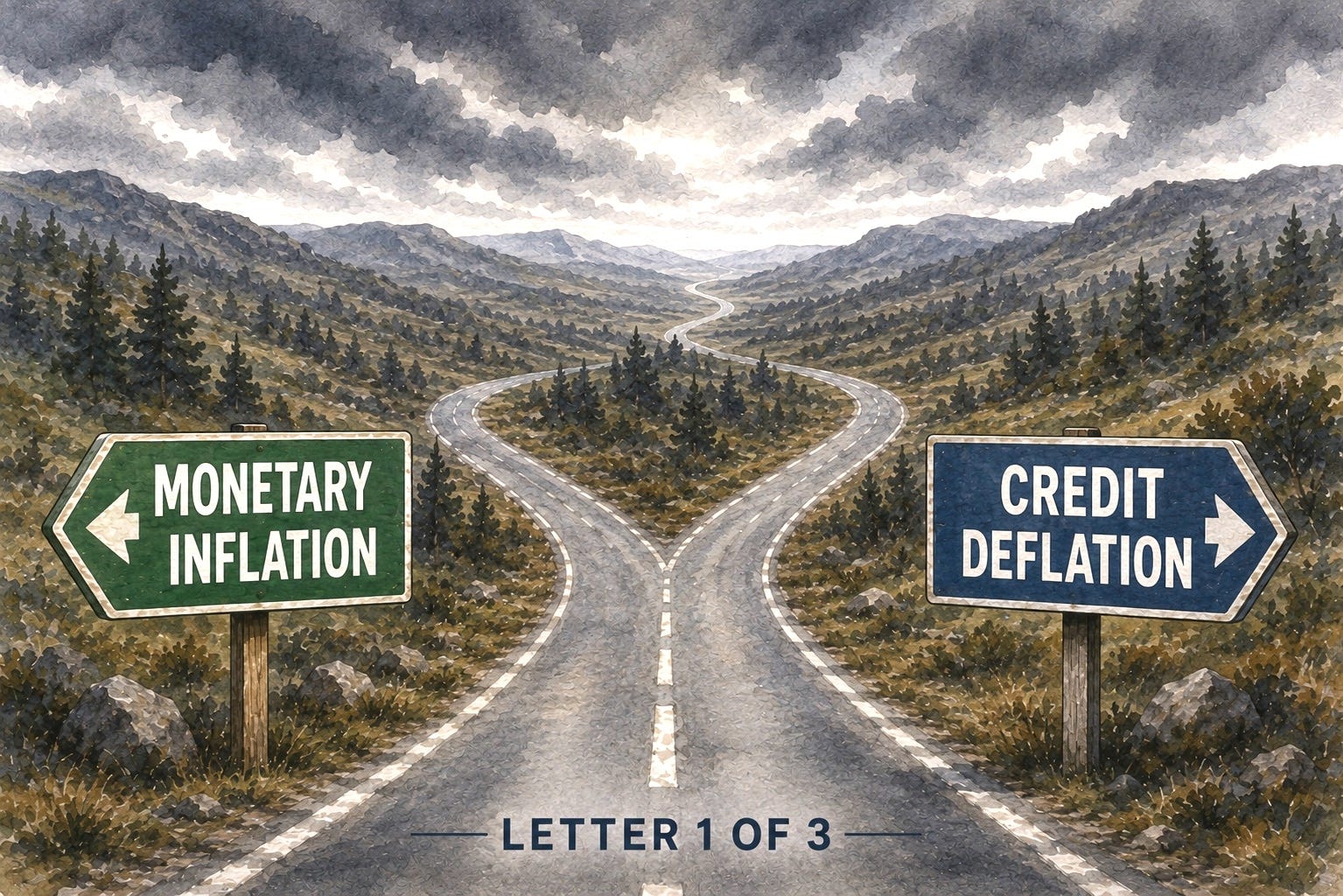
My purpose in these next few letters is to understand what is being foisted upon us and what we can do about it.
If we are soon to have a collapse, will it be deflationary or inflationary? In order to understand this, you can’t think Keynesian, because doing so will leave you dazed and confused. But to try to predict what is going to happen, we need to be aware of how Keynesians think, because they run the show.
We’ll start with getting terms straight, because Washington and the financial press have spent decades blurring them on purpose or out of ignorance or both. If you already know this stuff, great. I discussed this a bit just last week. But it is worth repeating, as this is the foundational material necessary to peer through the fog of modern economics to understand if we should prepare for aggressive inflation or aggressive deflation, and what to do about it.
This is not just academic jargon. This is jargon that you hear all the time in the real world—generally wrongly—and in the financial fantasy world as well.
Definitions
Austrian School economics (the school of thought that I consider internally consistent and honest) defines inflation as an increase in the supply of money and credit. Please note that rising prices are not part of the definition. To the Austrian, rising prices could be a symptom of inflation, or a symptom of many other disturbances.
Deflation, in the Austrian School is the opposite: a contraction of the supply of money and credit. A reduction in prices is not part of the definition.
Of course, the government-and-media definitions are Keynesian. Inflation, to them, is a rise in the price levels as measured in the Consumer Price Index (CPI) or similar indices. Deflation is a fall in the CPI.
That’s ridiculous thinking of course. Rising prices are a symptom, not a diagnosis.
Dr. Keynes gives you Tylenol for a headache without bothering to consider the possibility you have a brain aneurysm. And pats himself on the back for doing so.
An Austrian School doctor would evaluate the symptoms, seek their cause and treat the aneurysm.
The Keynesian mainstream CPI definition of “inflation” comes with a toolkit that those in charge of the stats can use for hiding the evidence. Hedonic adjustments are made arbitrarily by math nerds employed by the Bureau of Labor Statistics and always slant one way—to reduce the reported CPI number. Owner’s equivalent rent stands in for actual home expenses. Substitution effects that presume you’ll eat more chicken once steak gets pricey. Using Core inflation sometimes, but not always.
These terms have no meaning to the casual listener, but they sure sound like the experts know what they’re doing. All are prone to manipulation.
Under the government Keynesian definition, inflation is whatever next month’s CPI says, and that depends on whatever the methodology allows it to say. The Keynesian toolkit allows the people at the top of the Fed and the Bureau of Labor Statistics to bend things a bit here and there. It verges on gaslighting.
Deploying tricks such as these, the BLS can report “only 2% inflation” while the financial system expands the money supply by trillions. And that so-called controlled inflation is even easier to report if enough of that new money flows not into the basket of goods the CPI pretends to track, but rather into assets — stocks, real estate, private credit—which aren’t reflected in the CPI at all.
Asset prices, foreign reserves, and offshore money are all capacitors for the inflated dollars. The dollars get stuffed into those capacitors until a trigger causes them to discharge. New money doesn’t have to chase the goods in the CPI basket the moment it’s created — it gets parked outside the CPI measure, not bidding up the price of milk or gasoline.
Mises figured out that whether new money shows up as a fall in purchasing power depends on whether it’s met by a rising demand to hold money. The capacitor is that demand to hold: Americans and the world choosing for now to hold the new dollars as assets and reserves instead of spend them into goods. It’s a charge sitting on a capacitor. We’ll get to what happens when the capacitors discharge.
Okay, we have those basic definitions from the Keynesian mainstream (gaslighting) school, and the fringe Austrian (honest) school. Let’s take the first step to answering the question in the title of this article.
Money supply and credit are two different but related aggregates. Separate tallies of separate things.
Monetary Base is what the Fed and Treasury create directly, often by monetizing Federal debt, but barely hesitating to get even more crazy.
Circulation credit (aka fiduciary media) — bank lending not backed by real prior savings — is a second layer built on top of it, expanded or contracted by banks and shadow banks.
These are the two major components, the expansion of either or both of which is inflation (by Austrian thinking).
The two usually move together. But this is important: they don’t have to.
Here’s the central point to consider of this first letter in a series of three: the monetary base can undergo inflation, while the credit undergoes deflation.
Both at the same time.
Credit is not controlled by one entity. Controlling aggregate credit in our fiat currency system is like pushing on a boiled noodle and expecting the end to move. Credit inflation happens slowly, but credit deflation can happen suddenly.
Monetary inflation is in the hands of a small gang of people at the Federal Reserve who decide whether to inflate or deflate. They rarely decide to deflate.
Please note that CPI increases (Keynesian inflation) can occur suddenly when the capacitors that have been holding the money—the asset bubbles, foreign reserves, offshore currency—discharge, and the previously inflated dollars that have not been chasing US goods and services start chasing. That’s the popping of the aneurysm that Dr. Keynes had treated with Tylenol.
The injuries that happen from monetary inflation, capacitor discharge, and credit deflation are different.
In the next letter (tomorrow) I’ll parse out what happens when credit deflates and monetary authorities inflate in response. And what happens if the uncontrollable capacitors discharge in the midst of this. And in the third letter, how to position for it.
Sincerely,
John Hunt, MD
Editor, Doug Casey’s Crisis Investing
It's always better to use straight definitions when dealing with money. It's for sure the Fed's don't want the people to be able to clearly understand when they're being screwed over.
Jim Marshall
Beautifully explained. Looking forward to your next two letters on "when credit deflates and monetary authorities inflate in response. And what happens if the uncontrollable capacitors discharge in the midst of this. And in the third letter, how to position for it."