
America's 40-Ton Gold Problem
Chart of the Week #91

The United States has a gold problem.
Take a look at today’s chart:
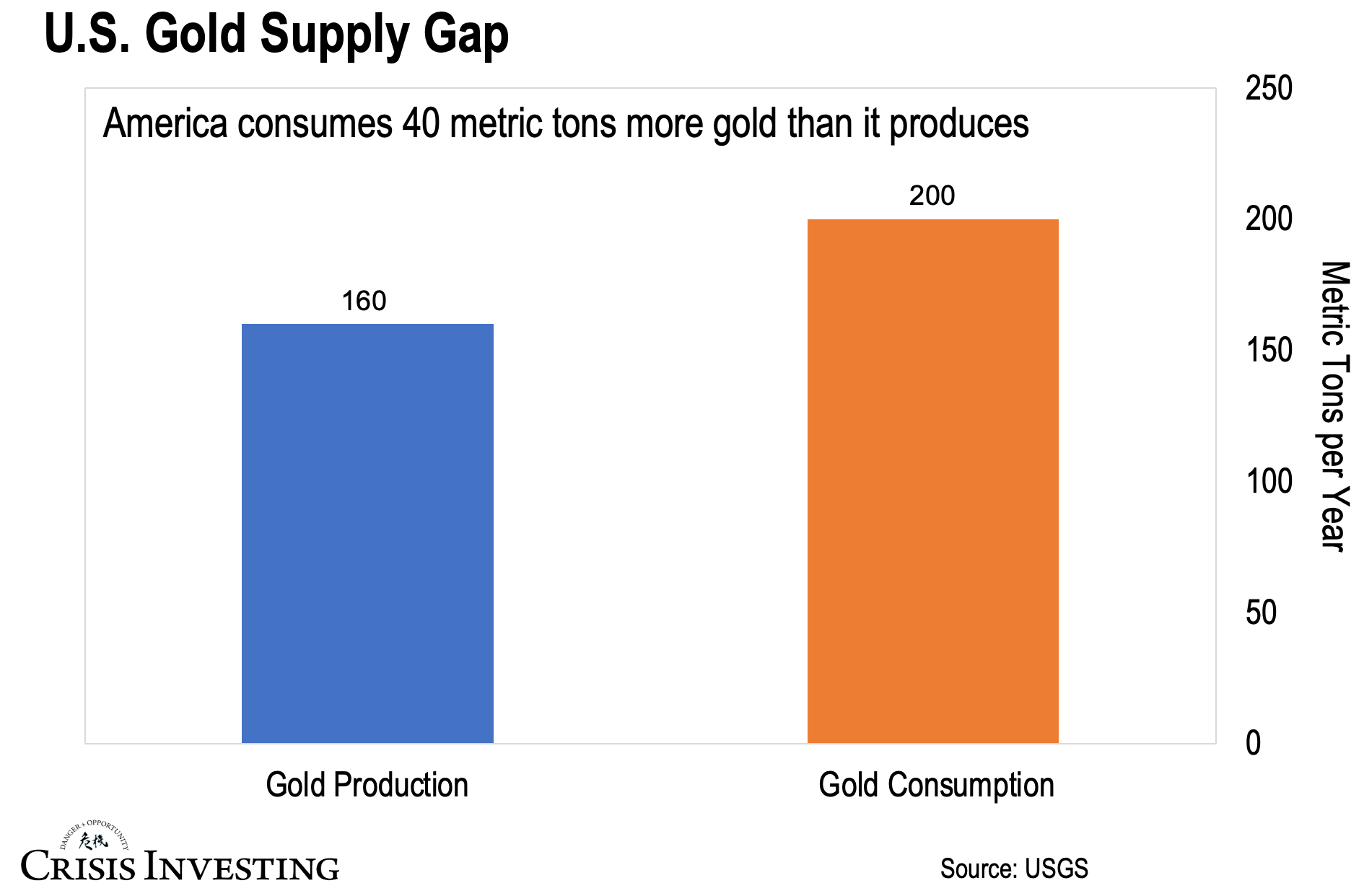
As you can see, the U.S. produces only 160 metric tons of gold per year—roughly 6% of global production. But it consumes around 200 tons annually. That’s a 40-ton shortfall.
Put differently, the U.S. must import roughly one-quarter more gold than it produces to meet domestic demand.
This gap has existed for years. And for most of that time, it didn’t matter much. Gold was cheap, global supply chains hummed along, and nobody in Washington cared where the metal came from. But two things changed after Donald Trump took office in January 2025: his administration began treating resource security as a national priority, and gold went from around $2,700 to over $5,000.
Suddenly, domestic gold production isn't just strategic—it's highly profitable. Projects that looked marginal at $2,000+ are now compelling at $5,000+. And in a world of trade wars and deglobalization, the powers that be are far less comfortable relying on foreign gold.
Now, here's something most people don't know…
Gold has never made it onto the official U.S. Critical Minerals List—not in 2018, 2022, or 2025. But Trump being Trump, he went around it. In March 2025, his Executive Order on “Immediate Measures to Increase American Mineral Production” explicitly broadened the definition of covered minerals to include gold (alongside uranium, copper, and potash), giving gold projects access to the same fast-track permitting and federal financing programs as official critical minerals.
That puts U.S. gold developers in a position they haven't seen in decades: both policy support and economics working in their favor. Major miners need to acquire U.S. ounces where permits are already in hand or moving through expedited pathways. They can’t wait a decade for greenfield exploration when Washington is pushing resource nationalism and gold is at $5,000.
The M&A data confirms it: metals and mining deal activity rose 61% globally in 2025, with a 139% surge in North America. But the supply gap remains—and that creates opportunity as the policy and market stars align for developers positioned to fill it.
Regards,
Lau Vegys
P.S. Doug Casey believes the case for precious metals has never been stronger. That's why a significant portion of our Crisis Investing portfolio is dedicated to precious metals mining stocks, most of which Doug himself owns. Keep an eye out for this month's issue later this week—we'll be featuring a new gold pick and an interview with Doug about how he sees the year ahead.
Since signing up with Crisis Investing in the New Year, I've almost recovered my subscription price in less than 1 month. I'm hoping this will be an exceptional year, ....... thanks guys!
You added another spoke to the wheel of my limited understanding of gold and the greenlight going forward. Thanks for that.